April 14, 2026
Geranium — The Bird Hidden in the Flower
When Carl Linnaeus named the genus *Geranium* in 1753, he was not thinking of the red balcony bloom most of us now picture. He was thinking of a crane. The Greek word *géranos* described the bird's long, angular beak, and Linnaeus saw the same shape in the plant's seed pod — narrow, pointed, patient. Two and a half centuries later, the flower has outgrown the comparison. The bird has disappeared into the name.
That is the kind of detail that usually starts a painting for me. Not a feeling — a thing. A word with a history folded into it, a door that opens onto something older than the subject.
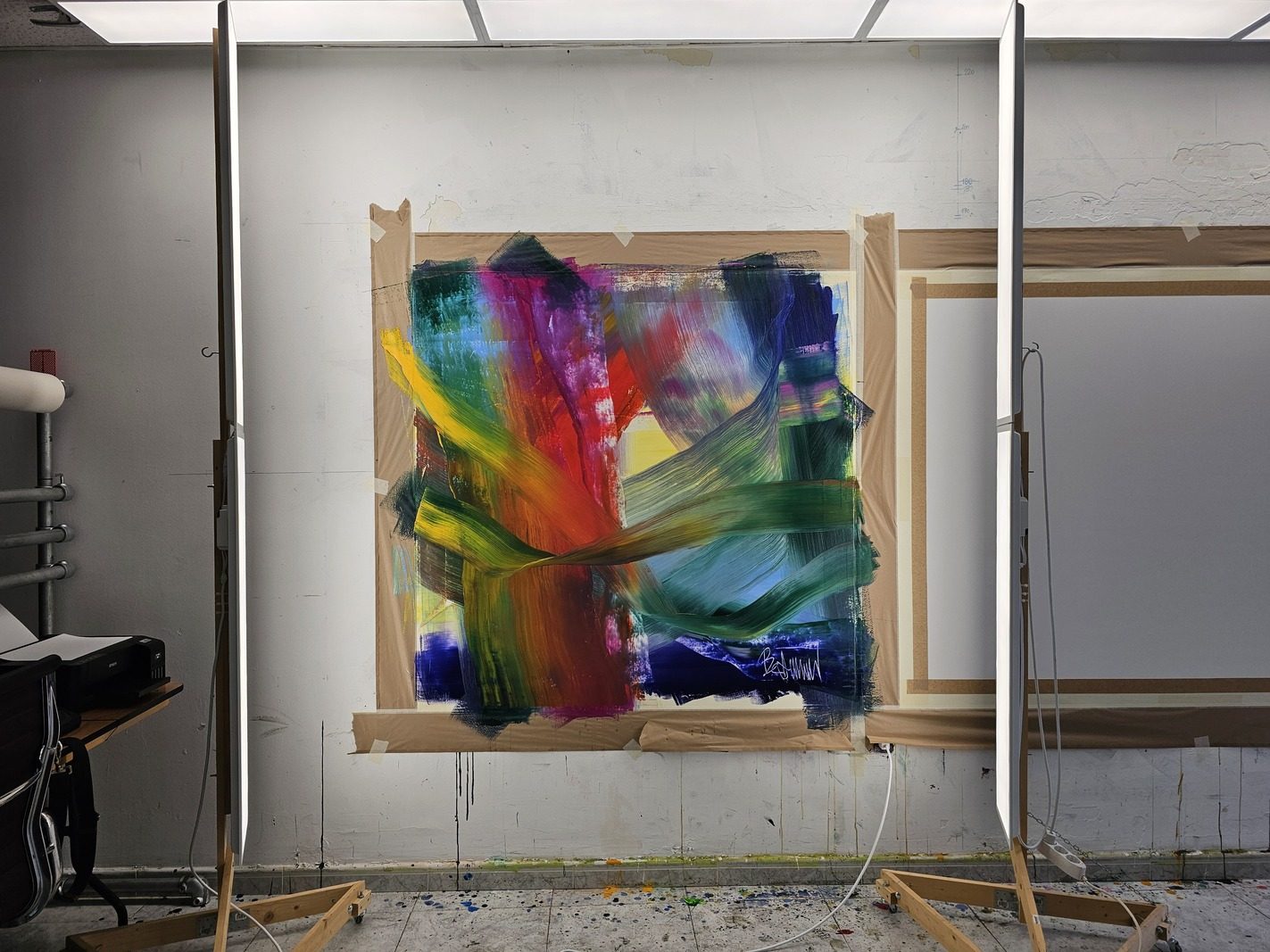
*Geranium* is a 130 × 130 cm oil on canvas, finished in my Oviedo studio in the spring of 2026. The square format matters: 130 × 130 removes the easy orientation of portrait or landscape and forces the image to hold its own centre. Spring, in this part of Asturias, arrives as a kind of pressure — the hills go from grey to an almost aggressive green inside a single week, the jasmine starts before you are ready for it, the light changes angle. The painting began with that pressure rather than with a composition.
The first ground went on wet, with the overwide brushes I use for the initial fields — a yellow that is almost acid against a deep magenta, laid in broad, sweeping motions. Over that, red, cobalt, a violet so dark it reads as black at the edges. Each layer had to dry just enough to take the next without dissolving it entirely, but not so much that the palette knife would merely scratch the surface. That timing is the whole craft of sedimentary painting: the window in which the layer below is still present but no longer sovereign.
The diagonal green that now cuts across the canvas was the fifth or sixth decision, not the first. It is the sweep that makes the painting readable — the movement that says *spring* without illustrating a leaf. Once it was in, I scraped. The palette knife took back the red in the upper centre, opened a yellow window where there had been magenta, and exposed the earliest ground at the lower right. What survives on the surface is not what was applied last; it is what was chosen to remain.
I keep returning to the same sentence when I explain this work to visitors: *what is scraped away is as important as what is added*. An abstract painting built this way is not a picture of something — it is the sediment of a sequence of decisions, some of them irreversible. The viewer does not see the choices in order; they see their result. That is closer to how memory actually works than any figurative painting I could make.
The title came afterwards. I had been reading about Linnaeus and the crane the week before, and the diagonal green in the finished canvas looked, from the side, like the beak he had in mind — not a flower, a bird. The name fitted the painting in the way the Greek word fits the plant: by a relation most people no longer see, but which is quietly there.
*Geranium* is available directly from the studio. Full details below.
## Artwork Details
- Title: Geranium
- Year: 2026
- Medium: Oil on canvas
- Size: 130 × 130 cm
- Signed: yes, front lower right
- Price: on request
- Enquiries: https://bertermann.art