April 8, 2026
Quintana: On Layers, Legacy, and the Debt Built Into a Name
There is a word in Asturian Spanish — Quintana — that you will see painted on stone walls and carved into wooden gateposts if you drive through the villages of Asturias and Galicia. It names farmhouses, valleys, streets. It sounds old because it is old. And like most old words, it carries more inside it than its surface suggests.
A Quintana, at its most basic, is the open space in front of a rural house — the threshold between the private world of a family and the shared life of a village. The place where neighbors gathered, where harvests were sorted, where the social fabric of a community was woven, season by season. If you have ever stood in one of those spaces — surrounded by hórreos, by stone walls covered in lichen, by the particular green of Asturian rain — you understand why it became the center of everything.
But the etymology goes further. The word derives from the Latin quinta — the fifth. Because the tenant who worked the land was once obliged to surrender the fifth part of every harvest to the landowner. One-fifth. Every season. Not as a gift, but as a condition of being allowed to stay.
That is the theme I was thinking about when I started this painting.
---
The Technique: Sediment as Method
My large-format abstract works are built on a principle I think of as sedimentary painting. I work in successive layers — oil on oil — each one applied with commitment and then partially removed before the next arrives. I use extra-wide brushes for the broad, rhythmic gestures that establish the structure of a composition. I use palette knives for the harder decisions: the cuts, the corrections, the moments where something underneath needs to come back to the surface.
The scraping is the most critical act. When I drag a palette knife across a layer of paint that is not yet fully dry, I am making an irreversible choice. What I remove is gone. What remains is what the canvas keeps. Over time, these accumulated decisions — apply, develop, remove, reveal — create something that resembles geology. Layers of color that exist simultaneously, each one influencing the ones above it and the ones below.
I often say: I don't paint what I see. I excavate what was already there.
This excavation — the accumulated result of physical decisions made and reversed over weeks — is what makes each painting irreducibly singular. It is hand-made in the most direct sense: applied, removed, and transformed by a human hand, layer by layer, until the painting reaches a point of resolution it chose for itself.
---
Quintana: What the Painting Holds
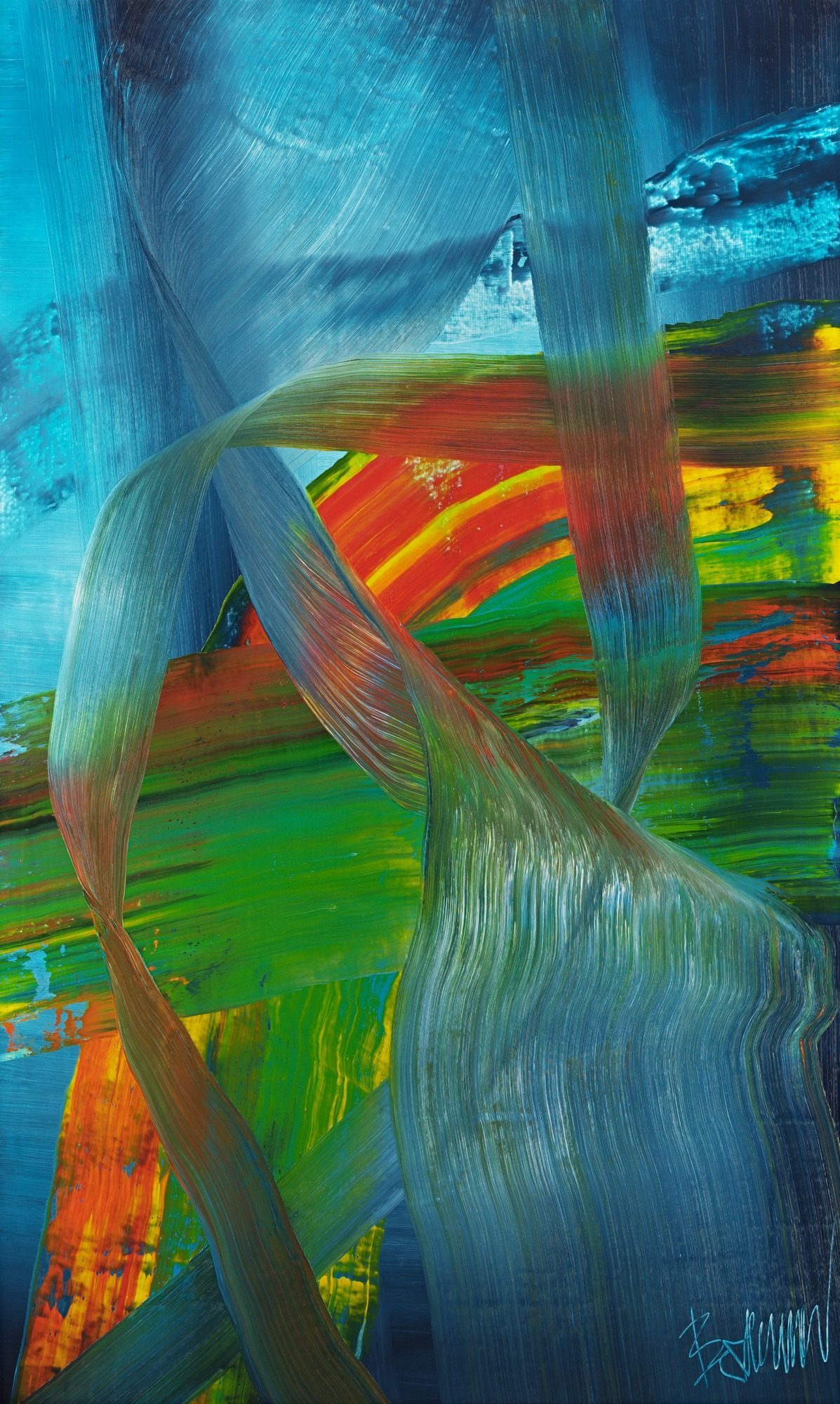
In "Quintana," the lowest layers are the warmest. Reds, oranges, and yellows — the colors of fire, of Asturian autumn, of the earth before it cools. These were laid down first, with urgency, without plan. They are the foundation, though you would not know it from looking at the finished surface.
Above them came the cooler tones: the turquoise, the silver-grey, the blue that moves like weather across the upper part of the canvas. These layers were applied with the extra-wide brush — long, sweeping movements that required the full engagement of the body, not just the wrist. At 200 centimeters of height, you do not paint a canvas like this from the elbow. You paint it from the shoulder, from the spine, from whatever is driving you that day.
The silver ribbons that twist through the center of the composition came last — or nearly last. They were created in a single session of continuous movement, each stroke building on the momentum of the one before. Then, partially scraped. What you see now is what survived.
The fire is still there. It is visible in the gaps, in the places where the cool surface has been removed and what was buried reasserts itself. The debt, you could say, is still being paid.
---
On Painting in Asturias
I have lived and worked in Oviedo for some years now, and the landscape here has entered my work in ways I did not entirely anticipate. Asturias is a place of extraordinary density — geological, historical, agricultural. The green is almost aggressively present. The stone is very old. The rain is patient.
My mother is Spanish, and the culture of this region is part of what I carry. The Quintanas I pass on country roads, the hórreos in village squares, the particular quality of the light after a long rain — these things are not illustrations in my work. They are pressures. They push on the painting from the inside.
"Quintana" is not a landscape. But it is a painting that could only have been made here.
---
Artwork Details
Title: Quintana
Year: 2026
Dimensions: 200 × 120 cm
Medium: Oil on Canvas
Status: Available for private acquisition
For acquisition inquiries, please visit bertermann.art or contact the studio directly.
---
Currently at Auction
Two of my large-format abstract works are currently up for auction at Setdart Auction House in Barcelona. Live bidding takes place on 16 April 2026 — both works estimated at 5,500–6,000 €.
"OSFH#CB" (2025), 150 × 130 cm, Oil on Canvas — Lot 57
→ https://www.setdart.com/subasta/displayimage/pintura-siglo-xxi/pid=351491621/newlang=english.html
"44B9#CB" (2024), 150 × 150 cm, Oil on Canvas — Lot 16
→ https://www.setdart.com/subasta/displayimage/pintura-siglo-xxi/pid=351491620.html
Setdart is one of Spain's leading auction houses, based in Barcelona. Registration and bidding at www.setdart.com.