April 3, 2026
What Would Miguel de Cervantes Say About This Portrait of Him?
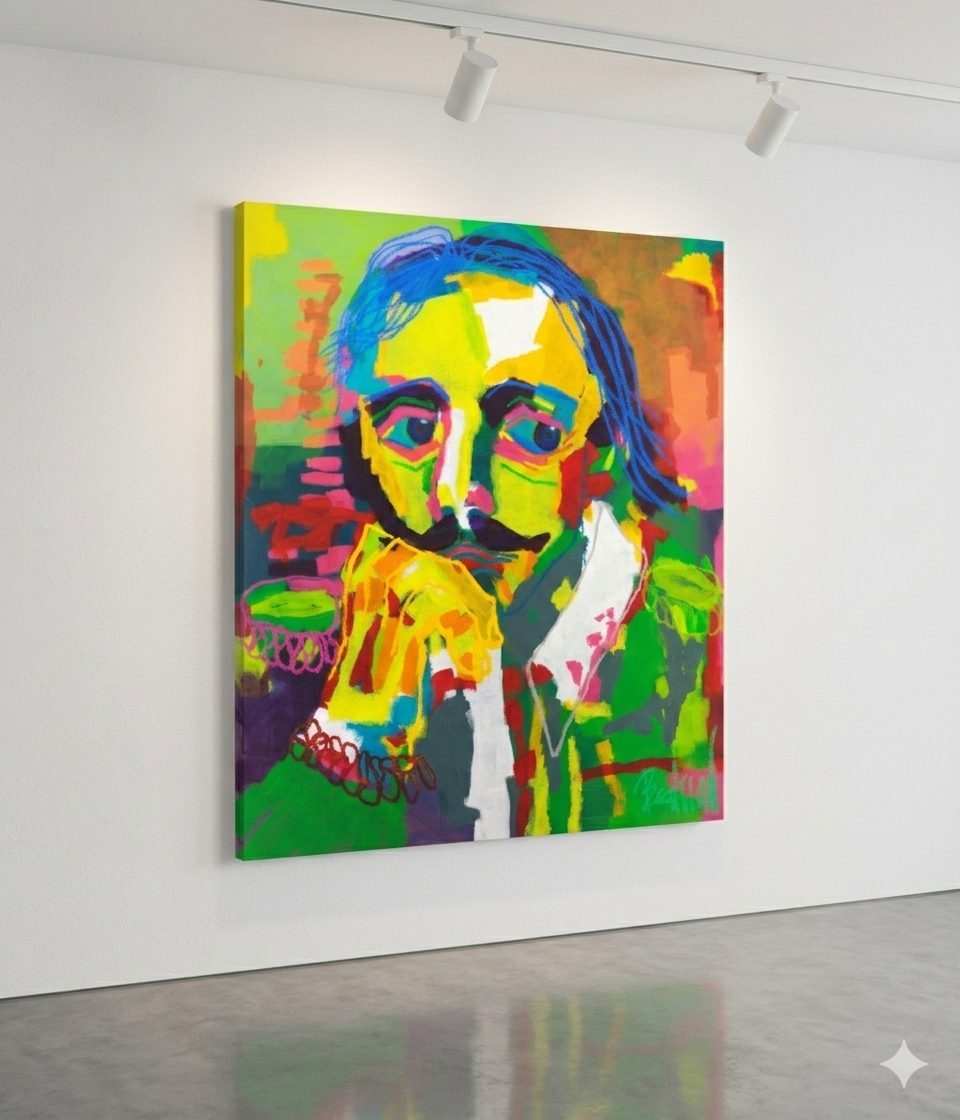
The Prince of Wits in Neon and Shadow
The Mystery Behind the Gaze It is one of the greatest ironies in literary history: Miguel de Cervantes Saavedra, the man who gave the world the first modern novel and the immortal figure of Don Quixote, left behind no confirmed contemporary portrait. We know his words, his wit, and his "aquiline face," but his true likeness remains a ghost in the annals of the Spanish Golden Age. As an artist, this mystery isn't a hurdle—it’s an invitation. In my latest work, CERVANTES, I set out not to replicate a historical myth, but to capture the vibrant, restless, and deeply human spirit of the man himself.
A Symphony of Color and Legacy In this 130x110 cm piece, I moved away from the somber, darkened palettes typically associated with 17th-century Spanish masters like Velázquez or El Greco. Instead, I chose to bathe Cervantes in a "Flower Shower" of neon greens, electric blues, and fiery magentas. Why? Because Cervantes’ mind was anything but gray. He was a soldier, a slave, a tax collector, and a dreamer. His life was a kaleidoscope of high stakes and deep reflections. The bold colors represent the timelessness of his irony—humor that remains as sharp today as it was in 1605.
The Composition: The Thinker and the Soldier The portrait focuses on the contemplative weight of the author. With his hand to his chin, we see the "Prince of Wits" in a moment of creation—perhaps at the exact second the idea for a mad knight attacking windmills first flickered into existence. The expressive, almost frantic brushstrokes around his ruff and doublet suggest a man who was always ahead of his time, a spirit that couldn't be contained by the rigid social structures of Imperial Spain.
What Would Cervantes Say? I often ask myself during the painting process: What would the subject think of his subordinate? If Cervantes stood before this canvas today, I believe he would meet it with his signature satirical smile. He was a man who understood the power of perspective. In this portrait, he isn't just a statue in a plaza in Alcalá de Henares; he is alive, questioning the viewer, and reminding us that reality is often just a matter of imagination.
A Connection Across Time This painting is more than a tribute; it is a dialogue. By bringing CERVANTES into a modern figurative style, I aim to bridge the gap between the historic Barrio de las Letras in Madrid and the contemporary art scene. Whether this piece hangs in a sunlit loft or a formal gallery, it commands the room, demanding that we look at history through a more vivid lens.
Why Cervantes Now? In an age of digital noise, the story of Cervantes is a reminder of the power of the individual voice. He wrote Don Quixote to "cleanse the world," and through this portrait, I hope to bring a bit of that cleansing, vibrant energy to the viewer. It is a celebration of the "Prince of Wits"—bold, unapologetic, and forever young.