Cosplay Royale (2026)
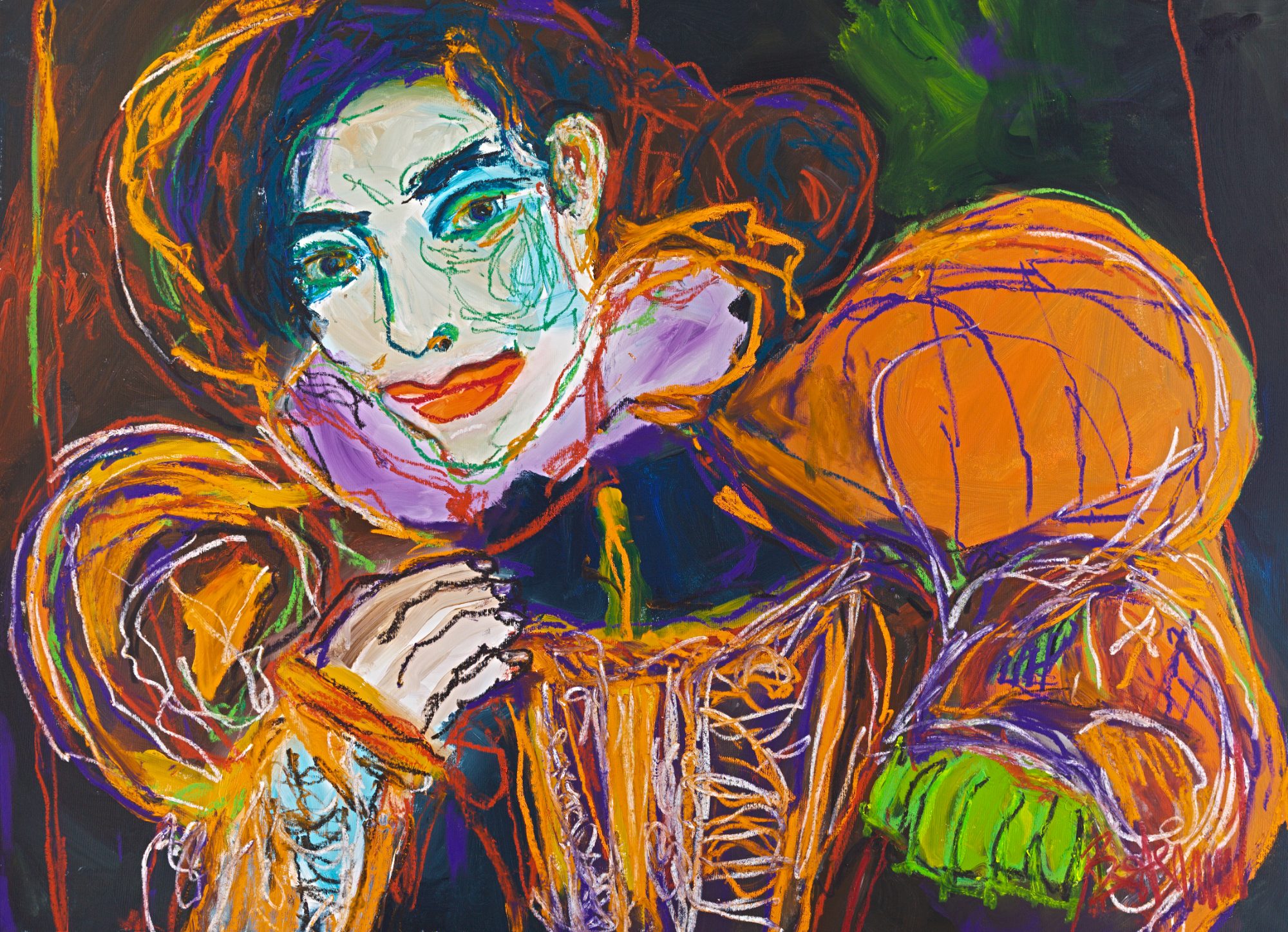
Every royal portrait ever painted was a costume drama. The ruff took two servants and half a morning to set. The white face was lead paint. The sleeves were padded, wired, and worth more than the horse. For four centuries the most expensive thing in a state portrait was never the person — it was the outfit, and everyone in the room knew it. Cosplay Royale simply moves that fact forward to 2026 and lets it stand there.
A condition, not a narrative
The sitter wears the whole apparatus: the wide lavender-white ruff, the enormous orange sleeves ribbed like a pumpkin, the laced bodice, the chalk-pale face with its painted red mouth. It is impeccable — and unmistakably made by hand at a kitchen table. The lacing is cord. The seams are drawn on. This is not a duchess; it is somebody who spent months sewing a duchess, and who is now standing in a dark hall waiting to be photographed. And she is bored. She has propped her head on her hand in the oldest pose in Western art, the melancholic sovereign weighed down by the crown, and her eyes have drifted sideways out of the role entirely. The painting fixes that gap: the costume is perfect and the person inside it has stopped performing.
Painted fast, drawn in oil stick
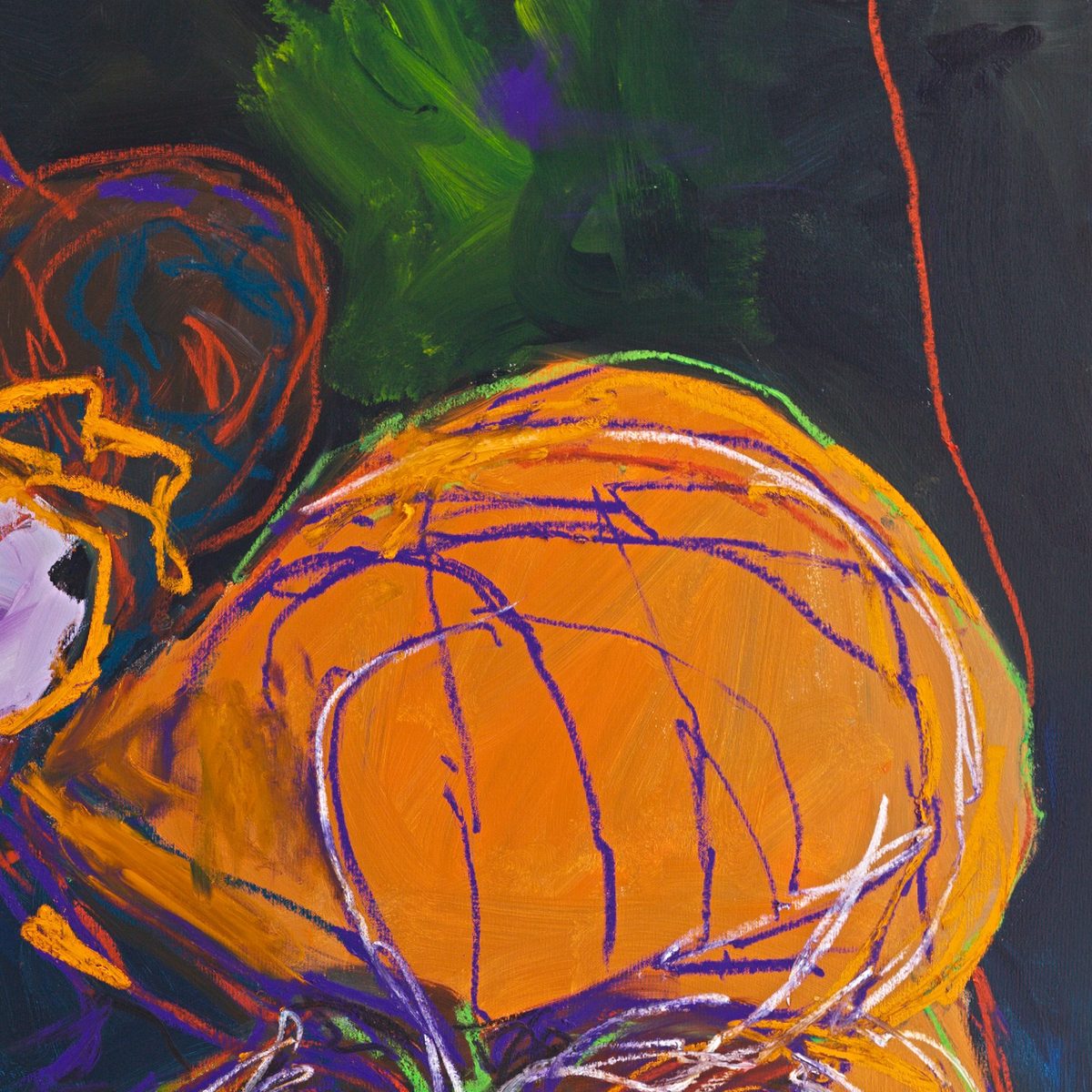
Cosplay Royale belongs to Bertermann's figurative method, the reverse of his abstract discipline. Broad fields of acrylic are laid down fast and loose — flame-orange, violet, acid green and chalk white over black — and the surface keeps the momentum of the arm that put it there.
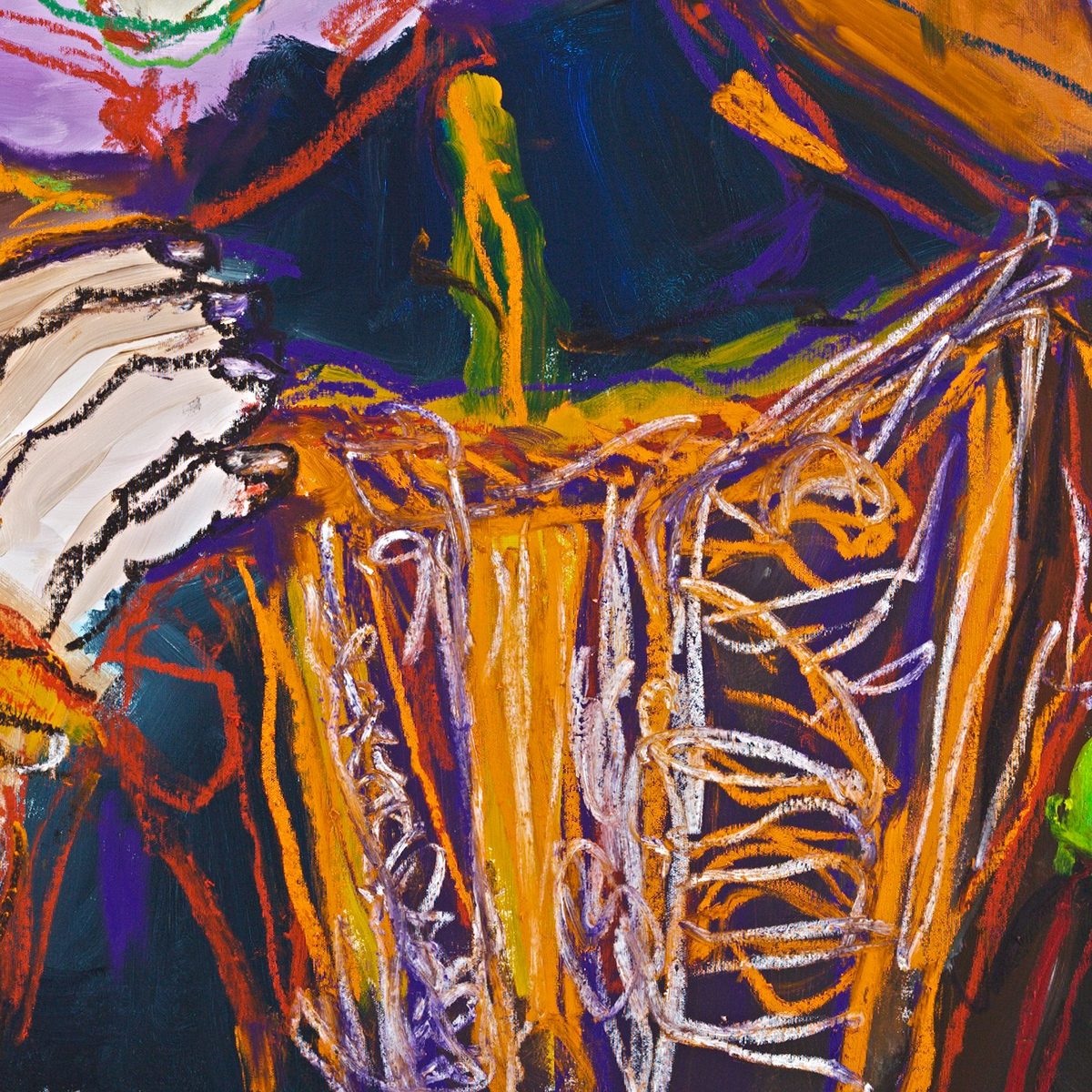
The figure, the ruff, the sleeves and the cross-lacing are then drawn straight over that ground in oil stick. The contour lines stay independent of the paint underneath; they sit on top of it and cut through the colour rather than follow it. That separation — raw painterly field against assertive line — is where the picture gets its charge, and it is why a bodice made of nothing but looped white cord still reads as a garment with weight.
Built forward, not scraped back
Collectors who know the abstract series will feel the difference at once. In the abstracts, layers are applied and scraped back — the image arrives by removal, like sediment. Cosplay Royale is built the opposite way: forward only. Coarse acrylic first, decisive oil-stick contour on top. And behind the figure, nothing: no throne, no drapery, no coat of arms. The single most reliable prop in the history of aristocratic portraiture has been removed, and without a palace to stand in, the costume has to do all the work. It does. It just no longer proves anything.
Made by a real person — not AI
Like every work in the studio, Cosplay Royale is an original, one-of-a-kind painting, made by hand by a real person, not AI. The breaks in the oil-stick line, the collisions of wet colour, the small irregularities of the surface — all of it is intentional, and all of it is the record of a human body moving in front of a canvas nearly two metres wide.
Cosplay Royale, 2026. Acrylic and oil stick on canvas, 130 × 180 cm (height × width). Signed on the front and the back. Part of the figurative works.