Eau Rouge (2026) — The Most Famous Corner in Racing Is Named After a Little Stream
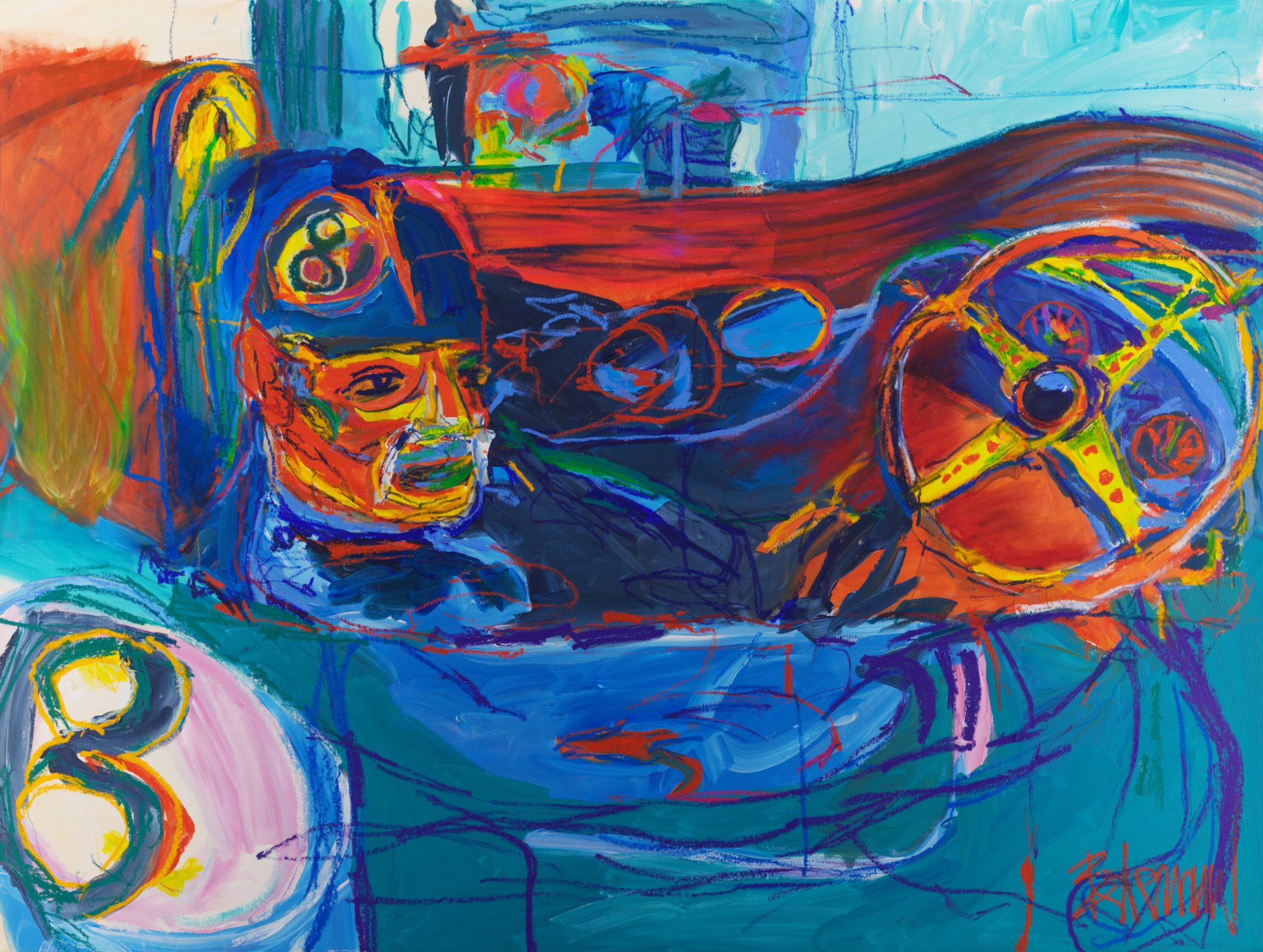
Spa-Francorchamps, the 1960s. A racing driver in car number 8 heads flat out towards Eau Rouge, the most famous corner in motor racing. The road dips, then rises in front of him like a wall and sweeps to the right at the top.
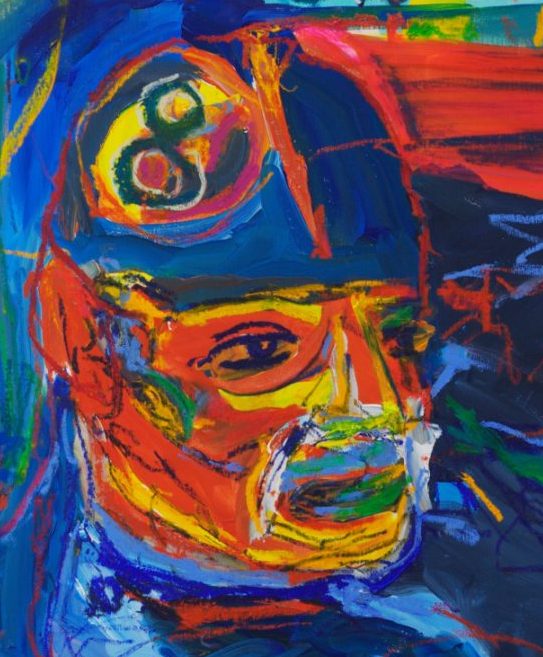
He does not lift. His eyes are calm, focused and full of confidence. He knows exactly what he is doing. And the oval rear-view mirror beside his steering wheel shows an empty road: he is out in front, and the rest of the field is long gone.
A condition, not a story
Eau Rouge does not show a race result or a moment of drama. It shows a state: full speed, total concentration, complete trust in his own hands. A simple cloth mask protects his face from dust and oil, as it did for many drivers of his generation. The asphalt rushes past in streaks of violet and blue. Everything moves — except his gaze.
Red water
Here is the twist. The corner that every racing driver wants to take flat out is named after a small, gentle stream. Eau Rouge means “red water”, and the brook that runs beneath the track is coloured reddish by the iron in the Ardennes soil.
Bertermann takes the name literally. The climbing curve becomes a broad red-brown current that rises across the upper half of the canvas, and the driver does not fight it — he rides it, like a swimmer who trusts the water.
Number 8, again
Collectors who know No Halo will recognise the number. There, a driver of the same era sits calmly beside his car after the race. Eau Rouge shows the moment that comes before: at full speed, in the corner that makes heroes. In this painting the 8 appears twice — on the helmet and on the car. Man and machine carry the same name. They are one team.
Freedom below, precision above
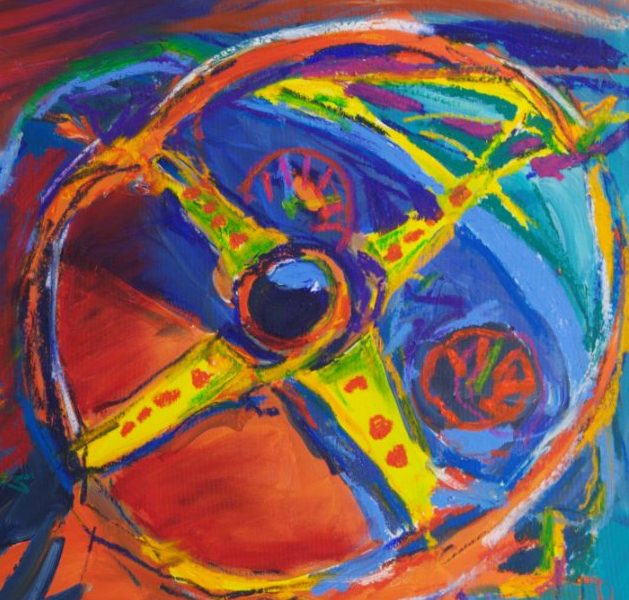
The picture is built in two separate moves. First the ground: the turquoise sky, the red-brown sweep of the curve, the orange field at the upper left and the deep blue and teal masses of the car, laid in with coarse, broad brushstrokes that settle nothing precisely. Then the drawing, on top of that ground: the helmet and its number, the face and the mask, the steering wheel with its drilled spokes, the gauges, the second 8 and the violet speed lines across the bottom of the canvas. The line never sinks into the paint; it stays on top. Like every figurative work in this series, the image is built forward, never scraped back — the exact inversion of the abstract series, where surfaces are built over months and cut back into.
An architect's scale
At 150 × 200 cm, the steering wheel is larger than a real one and the driver's head is close to life size. Bertermann, who holds a Master's degree in Architecture, uses that scale the way a building uses a façade: the canvas does not show the corner from the grandstand, it puts the viewer in the cockpit.
Made by a real person — not AI
Like every work in the studio, Eau Rouge is an original, one-of-a-kind painting, made by hand by a real person, not AI. The flying lines, the running colour, the drilled spokes drawn in a few fast strokes — all of it is intentional, and all of it is the record of a human hand working at speed in front of a canvas two metres wide.
Eau Rouge, 2026. Acrylic and oil stick on canvas, 150 × 200 cm (height × width). Signed on the front and the back. Part of the figurative works.
→ View Eau Rouge in the gallery
This painting belongs to Claus Bertermann’s 2026 figurative series — large-format works in acrylic and oil stick in which the drawn layer always lies on top of the paint, never in it.