Europa (Eigentlich, Nr. 1) (2026): A Europe That Rides, and Is Carried Nowhere
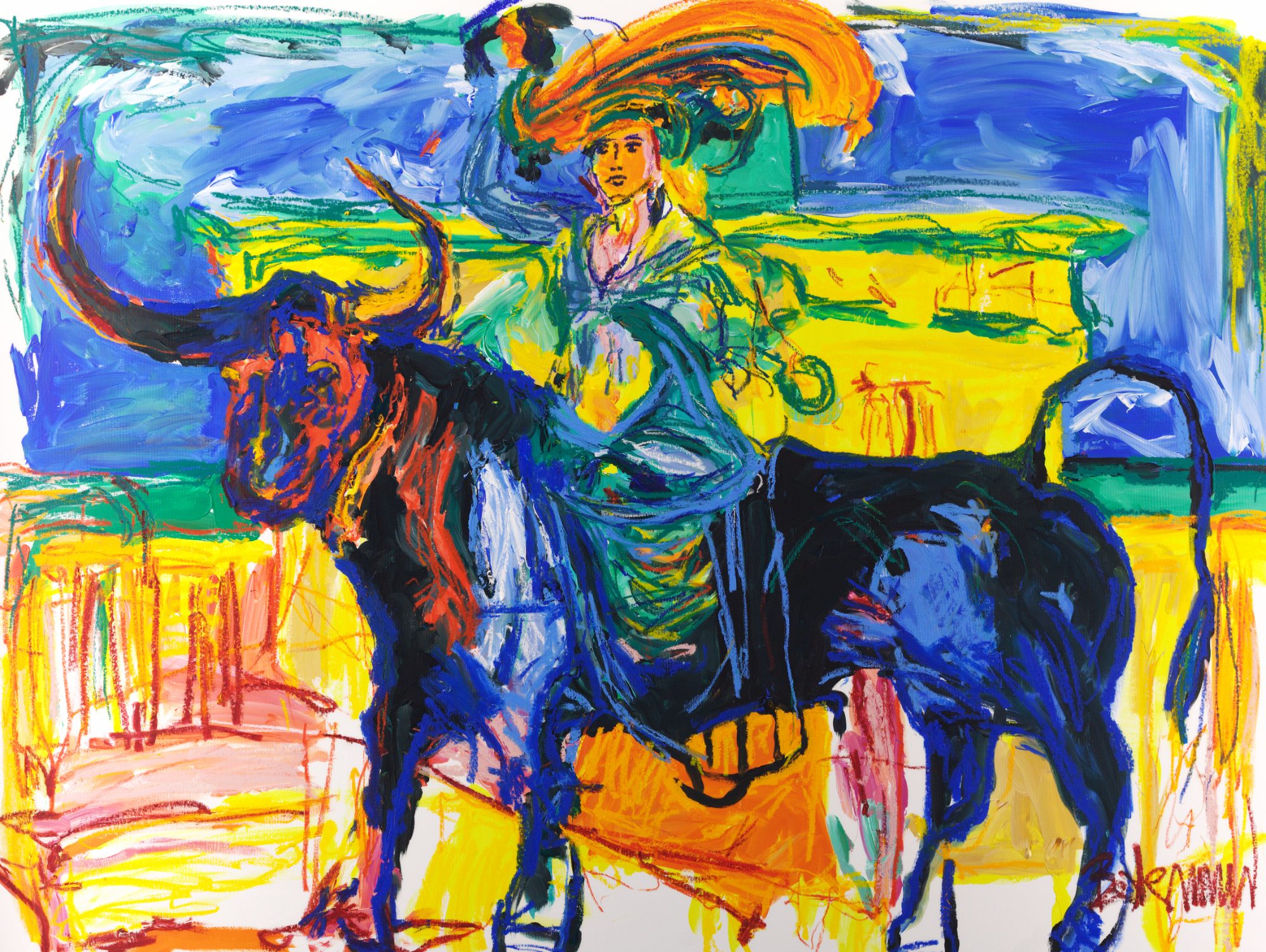
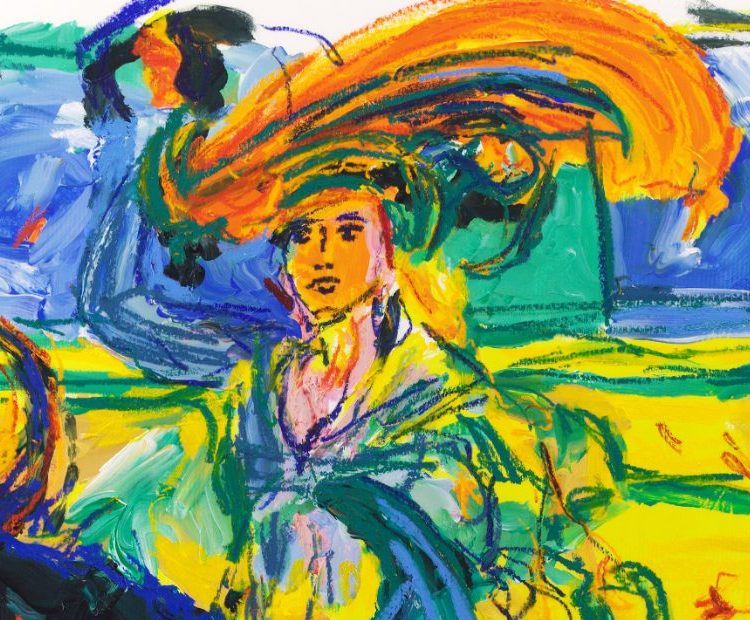
A woman rides a black bull through Berlin, and she is not holding on. One arm is raised to a wide orange pamela crowned with dark plumes, her dress spills over the bull's back in green and blue, and she looks at you with complete calm.
Behind her, sketched in yellow and green under a deep blue sky, stands the Brandenburg Gate.
A condition, not a story
Europa does not tell you where she is going or where she came from. It shows a state: composure. A rider who has nothing to prove, on an animal that could carry her anywhere and simply walks.
The oldest European story, turned around
Every European child knows the myth: Zeus turns himself into a white bull, the princess Europa climbs onto his back, and he carries her off across the sea. A continent is named after a woman who was taken.
This Europa is taken nowhere. She sits upright, side-saddle, and the bull walks at her pace. The myth is still there — the bull, the princess, the open horizon — but the direction is hers.
A goddess steps down from the gate
On top of the Brandenburg Gate stands Johann Gottfried Schadow's Quadriga: a goddess driving four horses. When it was made, she was understood as Eirene, the goddess of peace. Only after the Napoleonic wars was she renamed Victoria, the goddess of victory. Perhaps this is her — stepped down for an afternoon, four horses swapped for one bull, wearing the hat of a Spanish feria and her first name again.
Eigentlich
The painting opens a series called Eigentlich — the German word for “actually”, “in truth”, “really”. It is the word for what something already is, beneath everything else. Claus Bertermann, a German painter living in Spain, uses it for his view of Germany: a country capable of great things, which actually has no one to fear. The other works of the series show the people of that country — mostly couples embracing in front of the same gate.
Freedom below, precision above
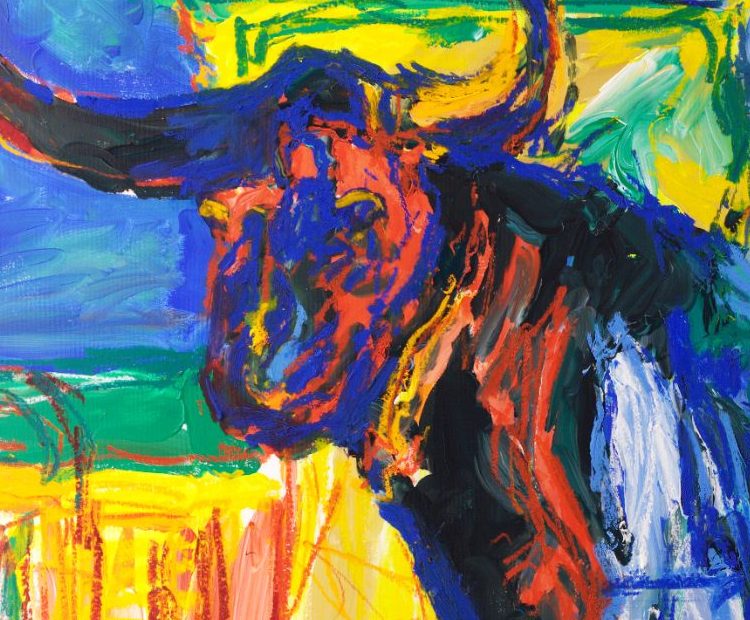
The picture is built in two separate moves. First the ground: the deep blue sky, the bands of emerald and bright yellow where the gate stands, the glowing yellow, orange and pink ground at the bottom, laid in with coarse, broad brushstrokes that settle nothing precisely. Then the drawing, on top of that ground: the woman's face and dark eyes, the folds of her dress, the plumes of her hat, the bull's horns and red-streaked head, and the loose loop of its tail curling into the sky — the same gesture as the feathers on her pamela. The line never sinks into the paint; it stays on top. Like every figurative work in this series, the image is built forward, never scraped back — the exact inversion of the abstract series, where surfaces are built over months and cut back into.
An architect’s scale
At 150 × 200 cm the bull is nearly life-size, and it crosses almost the full width of the canvas. Bertermann, who holds a Master’s degree in Architecture, uses that scale so that you do not look at the rider from a distance — you stand in her path, at eye level with the bull.
Made by a real person — not AI
Like every work in the studio, Europa is an original, one-of-a-kind painting, made by hand by a real person, not AI. The swirling plumes, the heavy black of the bull, the face drawn in a few sure strokes — all of it is intentional, and all of it is the record of a human hand working fast in front of a canvas two metres wide.
Europa (Eigentlich, Nr. 1), 2026. Acrylic and oil stick on canvas, 150 × 200 cm (height × width). Signed on the front and the back. Part of the figurative works.
→ View Europa (Eigentlich, Nr. 1) in the gallery
This painting belongs to Claus Bertermann’s 2026 figurative series — large-format works in acrylic and oil stick in which the drawn layer always lies on top of the paint, never in it.