Going Dutch (2026): The First Sip Is a Choice
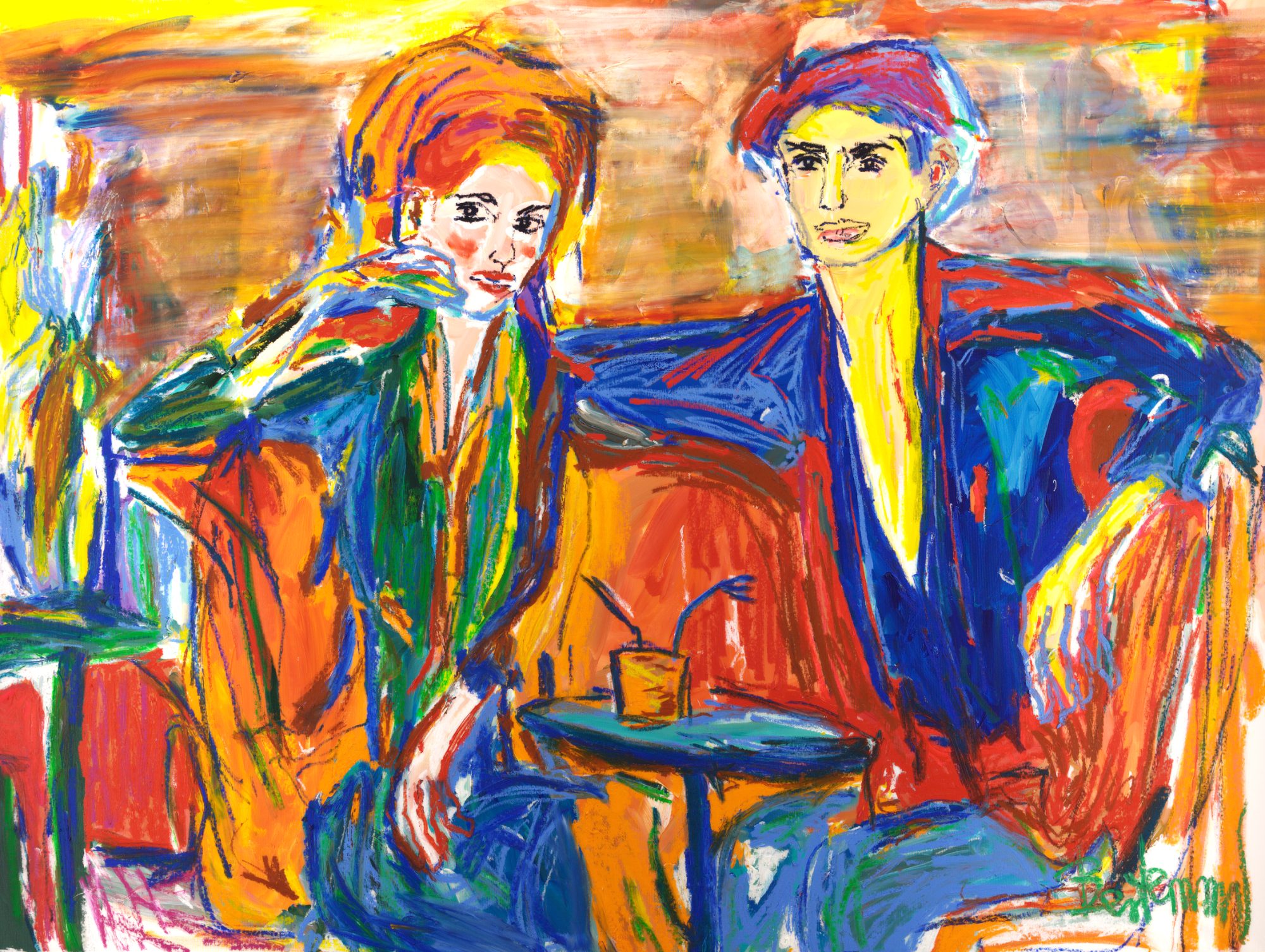
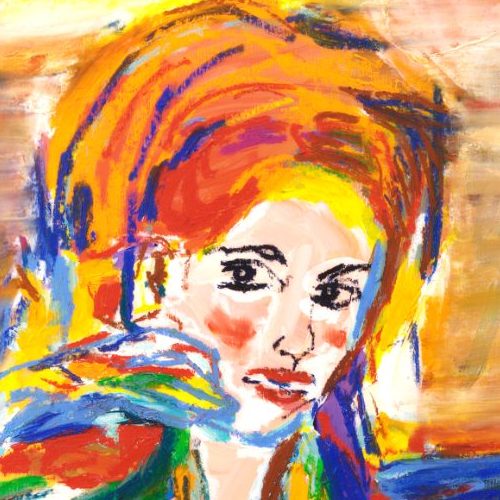
Two straws, one glass, and not a single sip taken. She rests her chin on her arm and studies you, as if you had just made an interesting offer.
He leans back on the red sofa, one arm stretched wide, in no hurry at all. Whatever brought these two to this little table, the real conversation has not started yet.
A condition, not a story
Going Dutch does not tell you who these two are, how they met or what comes next. It shows a moment of suspense at a café table: two people, one drink, and a decision that has not been made.
An old gesture, new terms
Going Dutch means splitting the bill. But the phrase reaches further back, to the Dutch painters of the seventeenth century and their scenes around small tables. Again and again they painted the same moment: a man fills a glass and offers it to a woman — and every viewer of the time read the gesture as a proposal.
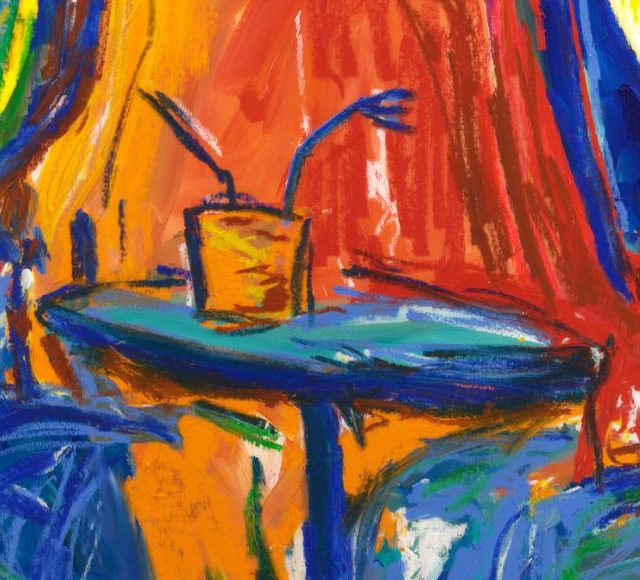
Here nobody pours and nobody offers. The glass stands exactly between them, one straw for each, equal shares from the very start.
The first sip is a choice
So the old tavern scene runs on new terms: the first sip is not taken, it is chosen. Look at the two of them again and the roles become clear. He has already relaxed into waiting. She is still weighing the offer — and judging by the look in her eyes, the answer is hers to give.
Freedom below, precision above
The picture is built in two separate moves. First the ground: the orange and ochre wall, the burst of yellow light, the red sofa and the blue and green masses of the clothing, laid in with coarse, broad brushstrokes that settle nothing precisely. Then the drawing, on top of that ground: the two faces, the man’s cap, the rim of the table, the glass and its two straws. The line never sinks into the paint; it stays on top. Like every figurative work in this series, the image is built forward, never scraped back — the exact inversion of the abstract series, where surfaces are built over months and cut back into.
An architect’s scale
At 150 × 200 cm the two figures are close to life size, and the little table sits at the height of a real café table. Bertermann, who holds a Master’s degree in Architecture, uses that scale so that you do not look at the scene from outside — you stand at the edge of the table, close enough to see who reaches for the glass first.
Made by a real person — not AI
Like every work in the studio, Going Dutch is an original, one-of-a-kind painting, made by hand by a real person, not AI. The loose sofa, the running colour, the two faces drawn in a few sure strokes — all of it is intentional, and all of it is the record of a human hand working fast in front of a canvas two metres wide.
Going Dutch, 2026. Acrylic and oil stick on canvas, 150 × 200 cm (height × width). Signed on the front and the back. Part of the figurative works.
→ View Going Dutch in the gallery
This painting belongs to Claus Bertermann’s 2026 figurative series — large-format works in acrylic and oil stick in which the drawn layer always lies on top of the paint, never in it.