La Perla (2026): The Real Pearl Is at the Table
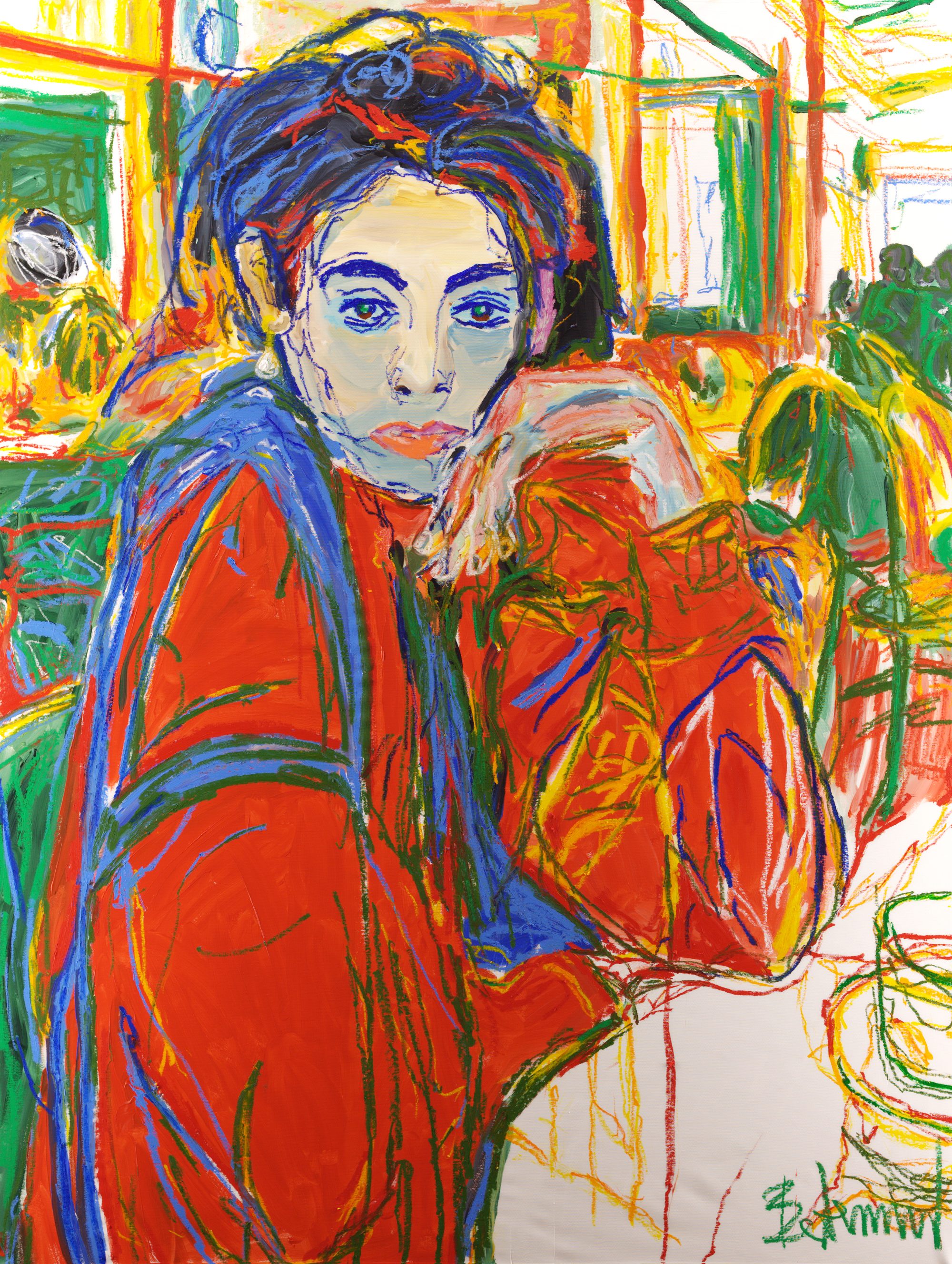
She came in for a coffee, but the coffee is not what keeps her here. Chin resting on her hand, a red coat around her shoulders, she looks straight at you with all the time in the world.
Around her the café hums in yellow, orange and green. And at her ear hangs one large teardrop pearl, catching the light like a little moon.
A condition, not a story
La Perla does not tell you who she is, whom she is waiting for or what she will order next. It shows a moment of complete composure at a café table: one woman, one look, one pearl.
A famous pearl, turned around
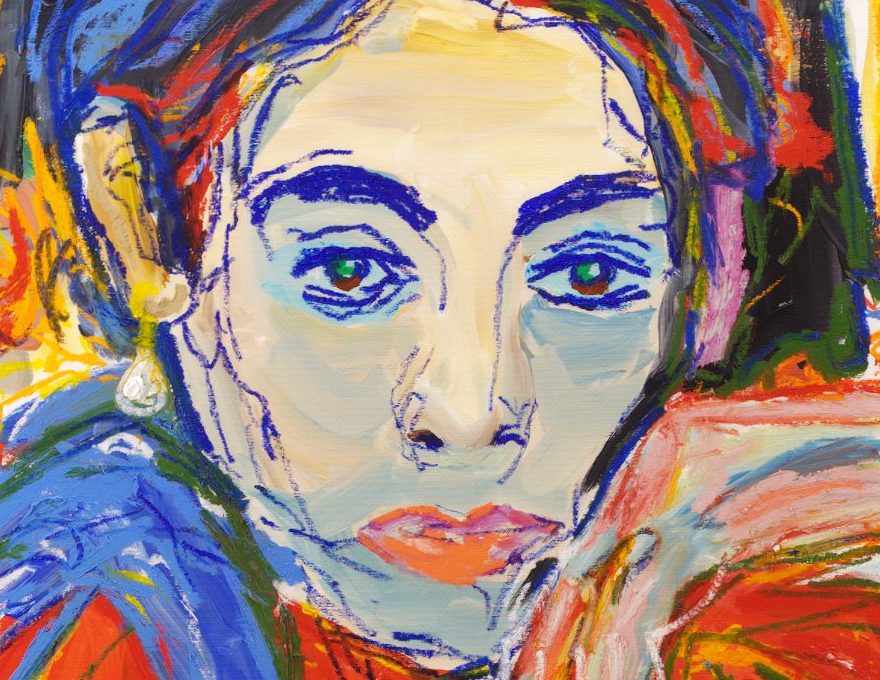
Every painting of a woman with a pearl earring talks to one famous ancestor: Vermeer’s Girl with a Pearl Earring, turning over her shoulder for a single second in a quiet, dark room. Here the old scene is turned around. She is not glancing back — she has arrived and taken her seat. The dark room has become a café full of colour. And the blue has slipped from a turban into a scarf she wears exactly as she likes.
The real pearl
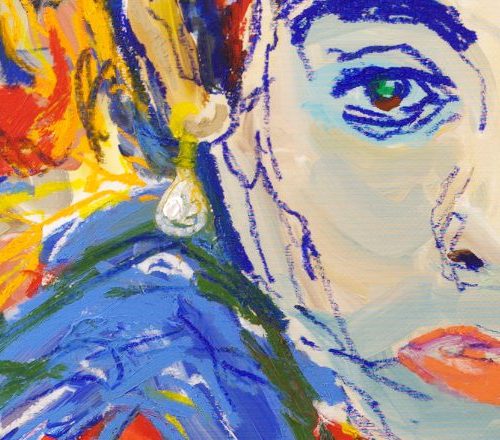
A pearl grows slowly, layer by layer, until it shines — and her face has that same quiet glow. In Spanish, la perla is also what you call a person who is rare and precious. So the earring is only the hint. The real pearl is the one sitting at the table.
Freedom below, precision above
The picture is built in two separate moves. First the ground: the yellow and orange window frames, the green plants, the great red field of the coat and the blue sweep of the scarf, laid in with coarse, broad brushstrokes that settle nothing precisely. Then the drawing, on top of that ground: the brows and eyes, the fine blue contours of the face, the lips, the hand, the pearl and the rim of the little table. The line never sinks into the paint; it stays on top. Like every figurative work in this series, the image is built forward, never scraped back — the exact inversion of the abstract series, where surfaces are built over months and cut back into.
An architect’s scale
At 200 × 150 cm the canvas stands upright like a person, and the woman is shown close to life size. Bertermann, who holds a Master’s degree in Architecture, uses that scale so that you do not look at a portrait from a distance — you sit down across the table from her, close enough to see the light on the pearl.
Made by a real person — not AI
Like every work in the studio, La Perla is an original, one-of-a-kind painting, made by hand by a real person, not AI. The loose coat, the running colour, the face drawn in a few sure strokes, the pearl set in thick white paint — all of it is intentional, and all of it is the record of a human hand working fast in front of a canvas two metres tall.
La Perla, 2026. Acrylic and oil stick on canvas, 200 × 150 cm (height × width). Signed on the front and the back. Part of the figurative works.
→ View La Perla in the gallery
This painting belongs to Claus Bertermann’s 2026 figurative series — large-format works in acrylic and oil stick in which the drawn layer always lies on top of the paint, never in it.