Le Café (2026) — He Is Not Waiting for Anyone
A café is the last place in Europe where sitting still counts as an activity. You buy a cup; what you actually purchase is a chair, a table the size of a dinner plate, and the right to stay there without explaining yourself to anyone.
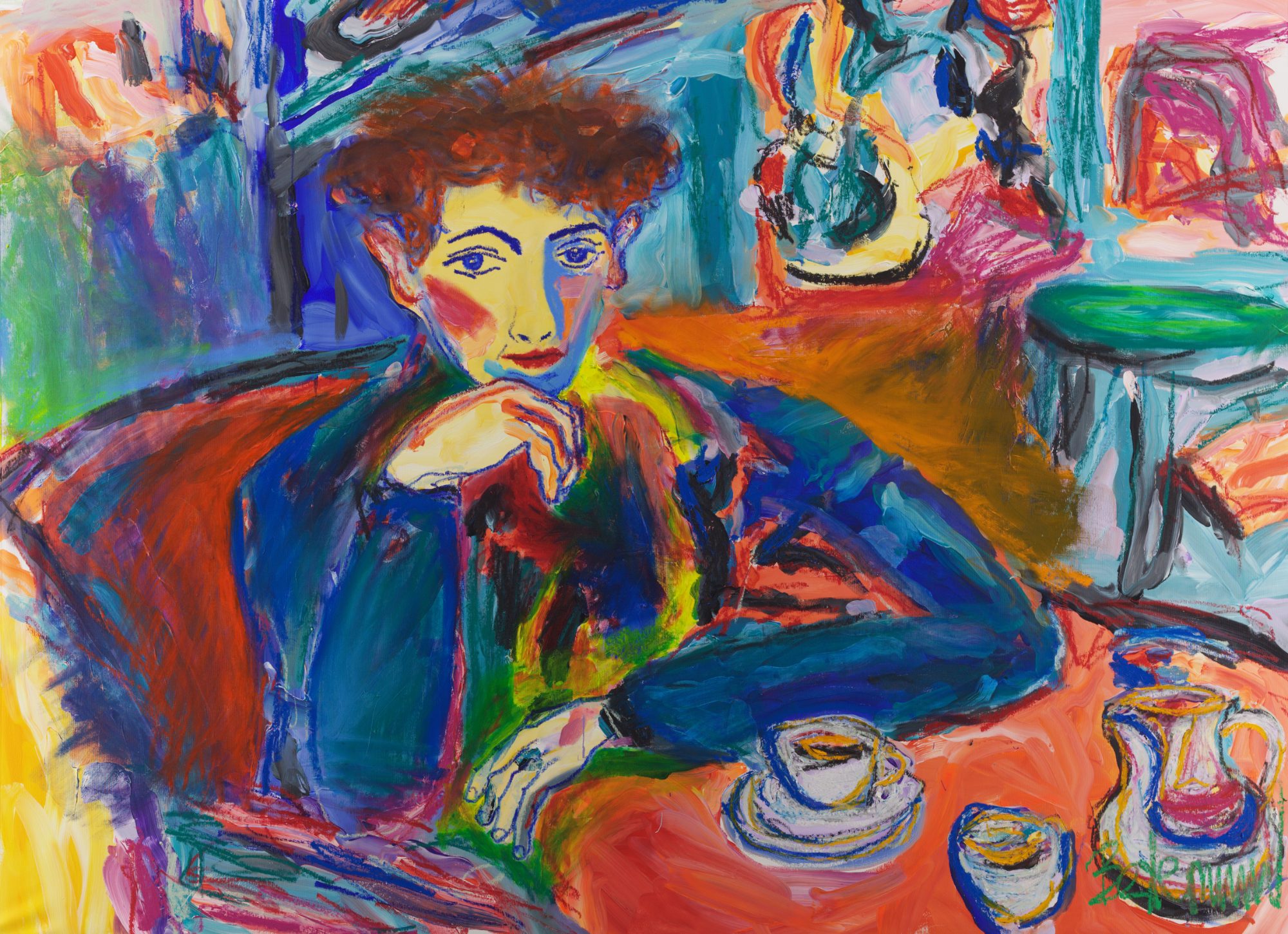
The young man in Le Café has been exercising that right for some time. Small cup, nearly finished. Little jug, untouched. Chin propped on the back of one hand, the other lying flat and open on the table. The waiter has him filed as a man who has been stood up.
A condition, not a story
He hasn't been. He came early on purpose. Something arrived at around the third sip, and he is holding very still so as not to frighten it off. That is the whole picture, and it is a harder thing to paint than it sounds, because from the outside thinking and waiting look exactly the same. Same posture, same cooling cup, same middle distance.
Only the colour gives him away. If this were disappointment the painting would not behave like this: the table would not be burning vermilion, the jacket would not be that cobalt, and a broad stripe of gold light would not cross the entire room to land on precisely one shoulder.
The still life is the calm
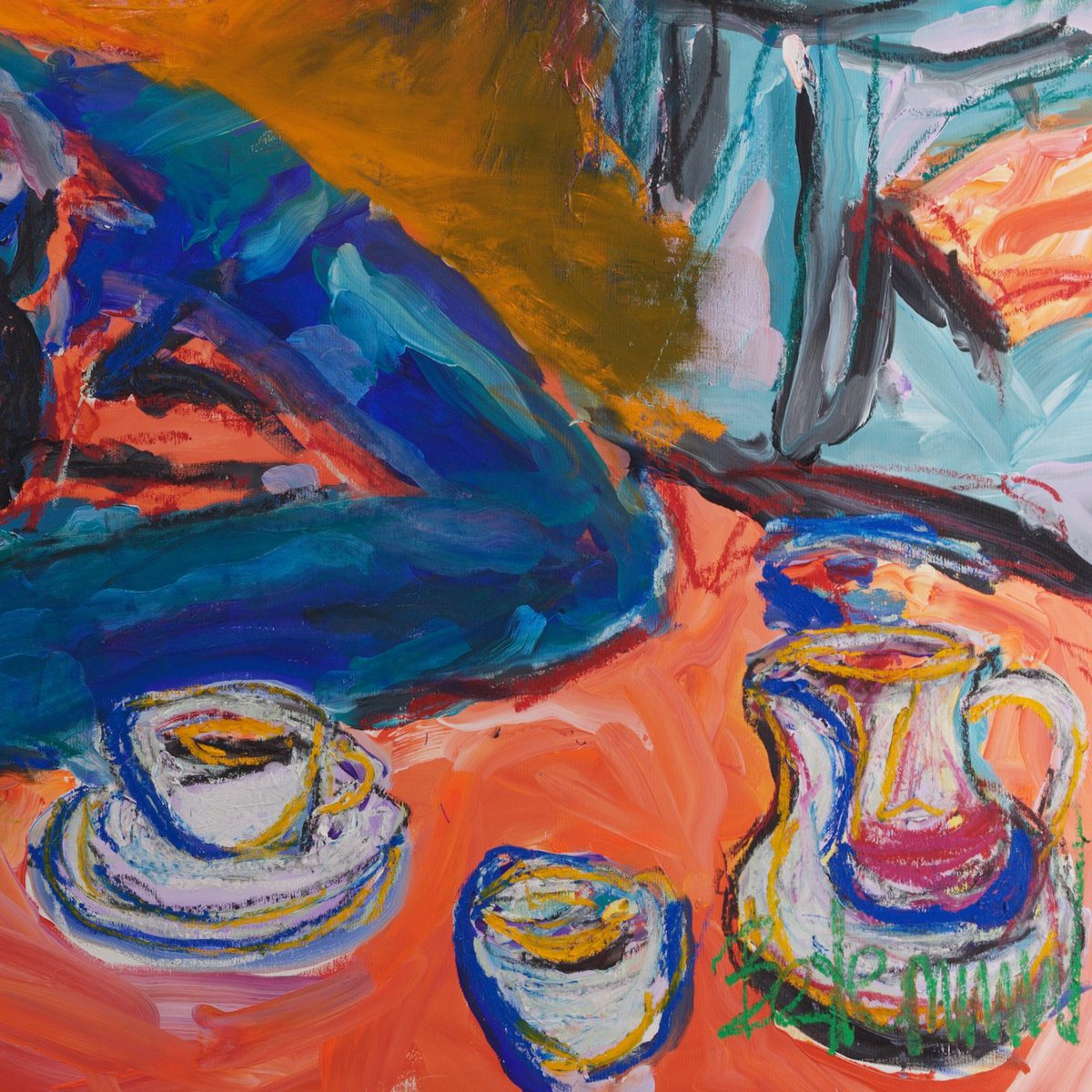
Three white objects at the lower right — cup, small bowl, jug — drawn almost entirely in oil-stick line over the orange table top: yellow rims, blue contours, a band of magenta on the jug. In a canvas this hot and this large they do the work a rest does in music. Everything else in the room is moving; the crockery is not.
Coarse ground first, the oil stick on top
Like the other works of the 2026 series, the picture is built in two separate moves. The ground comes first, in coarse, broad brushstrokes that settle nothing precisely — the café interior, the jacket, the table and the shaft of gold light. The reference points are the German Expressionists: bent perspective, heightened colour, a surface that keeps moving.
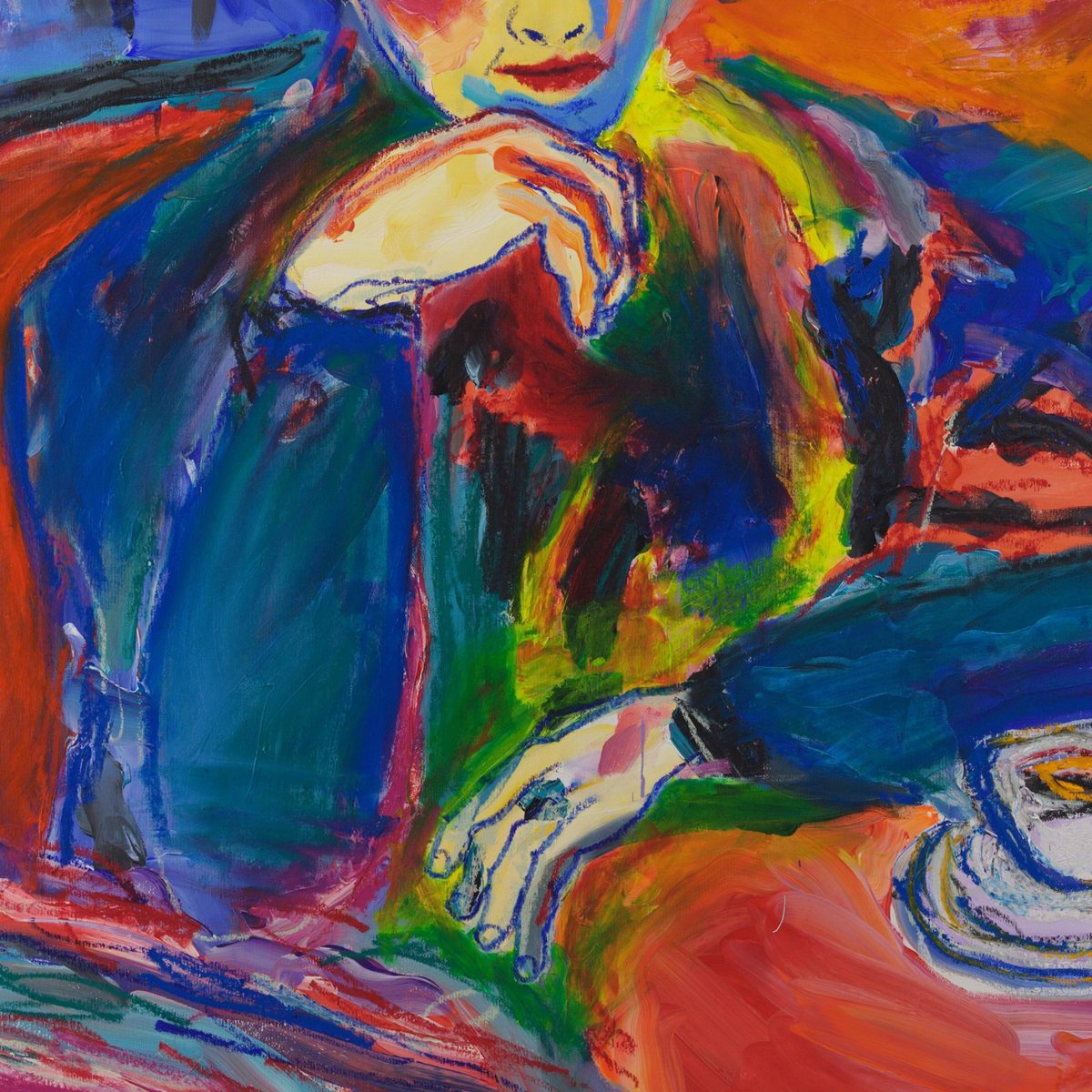
Only then does the oil stick arrive, laid on top of that painted ground and carrying the whole drawn layer: the blue contour of the hands and the open collar, the rims of cup, saucer and jug, the black lines that hold the furniture in place, the green signature at the lower right. Freedom below, precision above, and no scraping back — the image is built forward, like every figurative work in this series.
The most melancholic composition in modern painting, turned around
The café gave modern painting its first laboratory for watching strangers, and almost everything that came out of it is sad: the late-night table, the untouched glass, the figure sealed off from the room. Colour in those pictures does the mourning.
Le Café keeps the composition and inverts the mood. The room is most saturated exactly where the sitter is most at ease, and the light does not isolate him — it finds him. Collectors who know the abstract series will recognise the architect's instinct underneath the noise: the table as a horizontal anchor, the figure set just off centre, the still life closing the lower right corner.
Made by a real person — not AI
Like every work in the studio, Le Café is an original, one-of-a-kind painting, made by hand by a real person, not AI. The running colours, the drawn hands sitting proud of the painted surface, the scratched contours of the crockery — all of it is intentional, and all of it is the record of a human body working fast in front of a canvas nearly two metres wide.
Le Café, 2026. Acrylic and oil stick on canvas, 130 × 180 cm (height × width). Signed on the front and the back. Part of the figurative works.
This painting belongs to Claus Bertermann’s 2026 figurative series — large-format works in acrylic and oil stick in which the drawn layer always lies on top of the paint, never in it.