Madonnina (2026) — The Little Madonna, Painted at Full Scale
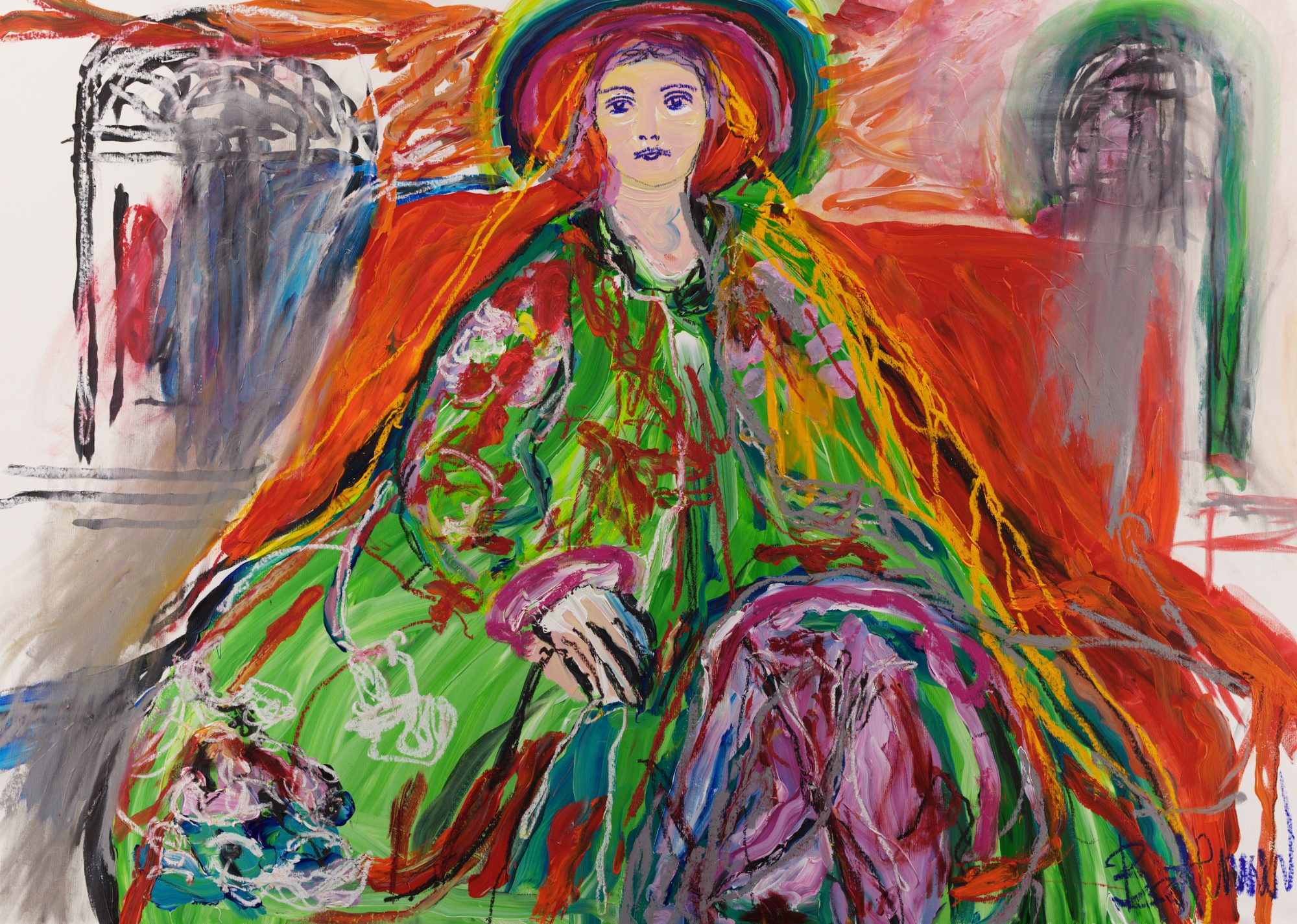
Travel through Italy long enough and you stop noticing them, which is exactly when they start working on you. A niche cut into a wall at the turn of a road. Inside it, a Madonna the length of a forearm — chipped, repainted by somebody's grandmother in colours no committee would have approved, a plastic flower in front of her, a bulb on a wire above. Italian calls her a madonnina: the diminutive. The little Madonna. A small name, of the kind you give to someone you love.
I saw one of these. Then I painted her at 130 by 180 centimetres.
A condition, not a story
That reversal is the entire work. The figure who fits into two cupped hands is given a museum wall. She sits frontally and immovably, her mantle opening across almost the full width of the canvas in a red that behaves more like weather than like cloth, her skirts spreading until they run off both edges. Behind her, two dark arched forms rise like the niche she came from — except that she has outgrown it now, and it has receded into shadow, and the white ground behind her has become as open as sky.
Everything moves except her hands
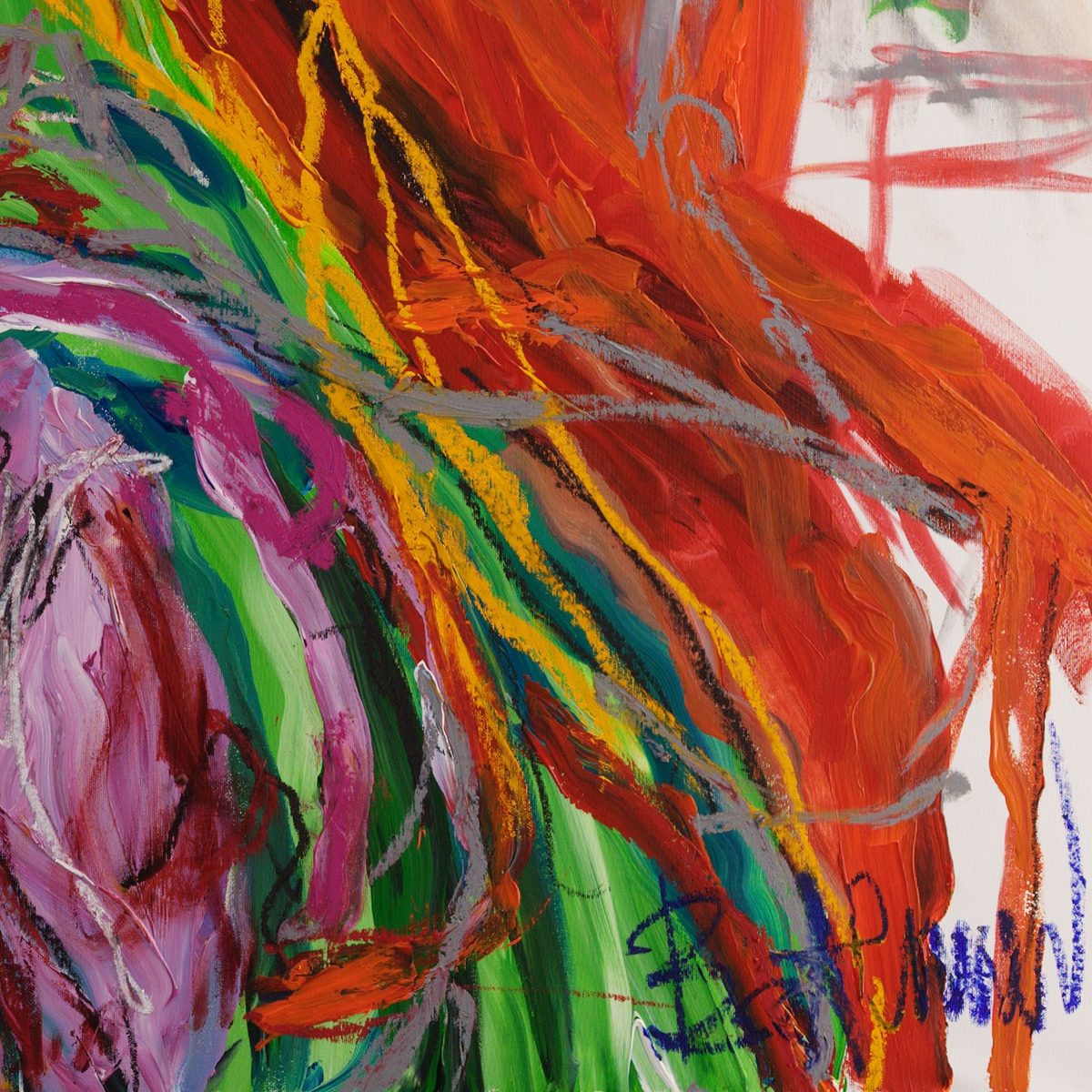
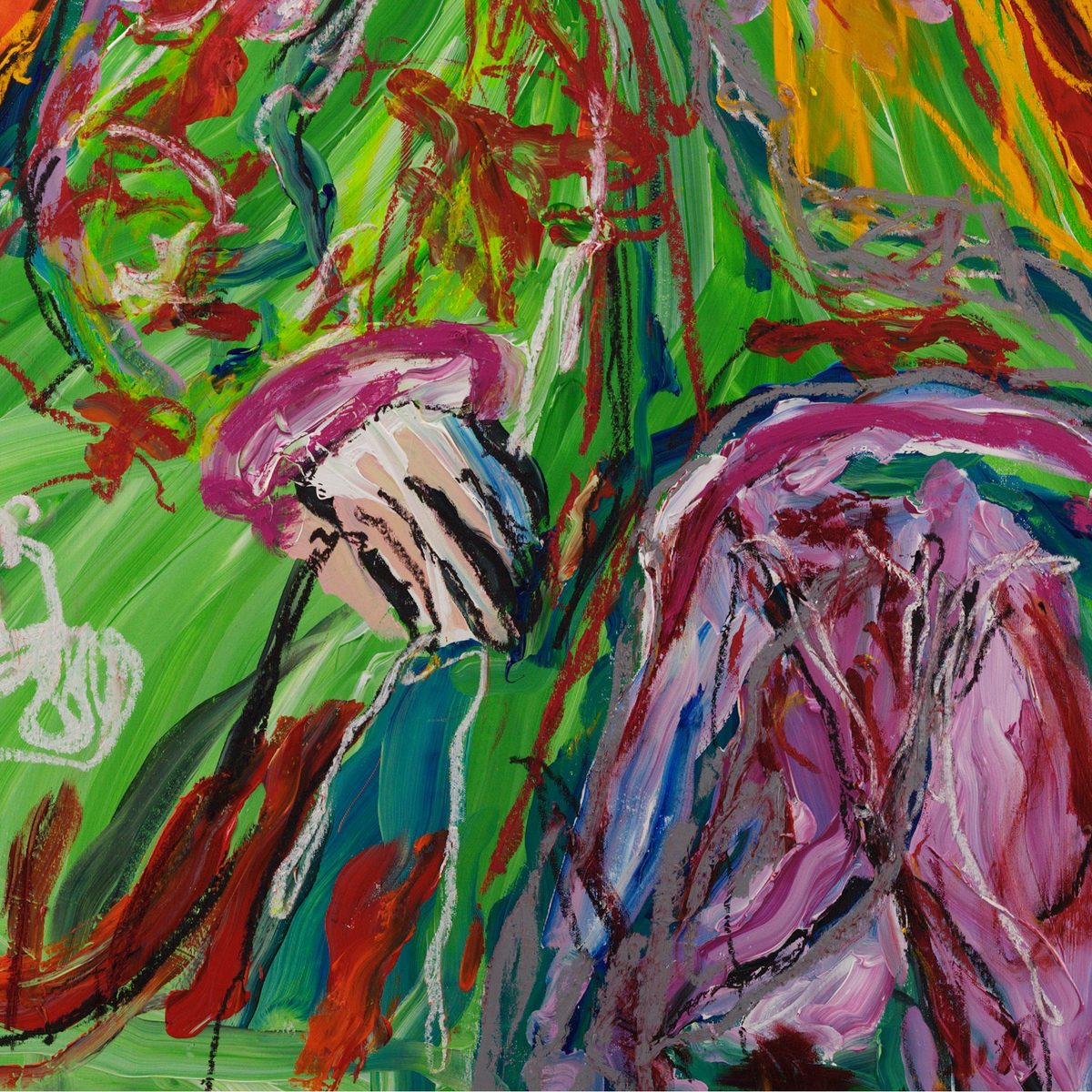
She keeps her hands folded. That is the part that is hard to walk away from. Everything around her has been let loose — colour running into colour, orange bleeding through green, the oil stick tearing yellow lines down through the red like rain across a windscreen — and in the middle of all that motion two small hands stay quietly closed, one over the other, the way hands have been folded in front of these niches for four hundred years by people who were not sure anyone was listening and did it anyway.
The title is a diminutive. The painting is not. Somebody in a village keeps changing those flowers, and nobody ever sees them do it. This is a picture about how much heart fits inside something very small — and what happens when a painter refuses to let it stay small.
Coarse ground first, the oil stick on top
Like the other works of the 2026 series, the picture is built in two separate moves. The ground comes first, in coarse, broad brushstrokes that settle nothing precisely — mantle, dress and the loose white-and-grey ground. The reference points are the German Expressionists: bent perspective, heightened colour, a surface that keeps moving.
Only then does the oil stick arrive, laid on top of that painted ground and carrying the whole drawn layer: the yellow, grey and white lines that fall through the mantle and drip, the black contour of the folded hands, the fine white scrawl looping across the skirt, the signature at the lower right. Freedom below, precision above, and no scraping back — the image is built forward, like every figurative work in this series.
Folk faith at altarpiece scale
The Italian roadside shrine — the edicola — is folk art in the most literal sense: maintained by no institution, funded by nobody, repainted by hand, kept alive by people who will never be named. This painting gives its occupant the scale that institutions reserve for their own altarpieces, and lets the colour do what village colour actually does: clash, glow, refuse restraint. Collectors who know the abstract series will recognise the architect's instinct for structure underneath the noise — the frontal symmetry, the arches anchoring both upper corners, the folded hands holding the exact centre of the picture.
Made by a real person — not AI
Like every work in the studio, Madonnina is an original, one-of-a-kind painting, made by hand by a real person, not AI. The running colours, the dripped oil-stick lines, the drawn hands sitting proud of the painted surface — all of it is intentional, and all of it is the record of a human body working fast in front of a canvas nearly two metres wide.
Madonnina, 2026. Acrylic and oil stick on canvas, 130 × 180 cm (height × width). Signed on the front and the back. Part of the figurative works.
→ View Madonnina in the gallery
This painting belongs to Claus Bertermann’s 2026 figurative series — large-format works in acrylic and oil stick in which the drawn layer always lies on top of the paint, never in it.