No Halo (2026) — The Only Halo in the Picture Belongs to the Car
Every open-wheel racing car today carries a halo: a curved titanium bar over the driver’s head, strong enough to hold the weight of a London bus. It has been mandatory since 2018, and it has already saved lives.
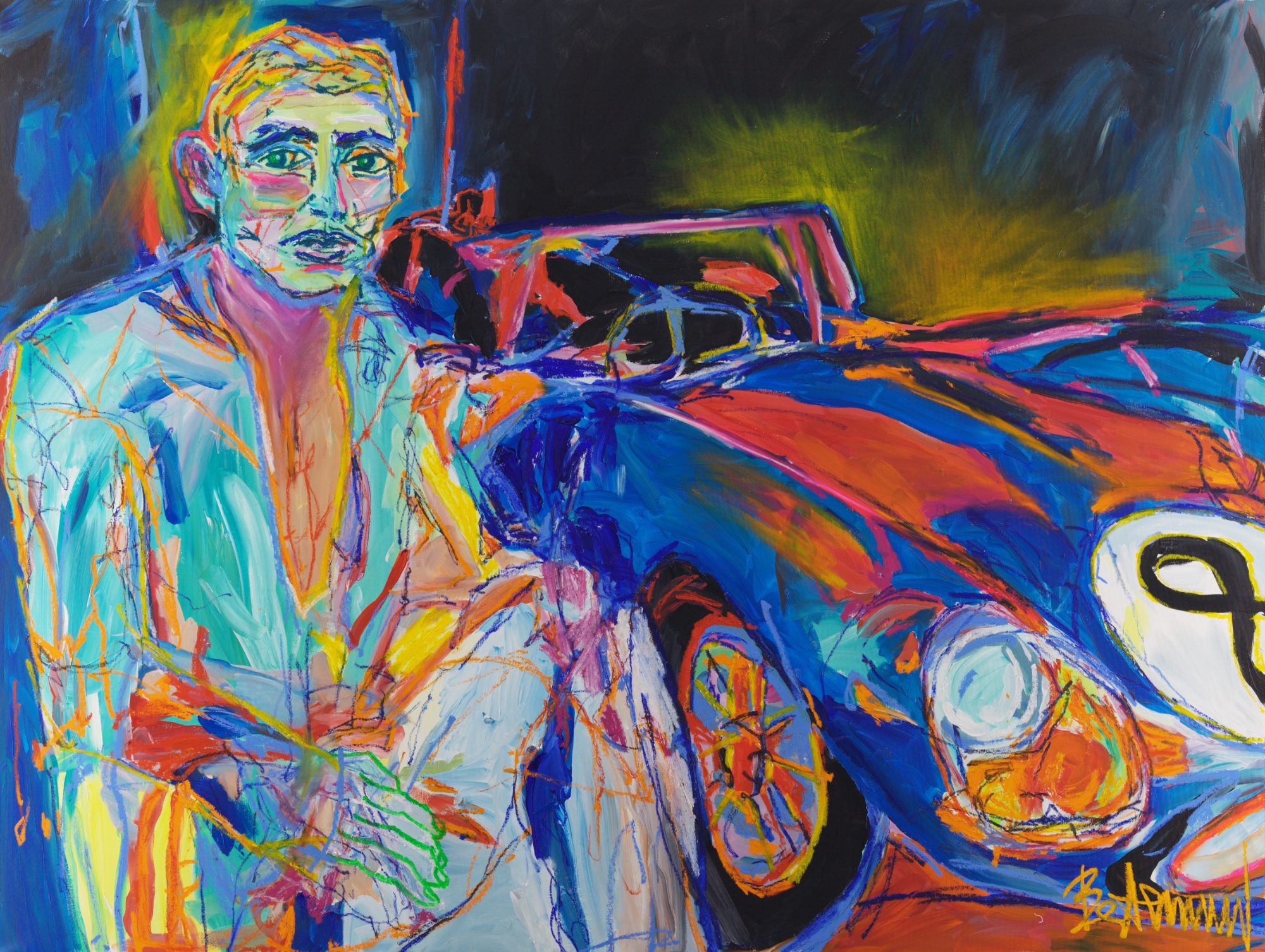
The man in No Halo never saw one.
A condition, not a story
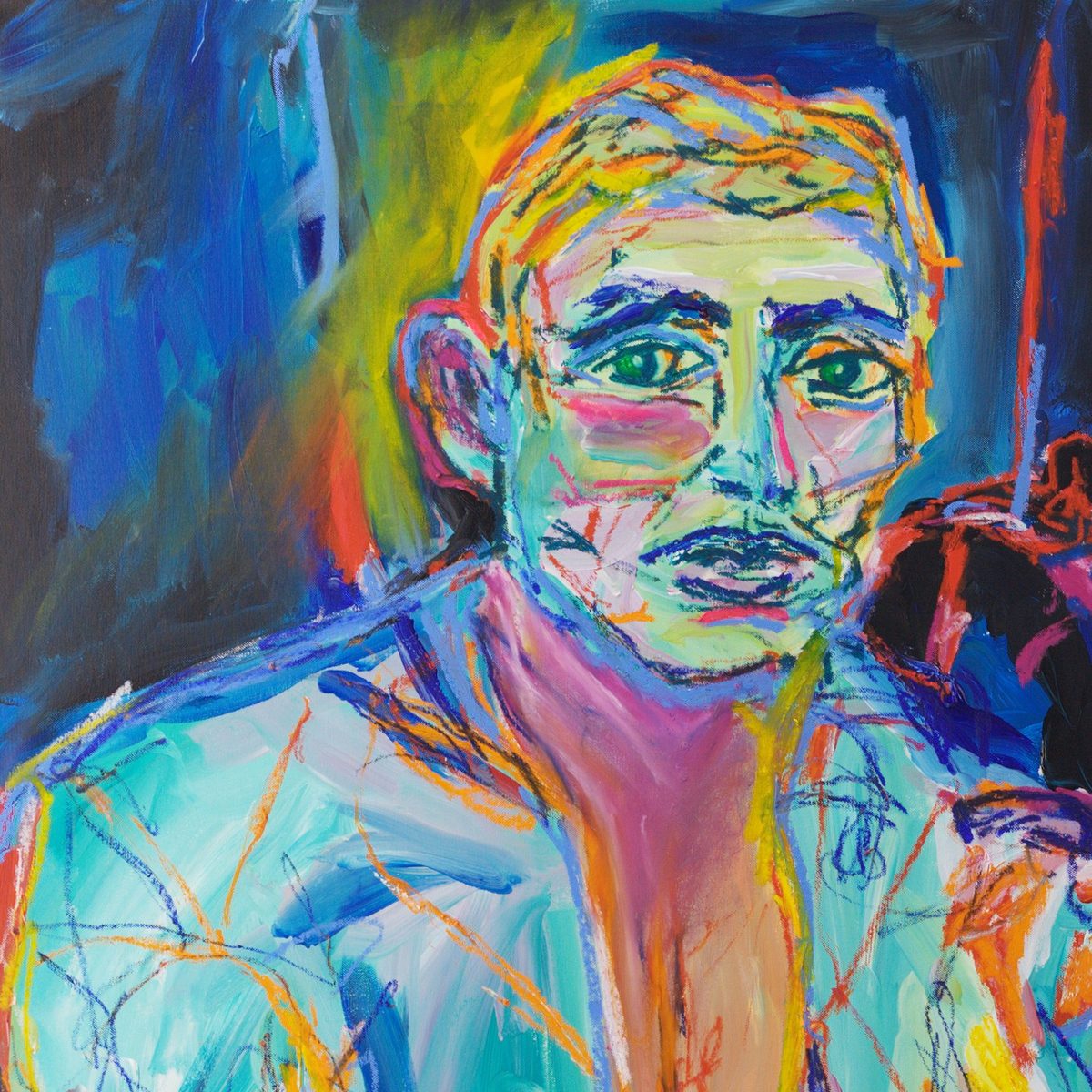
A racing driver of the early 1960s sits beside his car, number 8, and looks straight at us. Shirt open at the neck, hands resting in his lap, the face pale and a little exhausted. He has just climbed out. Nothing happens. The race is over, or has not started yet — the painting does not say, and it does not need to.
Nothing between the driver and the sky
In his era the list of safety equipment fitted on a postcard: a thin helmet, goggles, a cotton shirt and nerve. Many drivers refused seatbelts, because being thrown clear of a burning car seemed the better bet. Between the driver and the road there was nothing but talent — and between the driver and the sky there was nothing at all.
The title works twice
The era made saints of these men, and painting has a traditional tool for saints: a golden disc behind the head. Bertermann withholds it. No halo on the car, no halo on the man.
There is a golden glow in the picture — a broad cloud of ochre and olive-yellow light in the black night. But it hangs over the car, not over the driver. The painting has quietly given the halo to the machine and left the man with nothing but his own face.
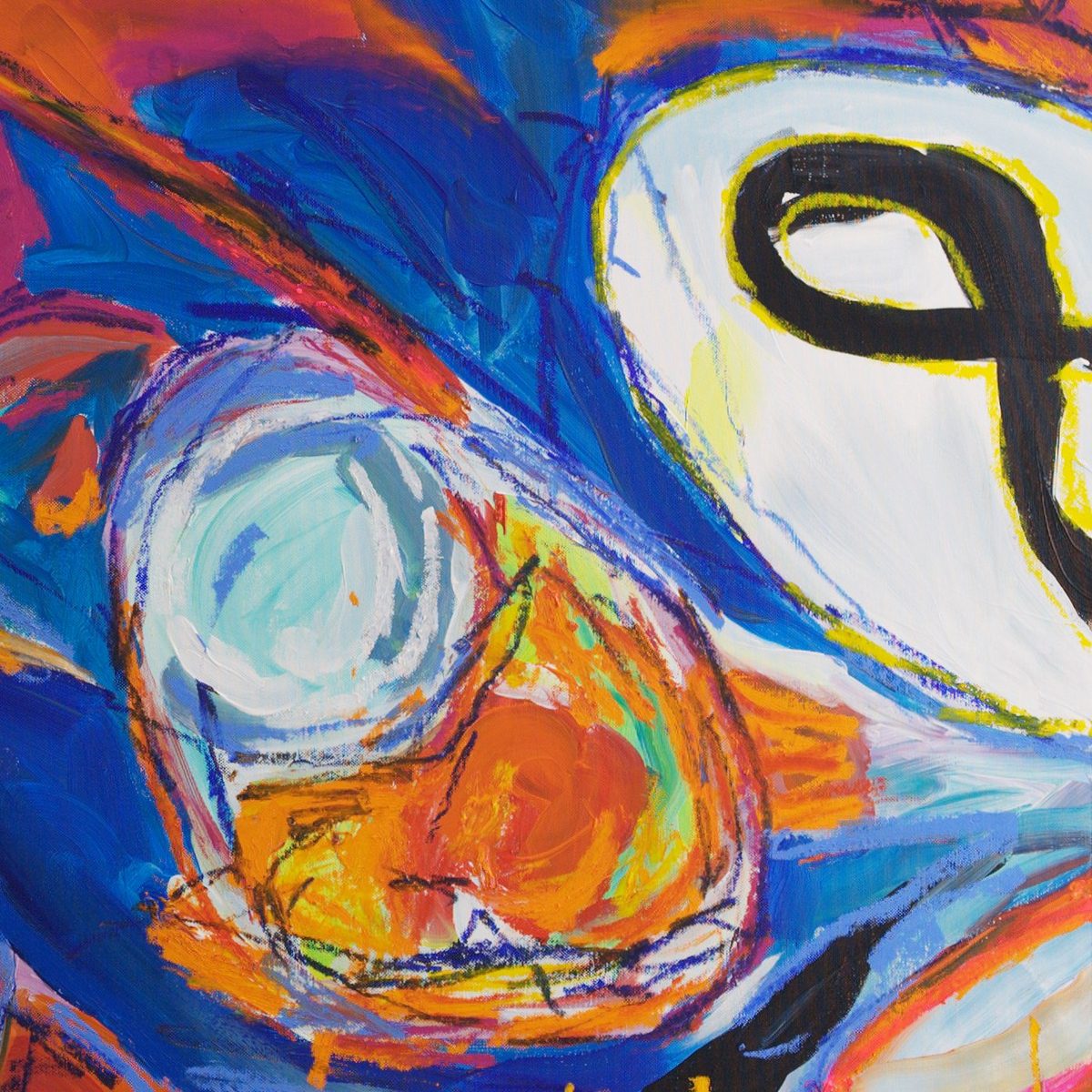
And the number: the 8 on the white roundel is pushed so far to the right that the canvas edge almost cuts it off, as if the car were already leaving while its driver stays. Turn that 8 on its side and it becomes the sign for forever — the only immortality this man was offered, painted on the bonnet, not above his head.
Eyes and hand
The green of the driver’s eyes appears in exactly one other place on the canvas: his hand, drawn in bright green oil stick where it rests in his lap. The eyes that read the track, the hand that steers — everything he needed to stay alive, in one colour.
Under that drawing the paint does something else. The night, the glow, the turquoise shirt and the cobalt and vermilion car body are laid in first, in coarse, broad brushstrokes that settle nothing precisely. The drawing arrives afterwards and sits on top of that ground — face, eyes, the tangle of lines over the shirt, the spoked wheel, the headlight, the number. Freedom below, precision above, and no scraping back: the image is built forward, like every figurative work in this series. Collectors who know the abstract series will recognise the inversion: there the surface is built over months and cut back into; here the line is laid on top and stays there.
Figure and machine on equal terms
No Halo is the first canvas in the series to give a machine as much room as a person. The car takes up more than half of the surface and is painted with the same appetite as the face beside it. It is not an illustration of motorsport — it is a portrait of exposure, and of the quiet minute after the race.
Made by a real person — not AI
Like every work in the studio, No Halo is an original, one-of-a-kind painting, made by hand by a real person, not AI. The running colour, the scribbled lines over the shirt, the green hand — all of it is intentional, and all of it is the record of a human body working fast in front of a canvas two metres wide.
No Halo, 2026. Acrylic and oil stick on canvas, 150 × 200 cm (height × width). Signed on the front and the back. Part of the figurative works.
This painting belongs to Claus Bertermann’s 2026 figurative series — large-format works in acrylic and oil stick in which the drawn layer always lies on top of the paint, never in it.