Orbit (2026) — For One Turn of the Dance, Two People Become a Solar System
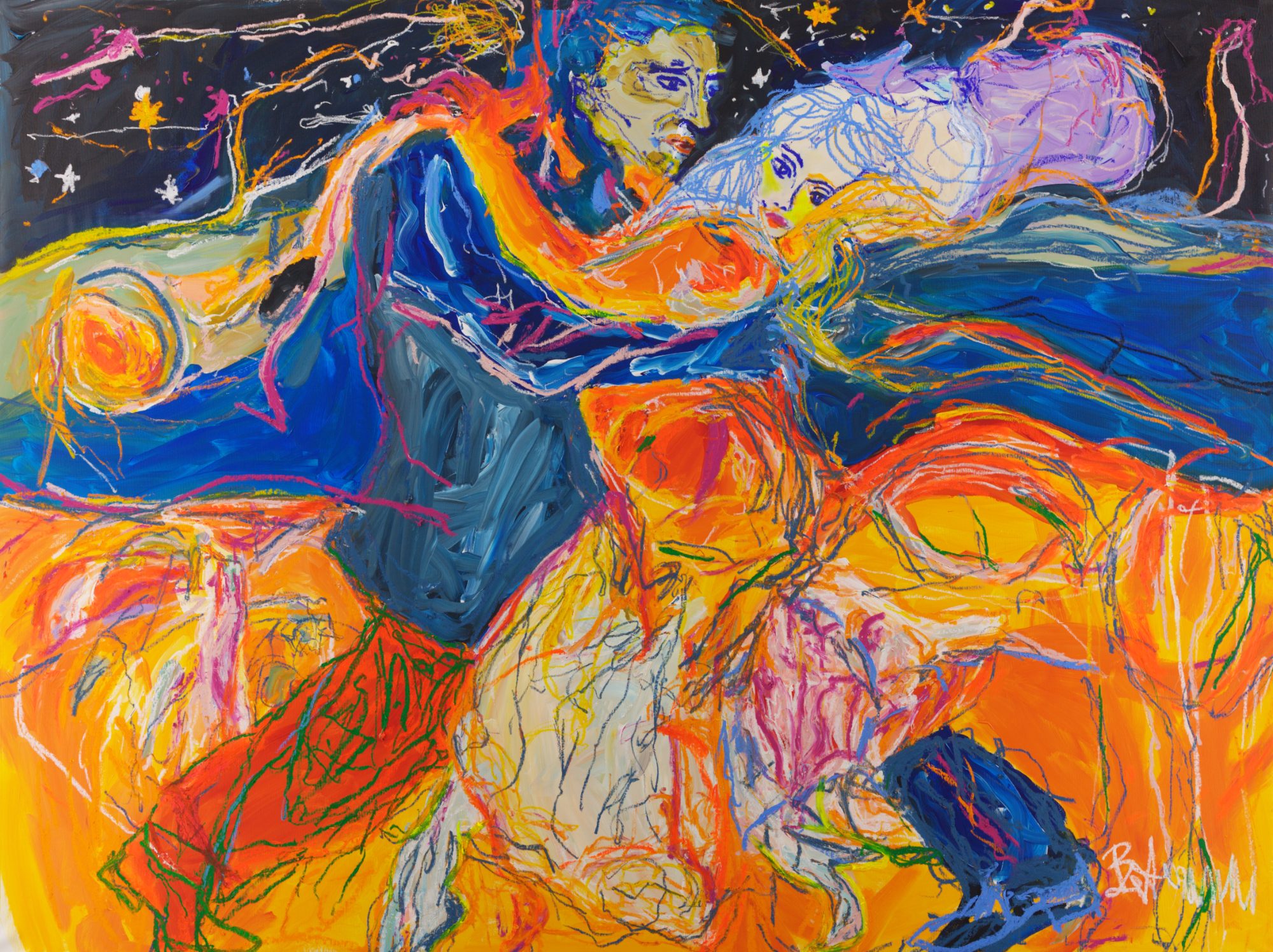
Night has fallen, and the dance floor is still glowing. A man in a dark blue suit holds a woman in a deep dip.
She leans back so far that her hair streams up into the starry sky. Her face is calm. His gaze is focused on the turn.
A condition, not a story
Orbit shows no ballroom, no audience and no music, and yet you can almost hear it. It shows one moment of a dance: the second in which she lets herself fall completely, because she knows he will hold her.
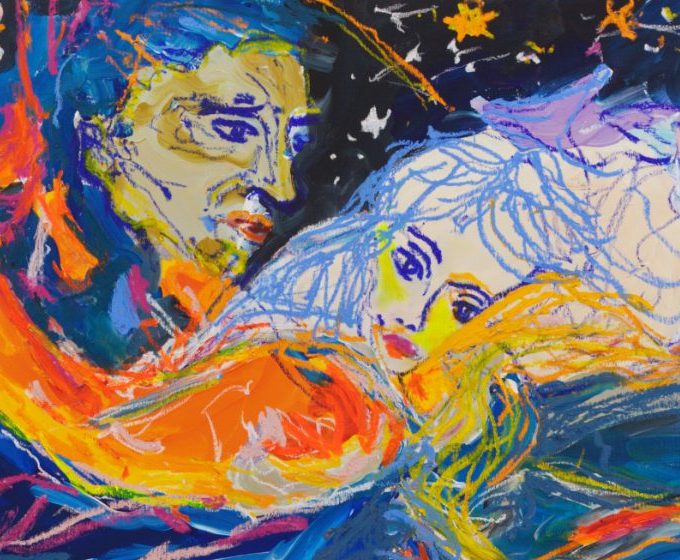
Their own solar system
In this moment the two of them are their own solar system. He is the centre, she circles around him, and everything else moves with them: lines of orange, gold and pink swirl around the couple like sparks.
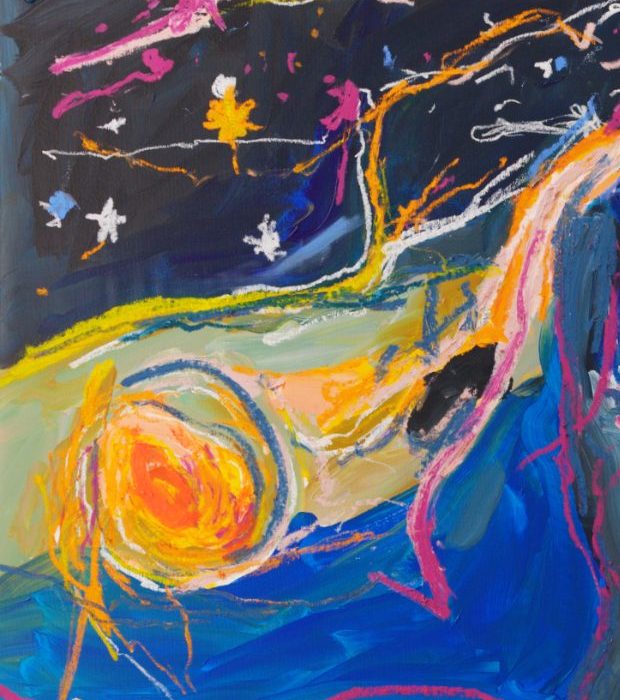
Even the sun has joined the dance. On the left a glowing orange disc hangs low, while the stars shine above. Night above, fire below, and two people in orbit around each other.
Her hair becomes the sky
Her hair is painted in the same blue and lilac as the night. She seems to become part of it, as if the dance has lifted her into the stars.
Freedom below, precision above
The picture is built in two separate moves. First the ground: the dark night sky, the band of deep blue, the man's suit and the blazing field of orange, yellow and red, laid in with coarse, broad brushstrokes that settle nothing precisely. Then the drawing, on top of that ground: the faces, the flowing hair, the stars, the circle of the sun and the loose lines that trace her dress and the movement of their legs. The line never sinks into the paint; it stays on top. Like every figurative work in this series, the image is built forward, never scraped back — the exact inversion of the abstract series, where surfaces are built over months and cut back into.
An architect's scale
At 150 × 200 cm the dancers are close to life size, and the diagonal of the dip runs across the whole canvas. Bertermann, who holds a Master's degree in Architecture, uses that scale to pull the viewer onto the dance floor: you do not watch the turn from a distance, you stand right next to it.
Made by a real person — not AI
Like every work in the studio, Orbit is an original, one-of-a-kind painting, made by hand by a real person, not AI. The sweeping strokes, the running colour, the lines drawn at the speed of the dance — all of it is intentional, and all of it is the record of a human hand working fast in front of a canvas two metres wide.
Orbit, 2026. Acrylic and oil stick on canvas, 150 × 200 cm (height × width). Signed on the front and the back. Part of the figurative works.
This painting belongs to Claus Bertermann’s 2026 figurative series — large-format works in acrylic and oil stick in which the drawn layer always lies on top of the paint, never in it.