Ricochet (2026): Every Look Lands Somewhere New
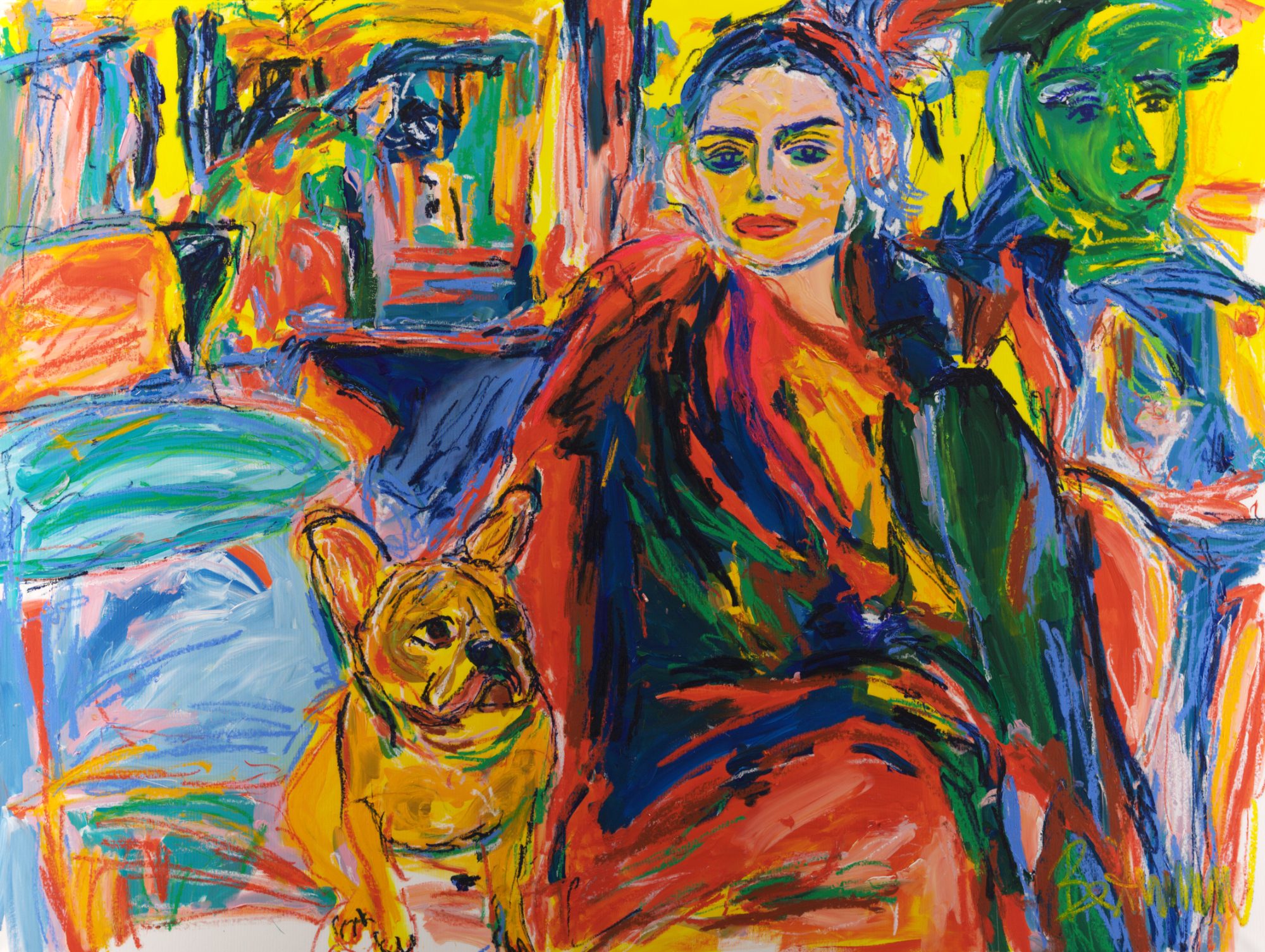
A woman sits at the centre of a bright room, wrapped in a coat of red, green and midnight blue. She looks straight at you.
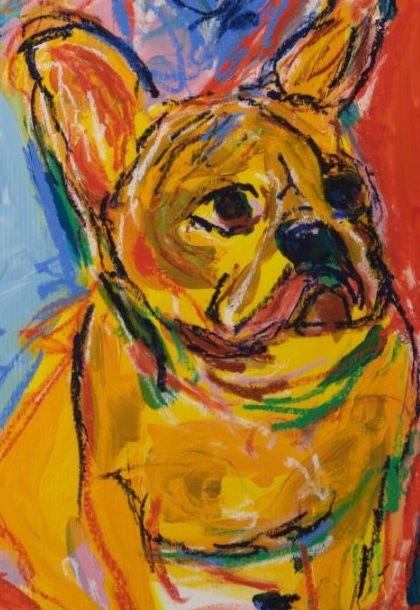
At her feet, a golden French bulldog has eyes only for her. Behind her shoulder, a man with a green face leans into the picture, his gaze heading your way.
A condition, not a story
Ricochet does not tell you who these three are, or what happened before. It shows a moment of attention: three figures in one room, and the looks that pass between them.
A stone skipping across water
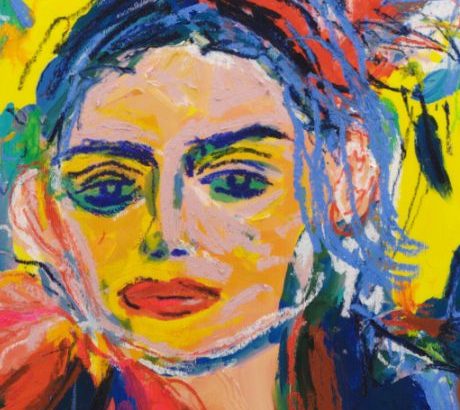
Follow the looks and they keep moving. The dog looks up at her, she looks at you, and the man looks almost at you, just past your shoulder. Attention travels through the painting like a stone skipping across water: a ricochet, from glance to glance, each one landing somewhere new.
You complete the picture
The last look lands on whoever stands in front of the canvas. You are not only watching this scene, you complete it. And the man’s glance is still on its way — which is why the painting starts over every time you look again.
Freedom below, precision above
The picture is built in two separate moves. First the ground: the yellow wall, the turquoise and blue furniture, the red and green masses of the coat and the blue around the man, laid in with coarse, broad brushstrokes that settle nothing precisely. Then the drawing, on top of that ground: the woman’s eyes and lips, the strands of her hair, the outline of the French bulldog and the features in the man’s green face. The line never sinks into the paint; it stays on top. Like every figurative work in this series, the image is built forward, never scraped back — the exact inversion of the abstract series, where surfaces are built over months and cut back into.
An architect’s scale
At 150 × 200 cm the three figures are close to life size. Bertermann, who holds a Master’s degree in Architecture, uses that scale so that the woman’s look reaches you across the room — and the man’s glance only just misses you.
Made by a real person — not AI
Like every work in the studio, Ricochet is an original, one-of-a-kind painting, made by hand by a real person, not AI. The loose coat, the running colour, the three faces drawn in a few sure strokes — all of it is intentional, and all of it is the record of a human hand working fast in front of a canvas two metres wide.
Ricochet, 2026. Acrylic and oil stick on canvas, 150 × 200 cm (height × width). Signed on the front and the back. Part of the figurative works.
→ View Ricochet in the gallery
This painting belongs to Claus Bertermann’s 2026 figurative series — large-format works in acrylic and oil stick in which the drawn layer always lies on top of the paint, never in it.