Roma 1 (2026) — Three Seconds of a Roman Morning
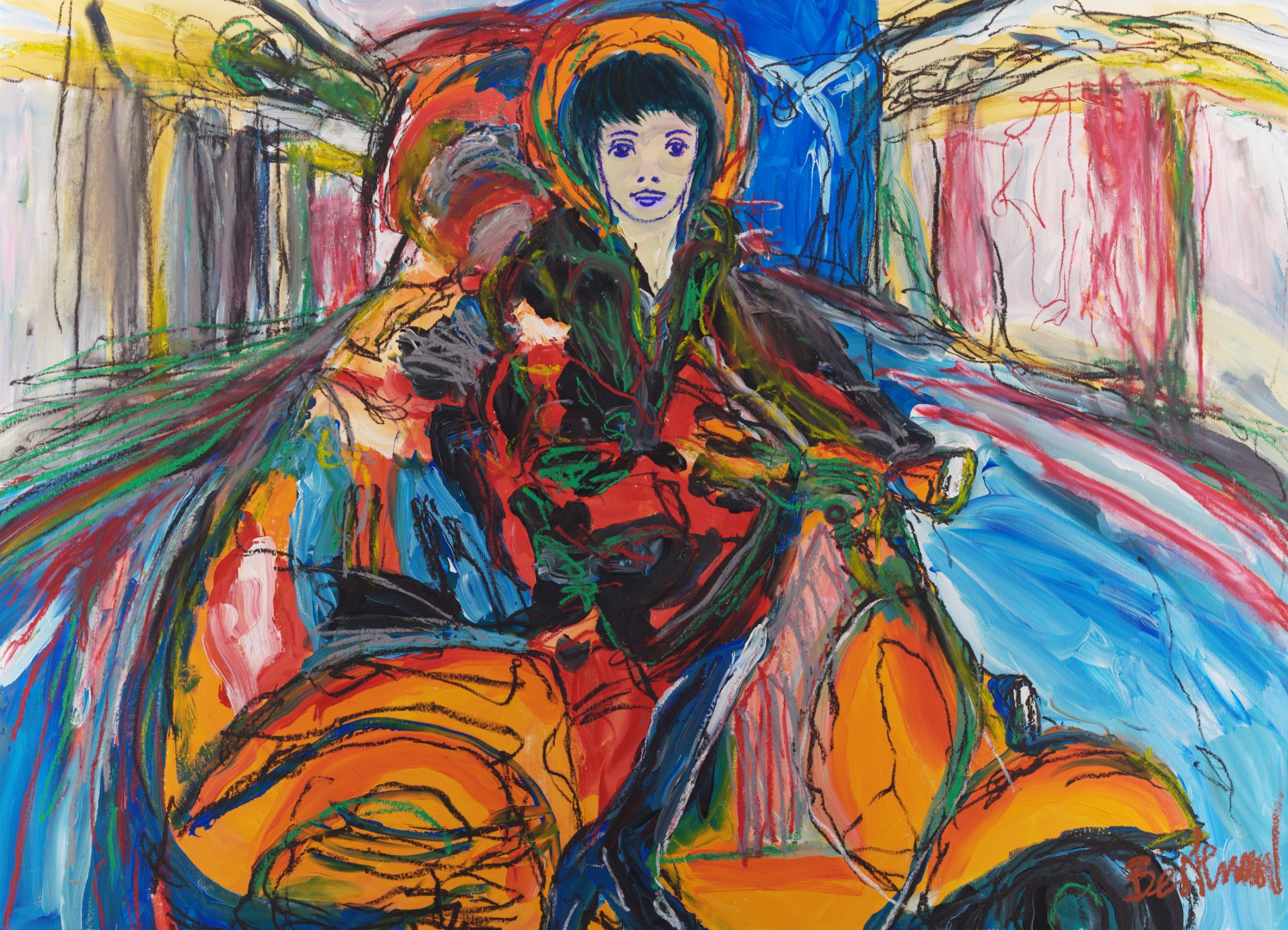
Rome does not hold still for anybody. The city is experienced almost entirely in passing — a face at a window, a waiter turning away, someone crossing the Lungotevere against the light. You get three seconds. Then the traffic closes and the moment belongs to the street again.
Roma 1 is a painting made out of one of those three seconds, and it is composed as an act of refusal: she is not allowed to pass.
A condition, not a story
The scooter comes head-on, orange and enormous, filling the lower half of the canvas and pushed so far forward that the front wheel has already left the picture. The rider is caught in the instant she notices the person watching her. Her hands stay on the bars. Her shoulders are still travelling. Only the face has stopped — turned squarely out of the painting, calm, unhurried, entirely unbothered — and it holds there while everything else keeps moving.
The face that has been looked at for two thousand years
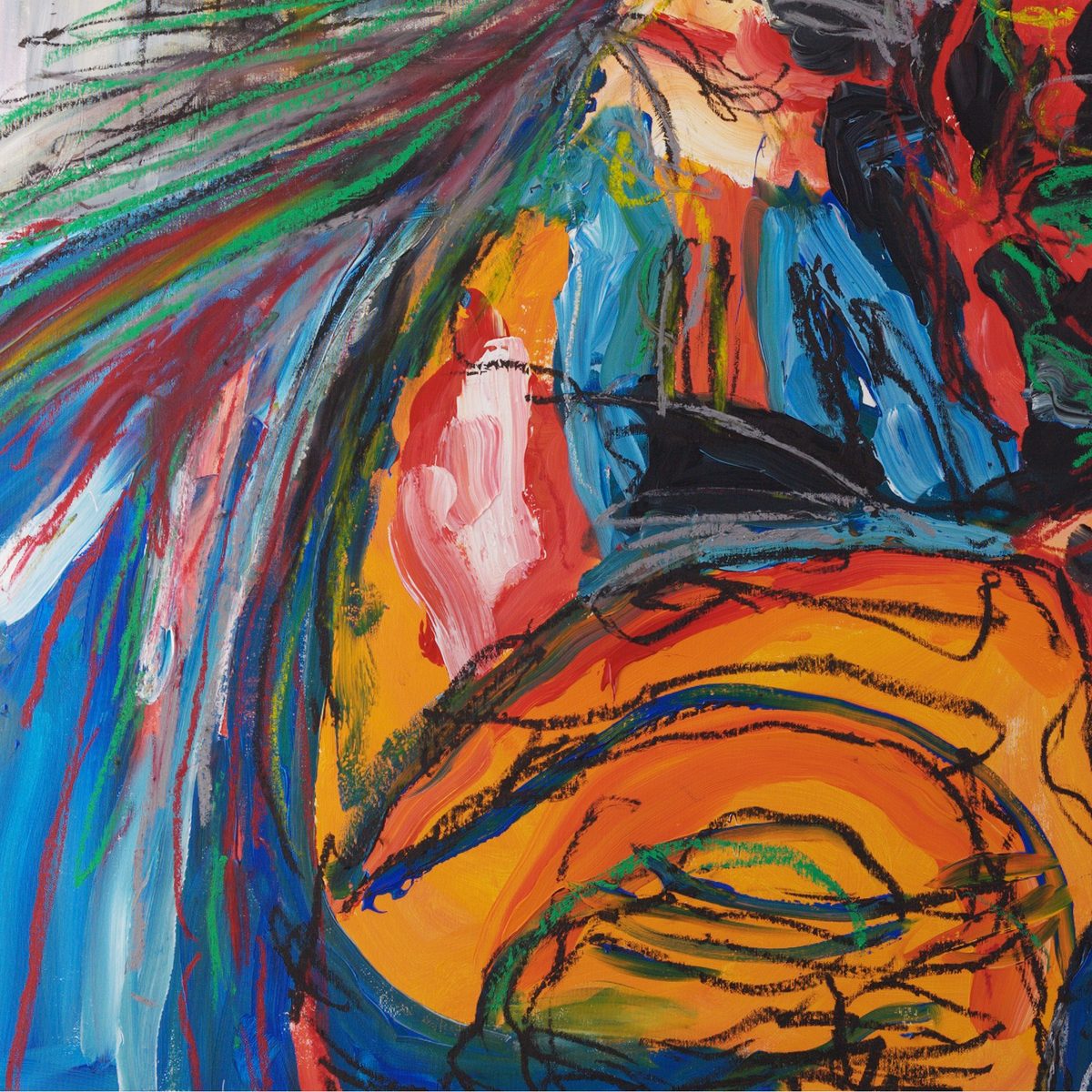
That is the joke of the composition and its whole emotional charge. The speed is real: the façades on the left have dissolved into vertical streaks, the air behind her shoulders is torn into ribbons of green, red and blue, the black oil-stick line skids across the bodywork like a slipped brake. And in the middle of it, one perfectly still face, looking back. Every Roman knows this expression. It is the look of someone who has been watched by tourists for two thousand years and has long since decided how much of it to return.
There is no drama here, no narrative, nothing to resolve. Just a woman on a scooter on an ordinary morning, going somewhere that has nothing to do with us, briefly and generously visible. The painting keeps her in the frame for as long as the wall stands — which is, in the end, the one thing painting can do that a city cannot.
Coarse ground first, the oil stick on top
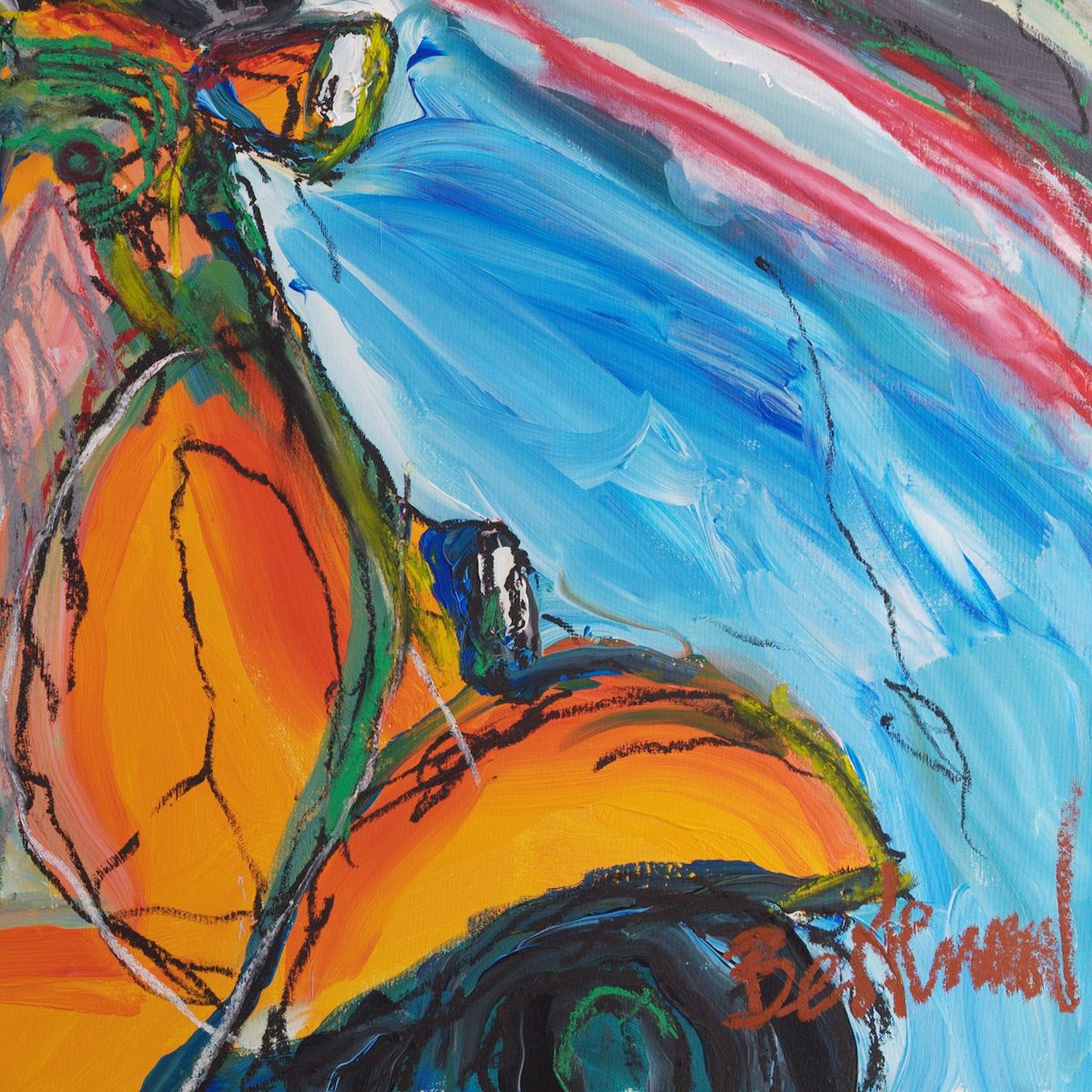
Like the other works of the 2026 series, the picture is built in two separate moves. The ground comes first, in coarse, broad brushstrokes that settle nothing precisely — façades, road, jacket and the restless background. The reference points are the German Expressionists: bent perspective, heightened colour, a surface that keeps moving.
Only then does the oil stick arrive, laid on top of that painted ground and carrying the whole drawn layer: the heavy black contour describing the scooter body and headlamp, the scribbled window grids in the buildings, the drawn folds of the jacket, the signature in red at the lower right. Freedom below, precision above, and no scraping back — the image is built forward, like every figurative work in this series.
The series goes out into the street
The 2026 series began with village scenes and landscapes, then moved indoors into portraiture. The two Roman canvases take it out onto the road. Roma 1 is the daylight half of a pair; Roma 2 is the same city after dark, built on headlamp and lamplight instead of morning sun. Each stands entirely on its own, and together they hold the two halves of one Roman day. Collectors who know the abstract series will recognise the architect's instinct for structure underneath the speed — the scooter's mass anchoring the lower third, the vertical bands of façade holding both edges, the cobalt field placed exactly behind the head.
Made by a real person — not AI
Like every work in the studio, Roma 1 is an original, one-of-a-kind painting, made by hand by a real person, not AI. The coarse brushwork, the skidding drawn line, the ribbons of wind — all of it is intentional, and all of it is the record of a human body working fast in front of a canvas nearly two metres wide.
Roma 1, 2026. Acrylic and oil stick on canvas, 130 × 180 cm (height × width). Signed on the front and the back. Part of the figurative works.
This painting belongs to Claus Bertermann’s 2026 figurative series — large-format works in acrylic and oil stick in which the drawn layer always lies on top of the paint, never in it.