Sidekick (2026)
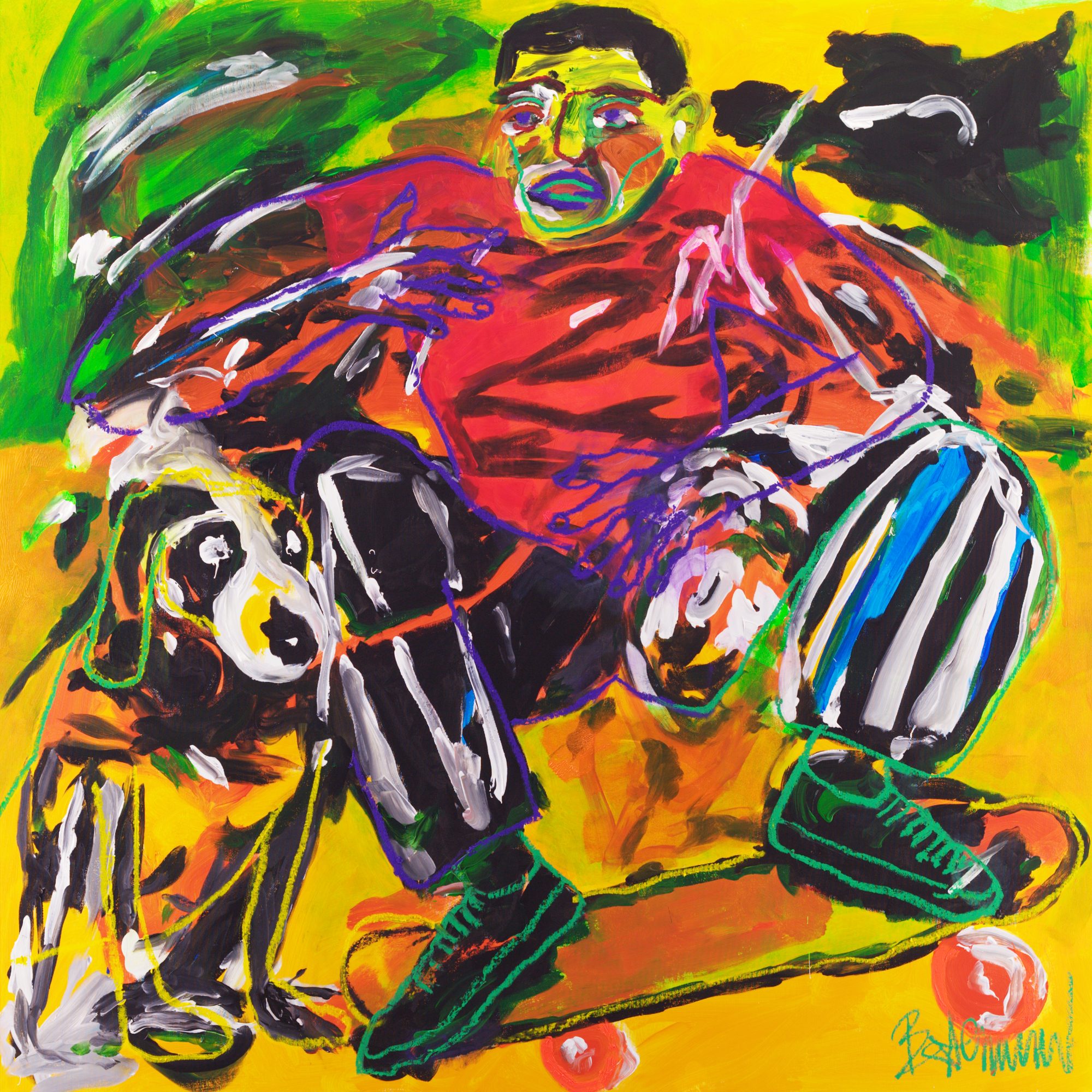
A man sits on a skateboard. He is not riding it — he is sitting on it, knees wide, arms hanging, filling the whole canvas in a shirt the colour of a stop sign. Beside him, held by a thin yellow line, is his dog. Watch where the two of them are looking, because that is the entire painting.
A condition, not a narrative
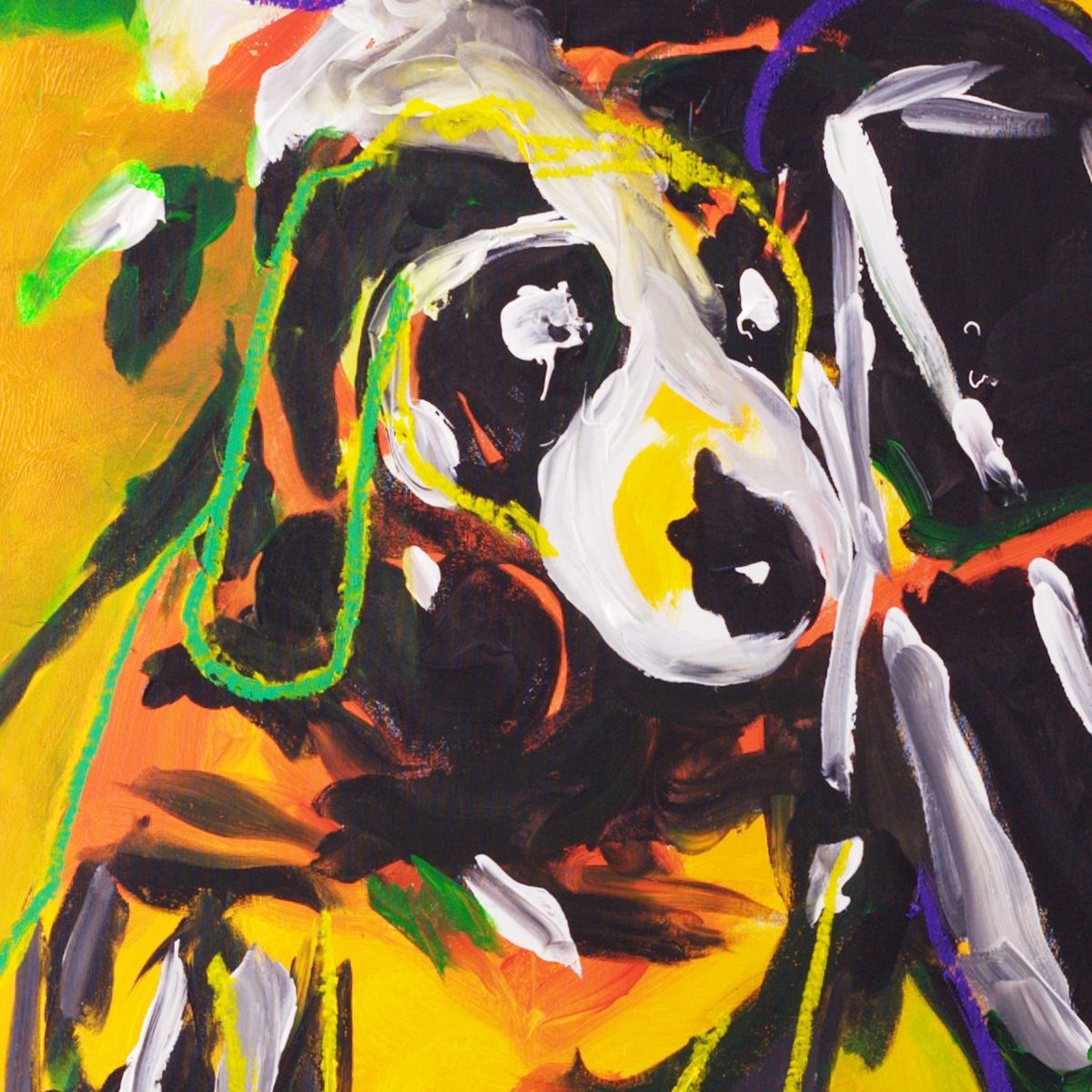
The dog is looking up. Straight up, at the man, with the kind of total attention that dogs give and humans almost never earn. The man is looking out — past the dog, past the board, past you, with the expression of someone waiting to be photographed for something he has not yet done. Nothing happens in the picture. Everything about the relationship is already decided.
Who is whose sidekick
By title, obviously the dog. That is the arrangement, and it is how the story has been told since the first hunter shared the first fire: the human is the protagonist, the animal is the loyal companion. But every hero needs a sidekick for one unflattering reason — alone, the hero would be unbearable. And nobody ever explained the casting to the dog. He simply decided this man was worth looking at, and has been doing it ever since, without conditions.
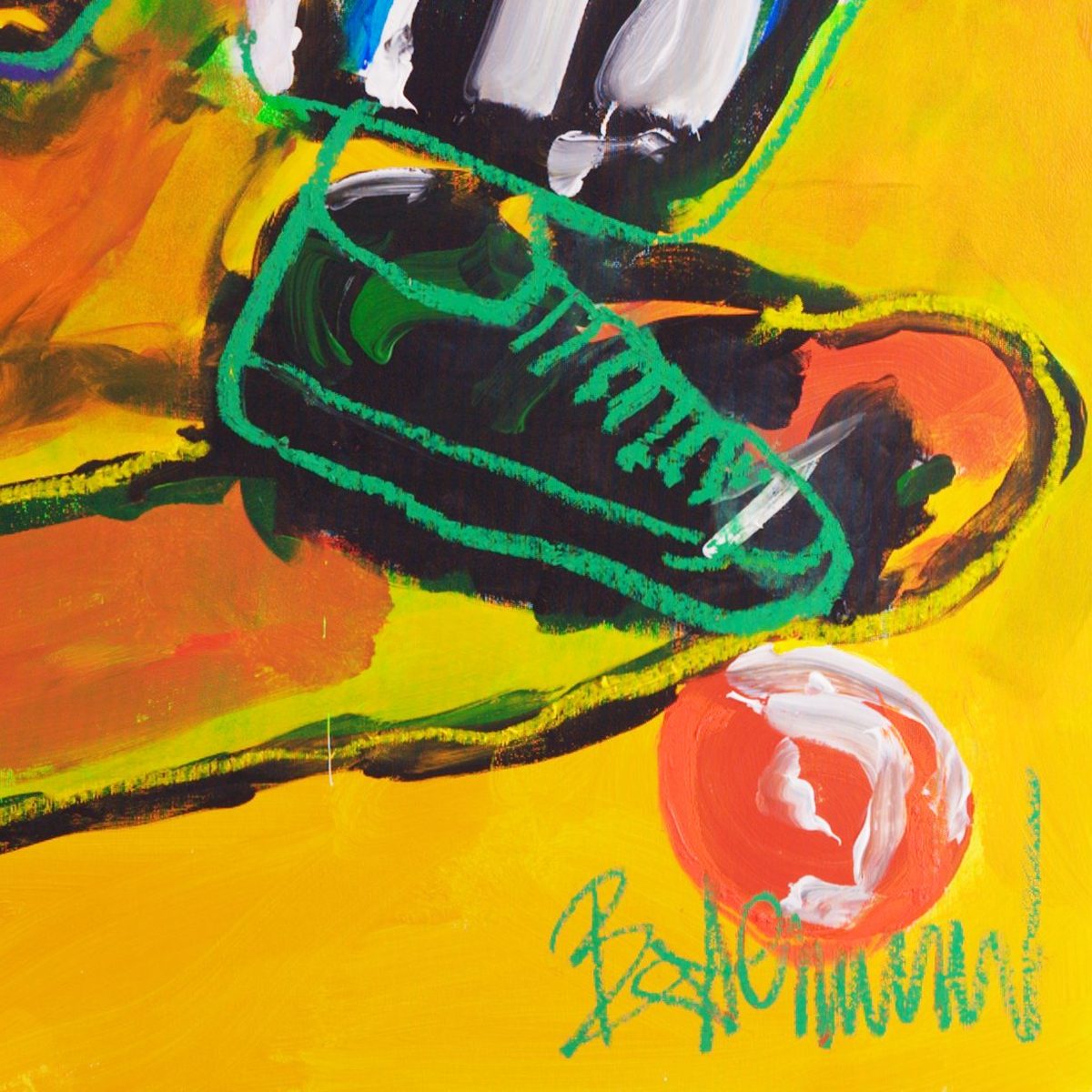
Meanwhile the man is on a board he is not using. In skateboarding, the kick is the push — the moment your foot leaves the ground and something actually happens. Here nothing is kicked. The two orange wheels sit dead still at the bottom edge. The only kick in the painting is the side one: the creature at the edge of the frame who never asked to be at the edge of anything. The dog has a hero. The man has an audience. One of those is a relationship.
Painted fast, drawn in oil stick
Sidekick belongs to Bertermann's figurative method, the reverse of his abstract discipline. Broad fields of acrylic go down fast and loose — chrome yellow, flame red, acid green, black — and the surface keeps the momentum of the arm that put it there.
The figure, the dog, the lead and the sneakers are then drawn straight over that ground in oil stick. The contour lines stay independent of the paint underneath; they sit on top of it and cut through the colour rather than follow it. That separation is why a lead made of nothing but a yellow chalk line still reads as something taut between two bodies.
Built forward, not scraped back
Collectors who know the abstract series will feel the difference at once. In the abstracts, layers are applied and scraped back — the image arrives by removal, like sediment. Sidekick is built the opposite way: forward only. Coarse acrylic first, decisive oil-stick contour on top, and the anatomy pushed past realism so that the man comes out heavy and monumental while the dog stays small and entirely present. The distortion is the point: it is a picture about who takes up room and who actually shows up.
Made by a real person — not AI
Like every work in the studio, Sidekick is an original, one-of-a-kind painting, made by hand by a real person, not AI. The breaks in the oil-stick line, the collisions of wet colour, the small irregularities of the surface — all of it is intentional, and all of it is the record of a human body moving in front of a canvas over a metre and a half square.
Sidekick, 2026. Acrylic and oil stick on canvas, 160 × 160 cm (height × width). Signed on the front and the back. Part of the figurative works.