So Be It (2026) — A King with the Evidence Removed
Kings are graded posthumously, and the grading is mostly luck. A chronicler survives or he doesn't. An archive burns or it doesn't. Two men can rule with identical competence over identical spans, and four hundred years later one of them is a name every schoolchild recites and the other is a gap in a list.
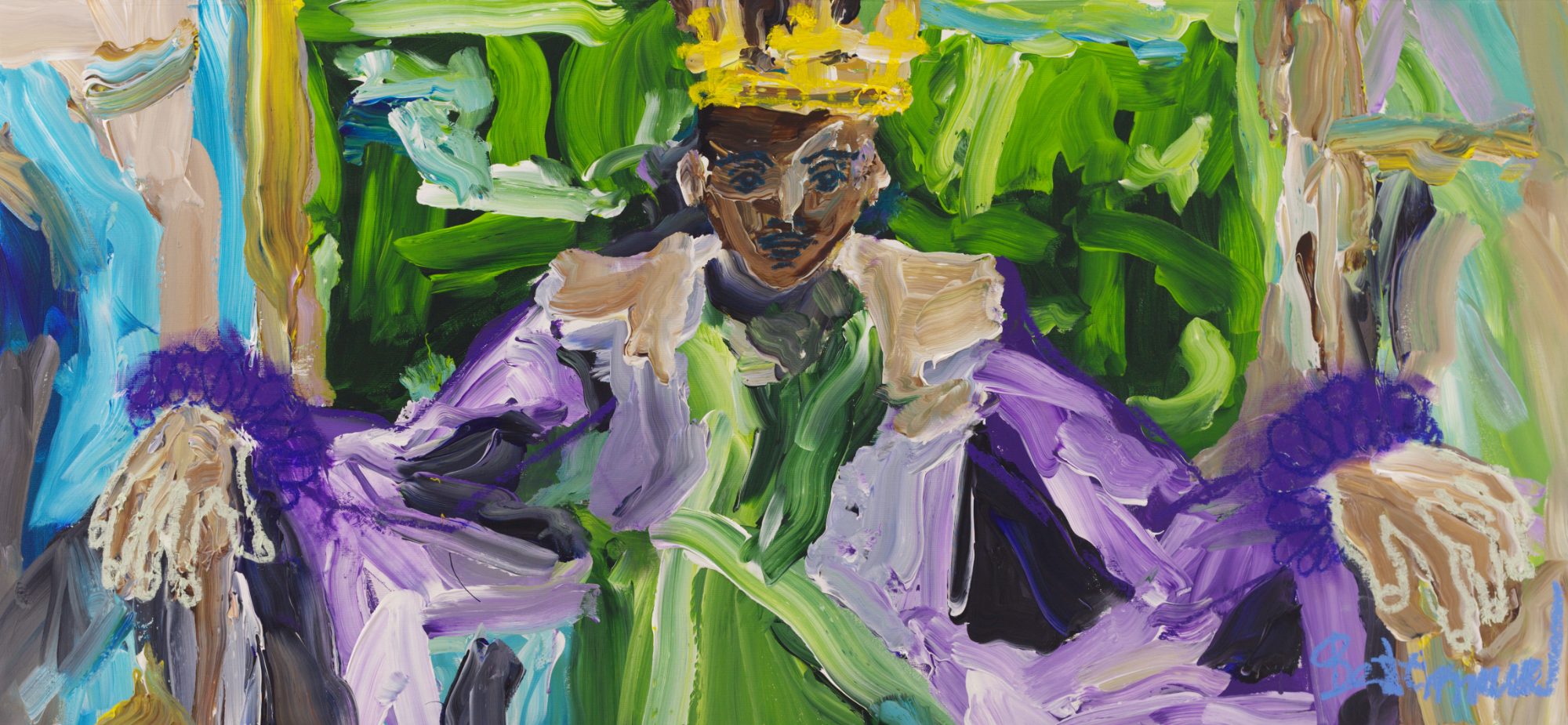
So Be It is a portrait of a king with all the identifying evidence deliberately withheld.
A condition, not a story
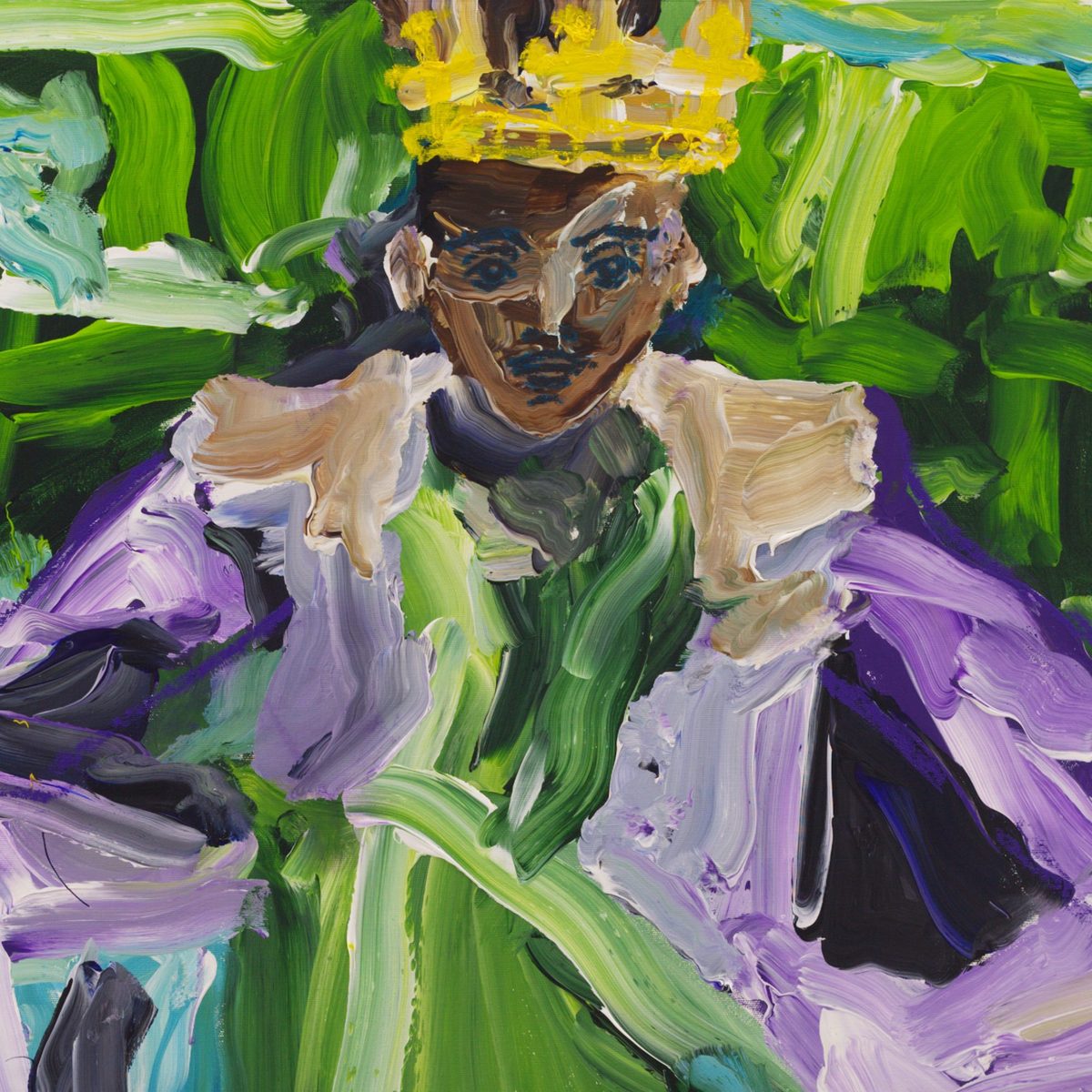
No coat of arms. No date. No hall of state, no territory, no dynasty. Behind him there is not architecture but a wall of green — foliage, a hedge, a garden — and the two pale figures at the edges of the canvas have already begun dissolving back into it. Only the crown is unambiguous: heavy, cadmium yellow, worn straight, laid on so thickly that it catches the light like actual metal.
He could be the monarch of a great power. He could be the king of a village of eleven houses. The portrait is identical either way, and that is the entire point of it.
The format is the argument
State portraits are vertical by rule. The sitter towers, the frame lifts him, the viewer looks up. This canvas is 60 by 130 centimetres — wider than it is tall, a letterbox. Nobody looks up at him. He is handed across at eye level, in the proportions normally reserved for landscape.
And he does not appear to mind in the slightest. Hands laid open on the arms of his seat, shoulders squared, expression level and faintly amused. So be it is what you say once you have stopped arguing with the verdict. He has stopped. The anxiety about his rank belongs entirely to whoever is standing in front of the painting.
Coarse ground first, the oil stick on top
Like the other works of the 2026 series, the picture is built in two separate moves. The ground comes first, in coarse, broad brushstrokes that settle nothing precisely — the green ground, the lilac mantle, the dark green tunic. This is among the most physical canvases of the group: the brush marks stand as ridges on the surface, left exactly where they fell.
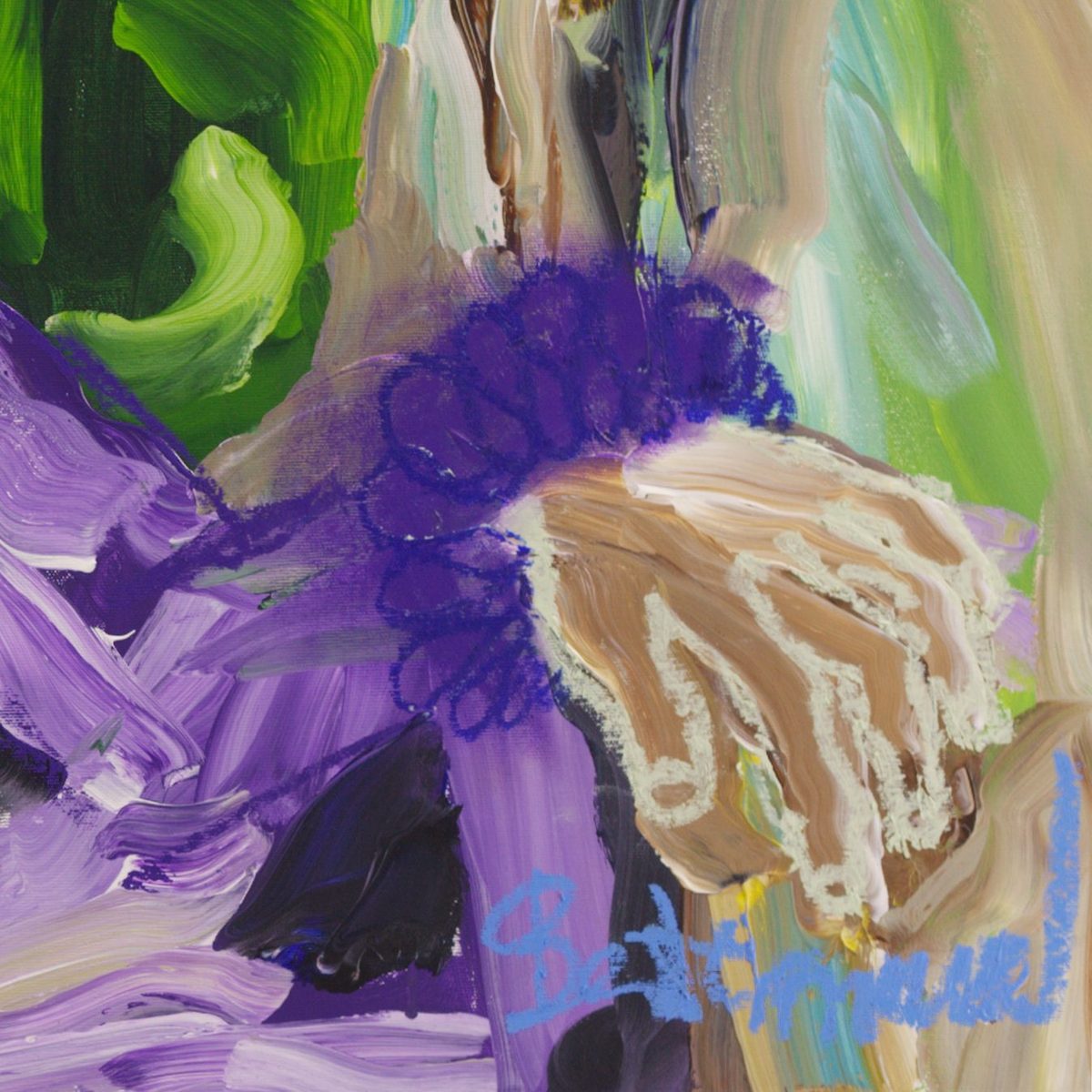
Over that field the oil stick carries the whole drawn layer: the dense violet loops that read as ermine at both cuffs, the white lines describing the fingers, the blue signature at the lower right. Freedom below, precision above, and no scraping back — the image is built forward, like every figurative work in this series.
Regalia without documentation
The seated ruler is one of the oldest formats in European painting, and it existed to remove doubt: rank, dynasty and claim spelled out in regalia, drapery, architecture and heraldry so that nobody looking could get it wrong. Expressionism inherited that vocabulary and turned it against itself, painting authority in colours that undermined its composure.
So Be It removes the evidence instead of contradicting it. Crown, mantle and ermine remain; the paperwork is gone. What is left is a man in a garden wearing the one object that makes the claim, entirely at ease with the fact that the claim can no longer be checked. Collectors who know the abstract series will recognise the structural instinct underneath: frontal symmetry, the crown holding the vertical axis, the mantle opening to both edges like a pediment.
Made by a real person — not AI
Like every work in the studio, So Be It is an original, one-of-a-kind painting, made by hand by a real person, not AI. The standing ridges of paint, the looped violet ermine, the fingers drawn proud of the painted surface — all of it is intentional, and all of it is the record of a human body working fast.
So Be It, 2026. Acrylic and oil stick on canvas, 60 × 130 cm (height × width). Signed on the front and the back. Part of the figurative works.
→ View So Be It in the gallery
This painting belongs to Claus Bertermann’s 2026 figurative series — large-format works in acrylic and oil stick in which the drawn layer always lies on top of the paint, never in it.