Stillness (2026) — The Title Names the Exception
European painting has a five-hundred-year habit of laying women down on furniture. Titian did it, Goya did it, Manet did it, Matisse did it for decades. Almost all of those women are performing rest for somebody standing outside the frame.
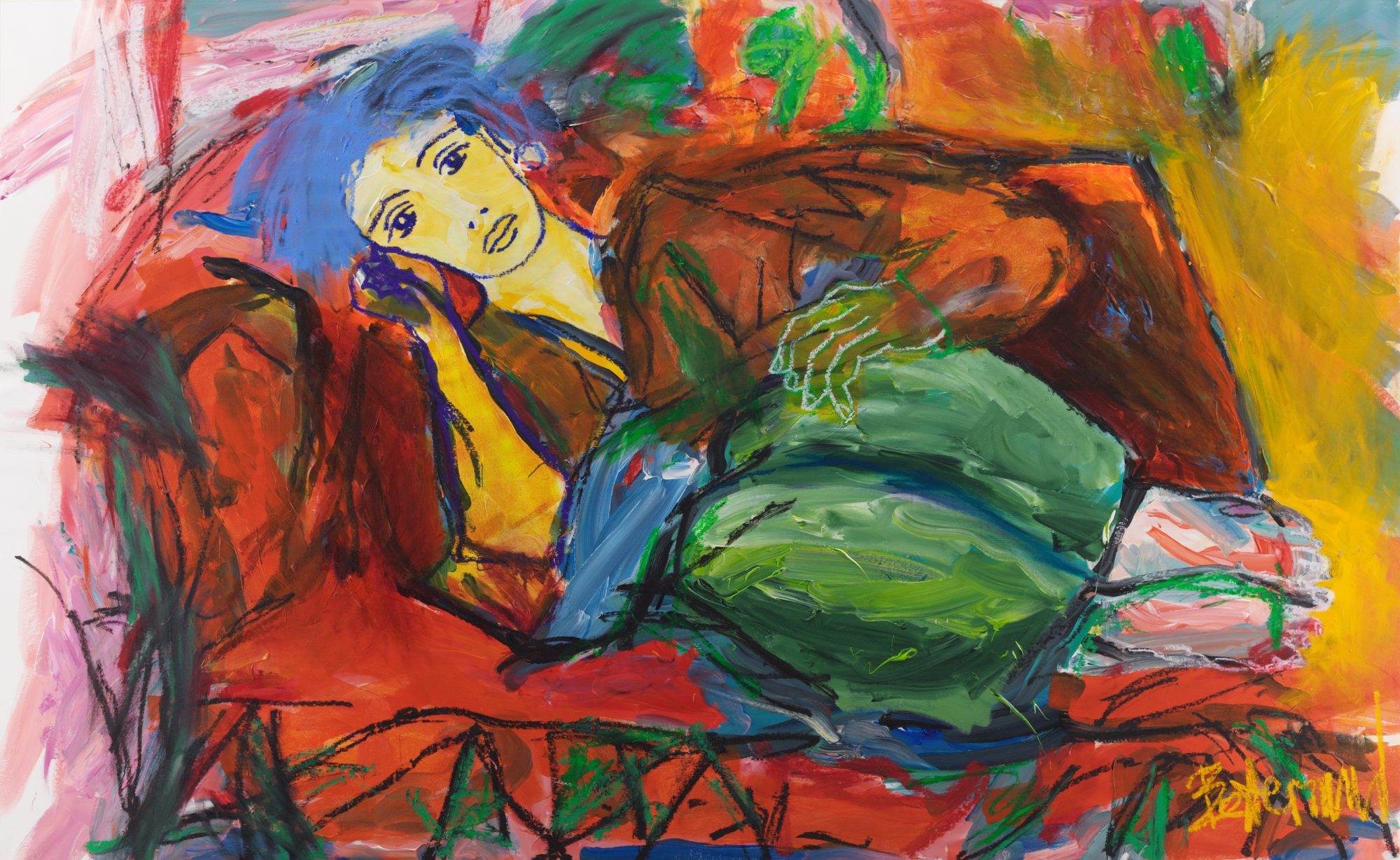
The woman in Stillness is not performing anything. She has lain down on a chaise longue in a room that is obviously hers, and she is not getting up.
A condition, not a story
The twist is in the title, and it takes a moment to catch. Everything in this painting is loud. The chaise burns vermilion. A field of raw cadmium blazes in from the right edge. Black oil stick crackles across the lower third like static. Orange, green and crimson collide behind her without a single quiet passage in between.
The one calm thing in all that noise is the woman. The picture is not still — she is. The title names the exception, not the rule.
The hand is the tell
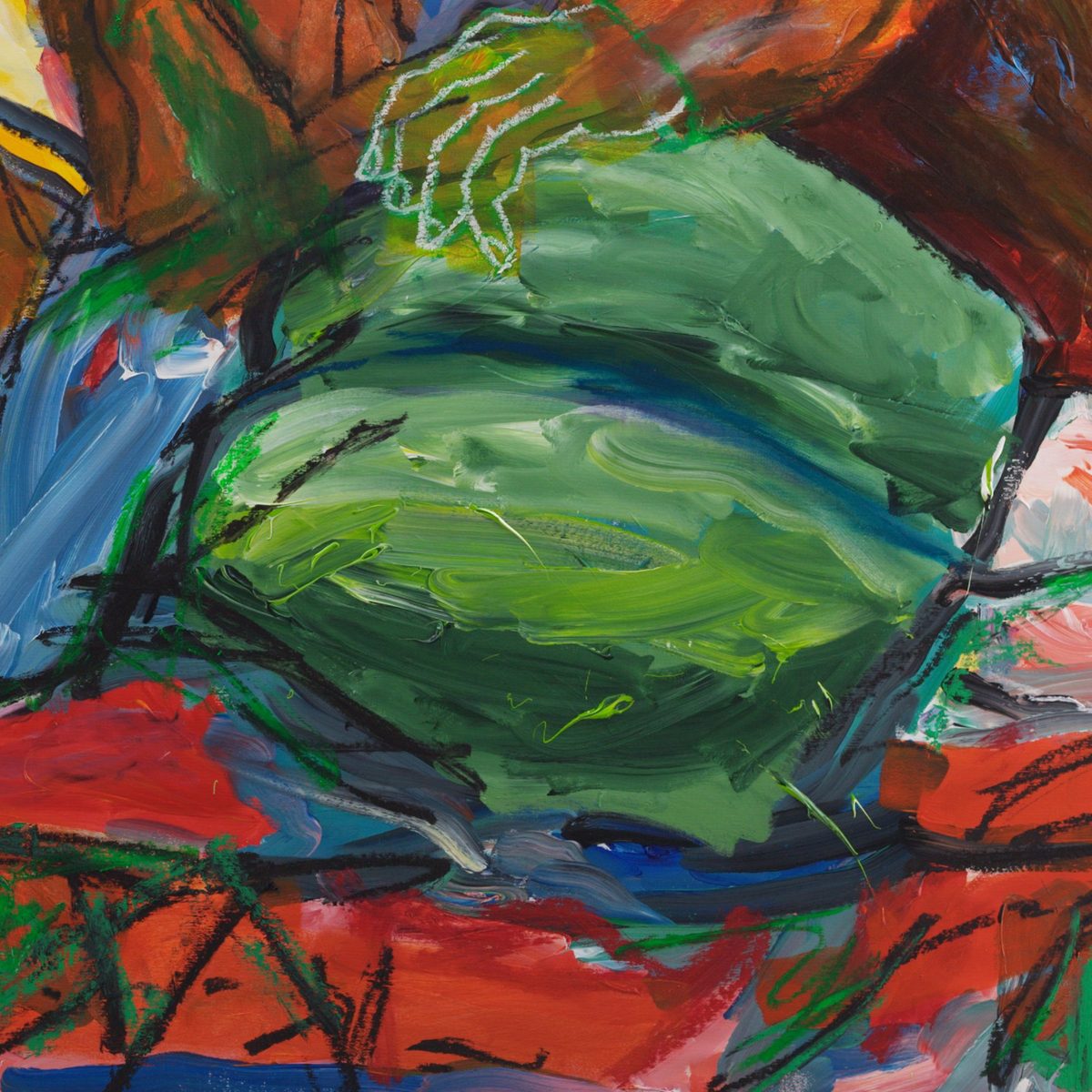
She is awake. Eyes open, level, aimed straight out of the canvas at whoever came in. And her hand is laid flat on the green across her legs, drawn in one continuous white line — the single precise mark in a painting that is otherwise all weather.
Nobody asleep places a hand like that. This is not a woman being looked at. It is a woman who has decided the day is over, and who was the one entitled to decide it.
Coarse ground first, the oil stick on top
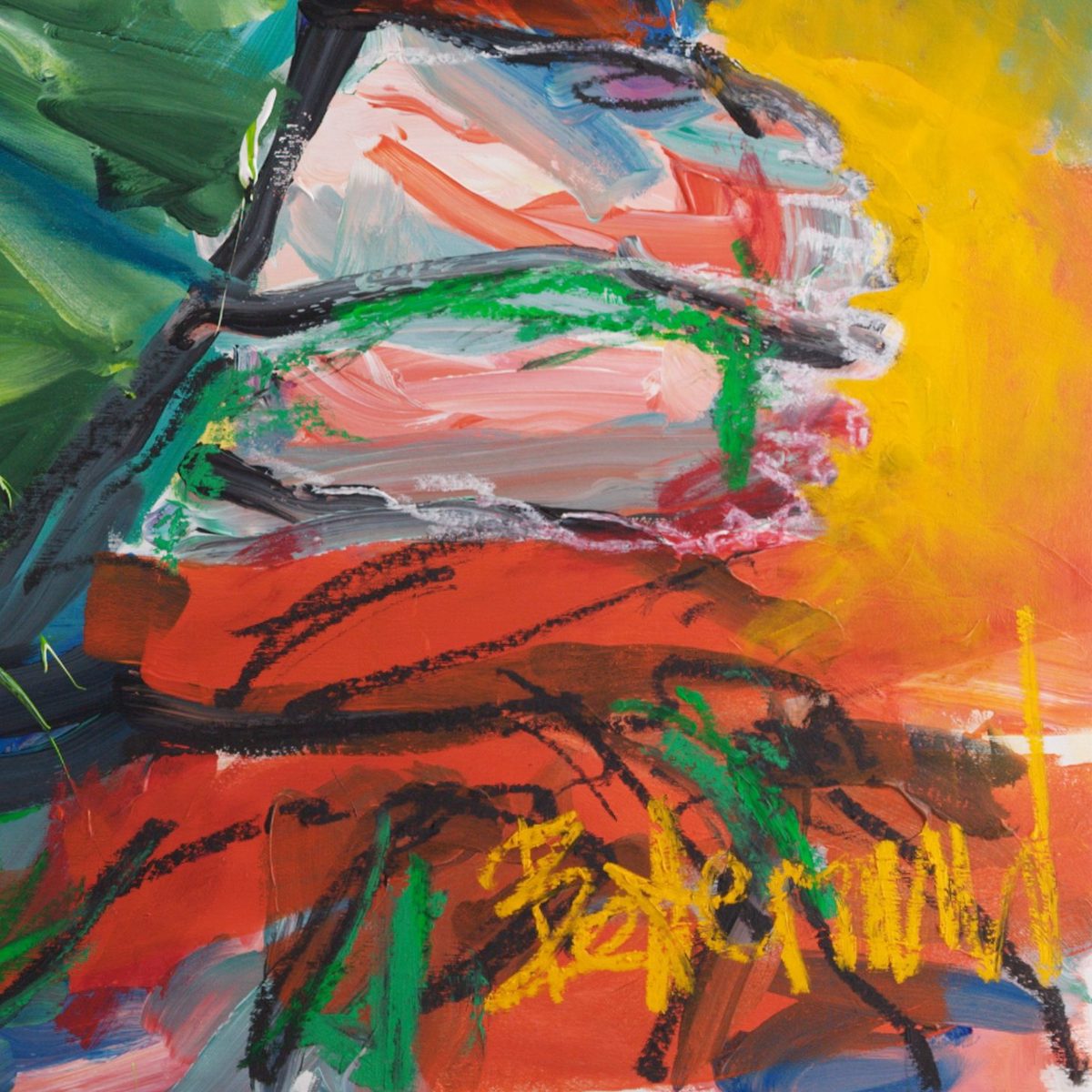
Like the other works of the 2026 series, the picture is built in two separate moves. The ground comes first, in coarse, broad brushstrokes that settle nothing precisely — chaise, wall, the green mass across her legs and the yellow light at the right. The reference points are the German Expressionists: bent perspective, heightened colour, a surface that keeps moving.
Only then does the oil stick arrive, laid on top of that painted ground and carrying the whole drawn layer: the blue-violet contour of the face and eyes, the white line of the hand, the green outlines around the cushions, the black scribbled lattice along the base of the chaise, the yellow signature at the lower right. Freedom below, precision above, and no scraping back — the image is built forward, like every figurative work in this series.
Whose room it is
The Expressionists inherited the reclining figure from the salon tradition and dragged it into the studio, swapping the classical couch for their own worn sofas and blankets. The furniture changed; the arrangement mostly did not. The room still belonged to the painter, and the woman was still a guest in it.
Stillness reverses that occupancy. The chaise, the cushions, the loud red room and the hour of the day are hers, and the painting arrives as the visitor. Collectors who know the abstract series will recognise the compositional problem being solved here: a body carrying the full 200 cm width without a single vertical to lean on, anchored at the centre by the green mass of the skirt.
Made by a real person — not AI
Like every work in the studio, Stillness is an original, one-of-a-kind painting, made by hand by a real person, not AI. The running colours, the scribbled black lattice, the drawn hand sitting proud of the painted surface — all of it is intentional, and all of it is the record of a human body working fast in front of a canvas two metres wide.
Stillness, 2026. Acrylic and oil stick on canvas, 130 × 200 cm (height × width). Signed on the front and the back. Part of the figurative works.
→ View Stillness in the gallery
This painting belongs to Claus Bertermann’s 2026 figurative series — large-format works in acrylic and oil stick in which the drawn layer always lies on top of the paint, never in it.