The Facilitator (2026)
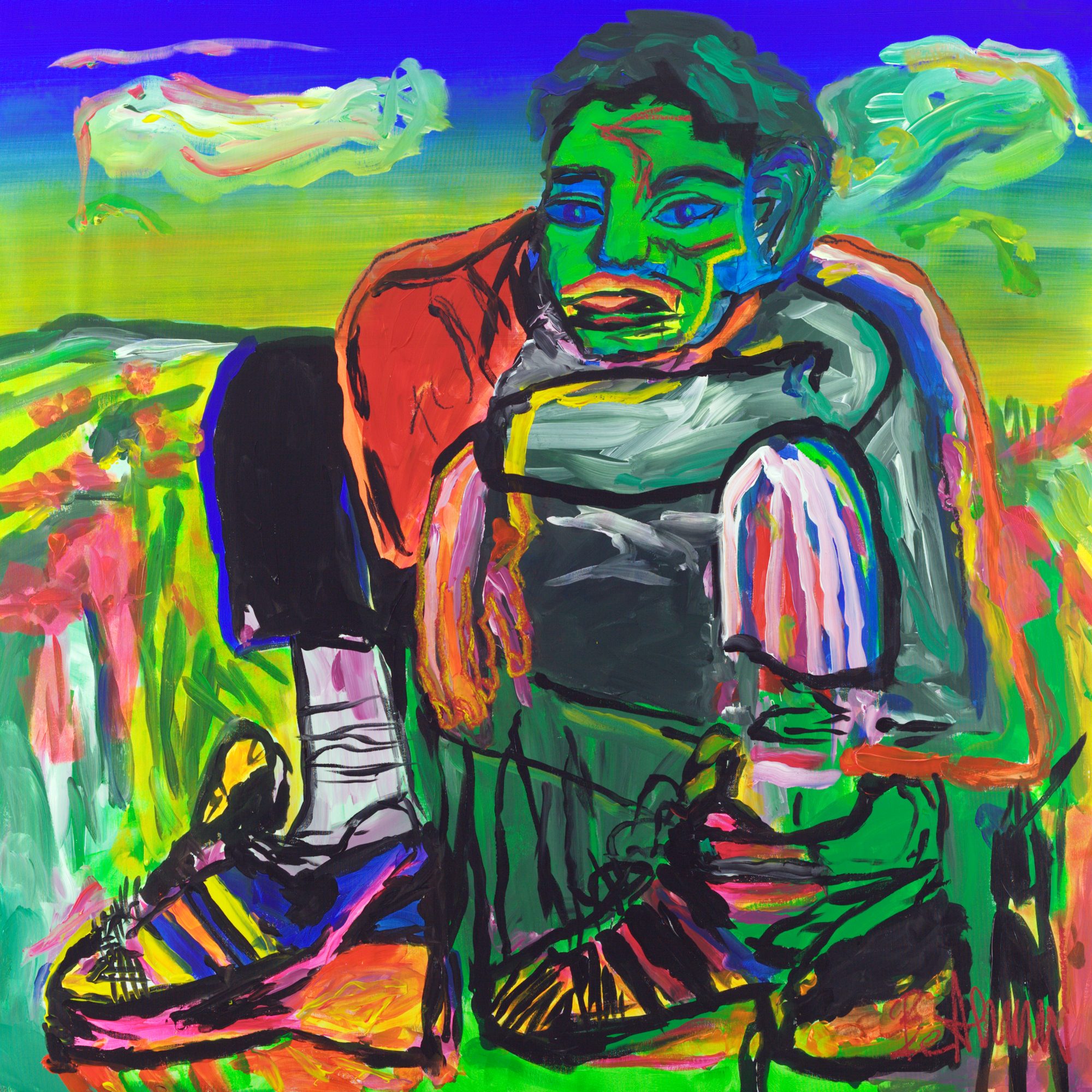
Every group has one. The person who books the table, remembers the birthdays, carries the spare towel, smooths the argument before it becomes one. In this painting he is enormous — a seated man in an open summer landscape, and the landscape barely reaches his shoulders. The clouds pass him at chest height. He is bent over the laces of his sneakers, and that small gesture is the entire picture.
A condition, not a narrative
Nothing happens here. No event, no drama — a man sits in a meadow and ties his shoes. But look at the scale. Bertermann has painted the organiser, the connector, the one everybody calls «just» the facilitator, at the size he actually occupies: take him out of the valley and the valley collapses. The meadows, the flower fields, the rose-coloured fall at the left edge — all of it arranges itself around his body like furniture around the person who owns the room and never sits in the good chair.
Who facilitates the facilitator?
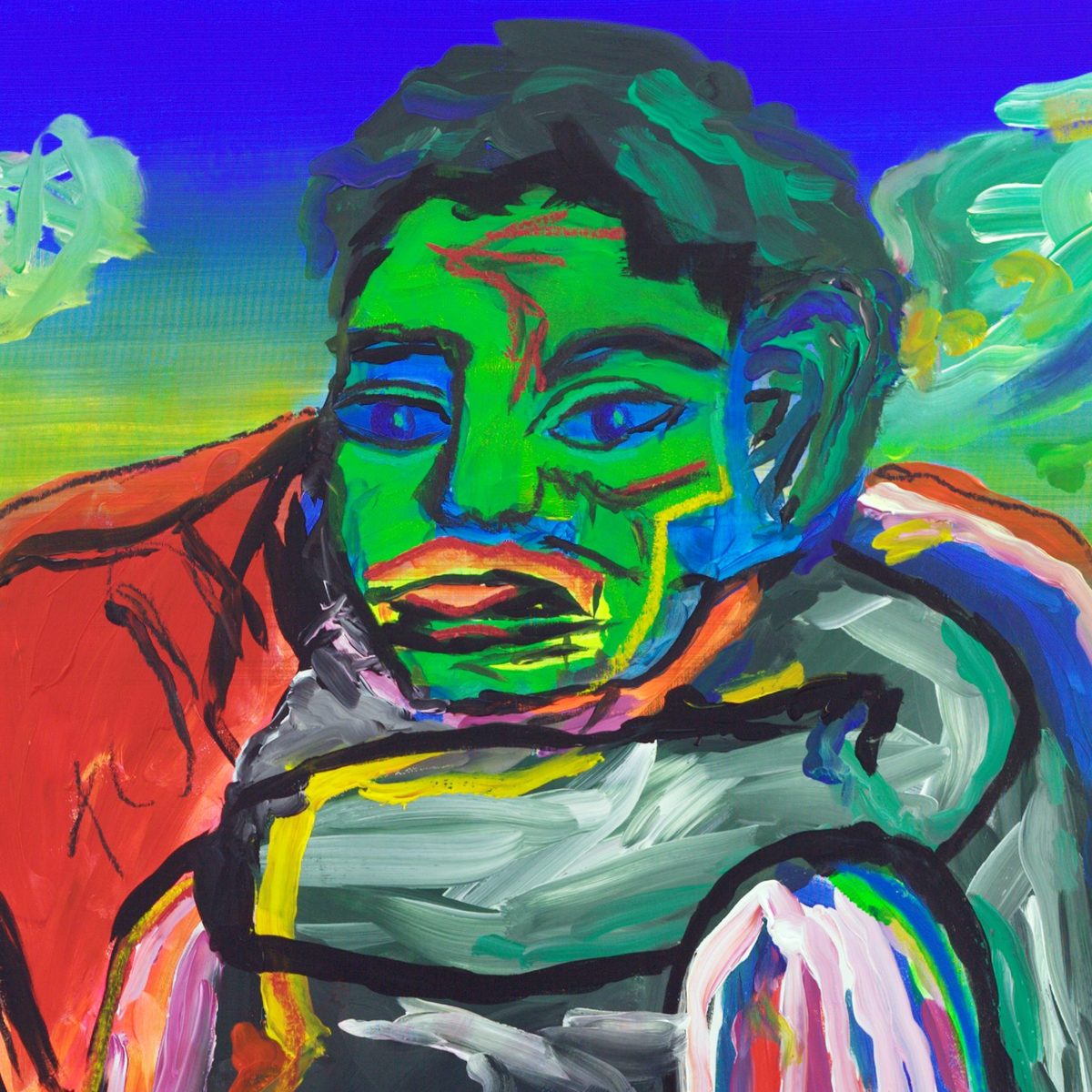
Look at his face. It has gone the exact green of the landscape behind him. That is the occupational condition: spend enough years being the background — making things possible, staying out of the frame, absorbing everyone else's logistics — and the background moves into your skin. The blue shadow down one side of his head is the same ultramarine as the sky. He is camouflaged into the world he maintains. The camouflage fails for one reason only: he is too big to hide.
And now the twist of the picture. He is caught doing the one thing facilitators never get to do — something exclusively for himself. Sitting down. Tying his own shoes. An unscheduled break in a life that runs on everyone else's schedule. One shoe carries its stripes neatly; the other ends in a loose black scribble of laces, not yet knotted. Is he arriving or leaving? The painting refuses to say — because that is the question nobody ever asks the facilitator. They only ever ask whether everything is ready.
Painted fast, drawn in oil stick
The Facilitator belongs to Bertermann's figurative method, the reverse of his abstract discipline. Broad fields of acrylic go down fast and loose — an ultramarine sky graded to chartreuse at the horizon, mint-green clouds streaked with pink, an emerald meadow drifting into fields of flowers — and the surface keeps the momentum of the arm that put it there.
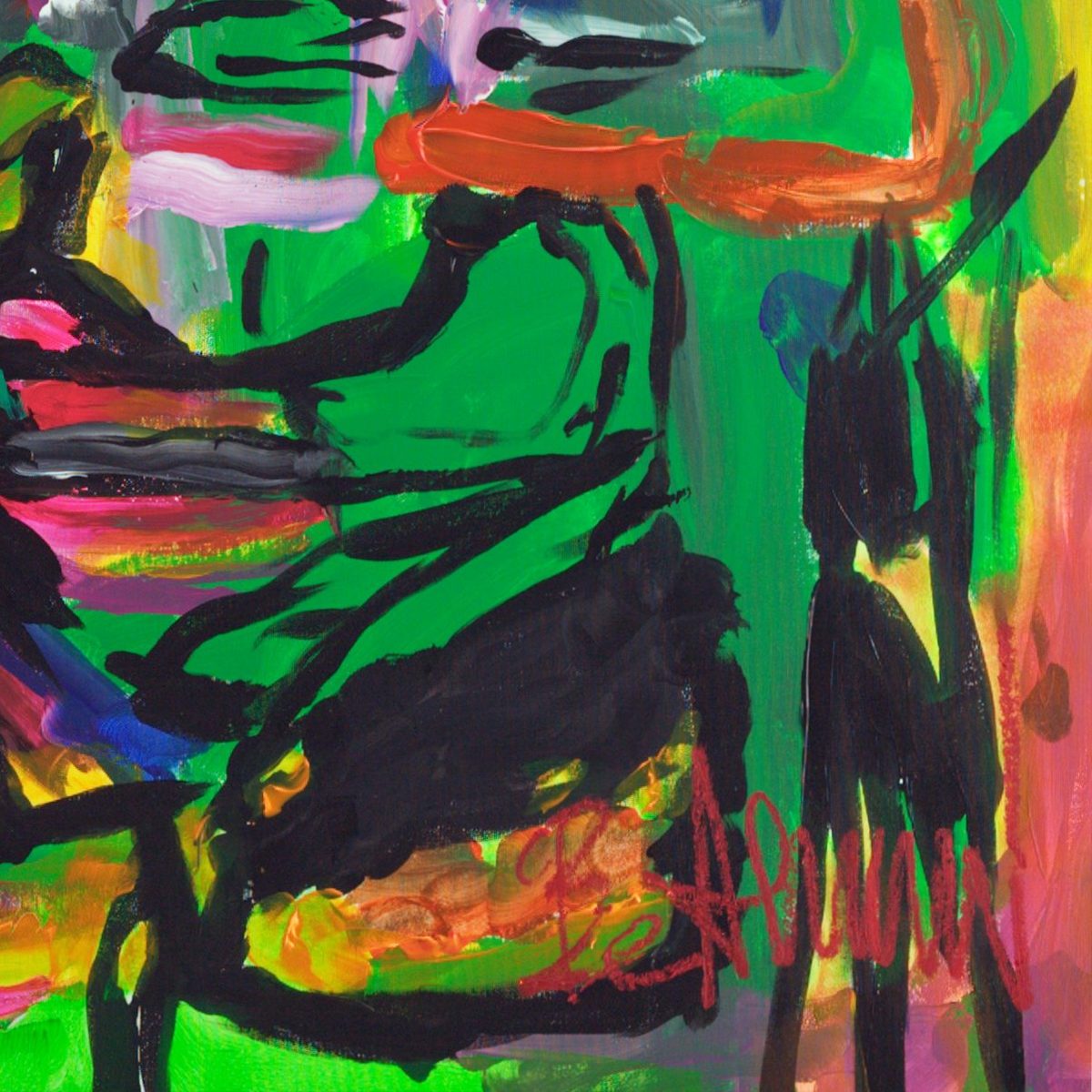
The figure is then drawn straight over that ground in oil stick: the black contour of the crouched body, the red marks on the forehead, the stripes on the sneaker, the scribbled laces. The lines stay independent of the paint underneath; they sit on top of it and cut through the colour rather than follow it. That separation is why a man built from meadow-green and sky-blue still detaches from a landscape made of exactly the same colours.
Built forward, not scraped back
Collectors who know the abstract series will feel the difference at once. In the abstracts, layers are applied and scraped back — the image arrives by removal, like sediment. The Facilitator is built the opposite way: forward only. Coarse acrylic first, decisive oil-stick contour on top, and the scale pushed far past realism so that the helper comes out monumental and the world he holds together stays small. The distortion is the point: it is a picture about who actually carries the scenery.
Made by a real person — not AI
Like every work in the studio, The Facilitator is an original, one-of-a-kind painting, made by hand by a real person, not AI. The breaks in the oil-stick line, the collisions of wet colour, the small irregularities of the surface — all of it is intentional, and all of it is the record of a human body moving in front of a canvas over a metre and a half square.
The Facilitator, 2026. Acrylic and oil stick on canvas, 160 × 160 cm (height × width). Signed on the front and the back. Part of the figurative works.