As de Oros (2026) — She Stepped Out of the Coin. The Gold Followed Her
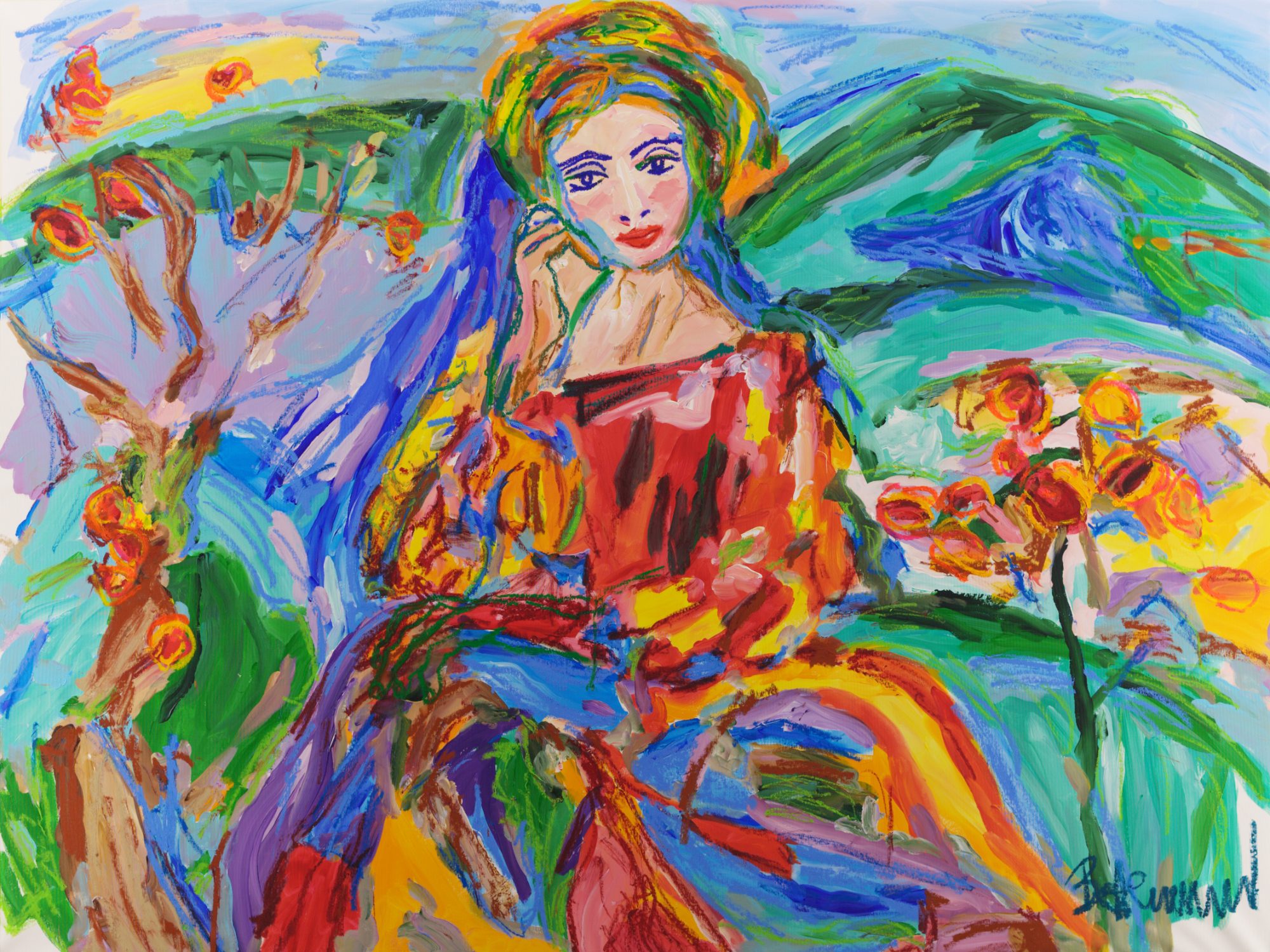
Everyone who has played cards in Spain knows her. On the As de Oros, the ace of coins, a woman looks out in profile from a large golden coin. It is the highest card of its suit, worth eleven points in a game of brisca or tute.
In this painting she has stepped out of the coin. She sits in a sunlit landscape, rests her hand lightly against her cheek and turns to look straight at us.
A condition, not a story
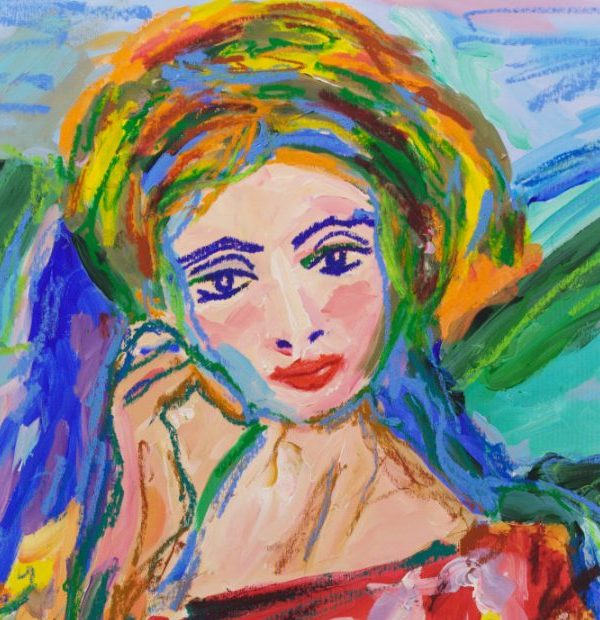
As de Oros shows no game, no table and no players. It shows a young woman at ease in the open air, between green hills and a deep blue mountain, with a wreath of green, yellow and orange in her hair. Everything about her is calm, warm and present.
The gold came with her
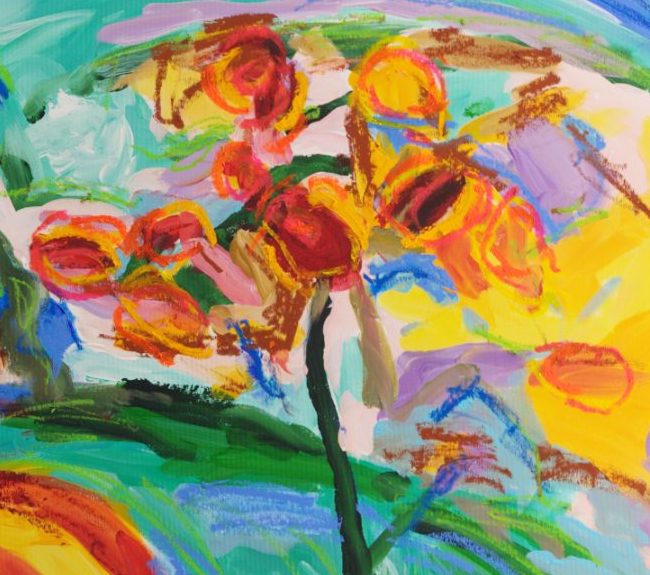
On the card the gold is a single coin. In the painting it hangs in the trees on both sides of her: round, golden-orange fruits, ripening on the branches like coins. The treasure of the suit is growing all around her.
The colours of the card have followed her too. Red, yellow and red flow down from her dress to the lower right like a ribbon, the colours of Spain. She no longer needs to be printed on a coin. She is the ace now, and the whole landscape is her suit.
Freedom below, precision above
The picture is built in two separate moves. First the ground: the pale sky, the green and turquoise hills, the deep blue mountain, the red dress and the band of red and yellow, laid in with coarse, broad brushstrokes that settle nothing precisely. Then the drawing, on top of that ground: the face, the eyes, the wreath, the hand at her cheek, the branches and the circles of the golden fruits. The line never sinks into the paint; it stays on top. Like every figurative work in this series, the image is built forward, never scraped back — the exact inversion of the abstract series, where surfaces are built over months and cut back into.
An architect's scale
At 150 × 200 cm the woman is seen at close to life size, and the landscape opens around her like a stage. Bertermann, who holds a Master's degree in Architecture, uses that scale to place the viewer inside the scene: you do not look at a playing card, you sit across from the ace.
Made by a real person — not AI
Like every work in the studio, As de Oros is an original, one-of-a-kind painting, made by hand by a real person, not AI. The loose strokes of the hills, the running colour of the dress, the fruits drawn in a few round gestures — all of it is intentional, and all of it is the record of a human hand working fast in front of a canvas two metres wide.
As de Oros, 2026. Acrylic and oil stick on canvas, 150 × 200 cm (height × width). Signed on the front and the back. Part of the figurative works.
→ View As de Oros in the gallery
This painting belongs to Claus Bertermann’s 2026 figurative series — large-format works in acrylic and oil stick in which the drawn layer always lies on top of the paint, never in it.