Pianissimo (2026) — In a World That Shouts, Calm Is a Crown
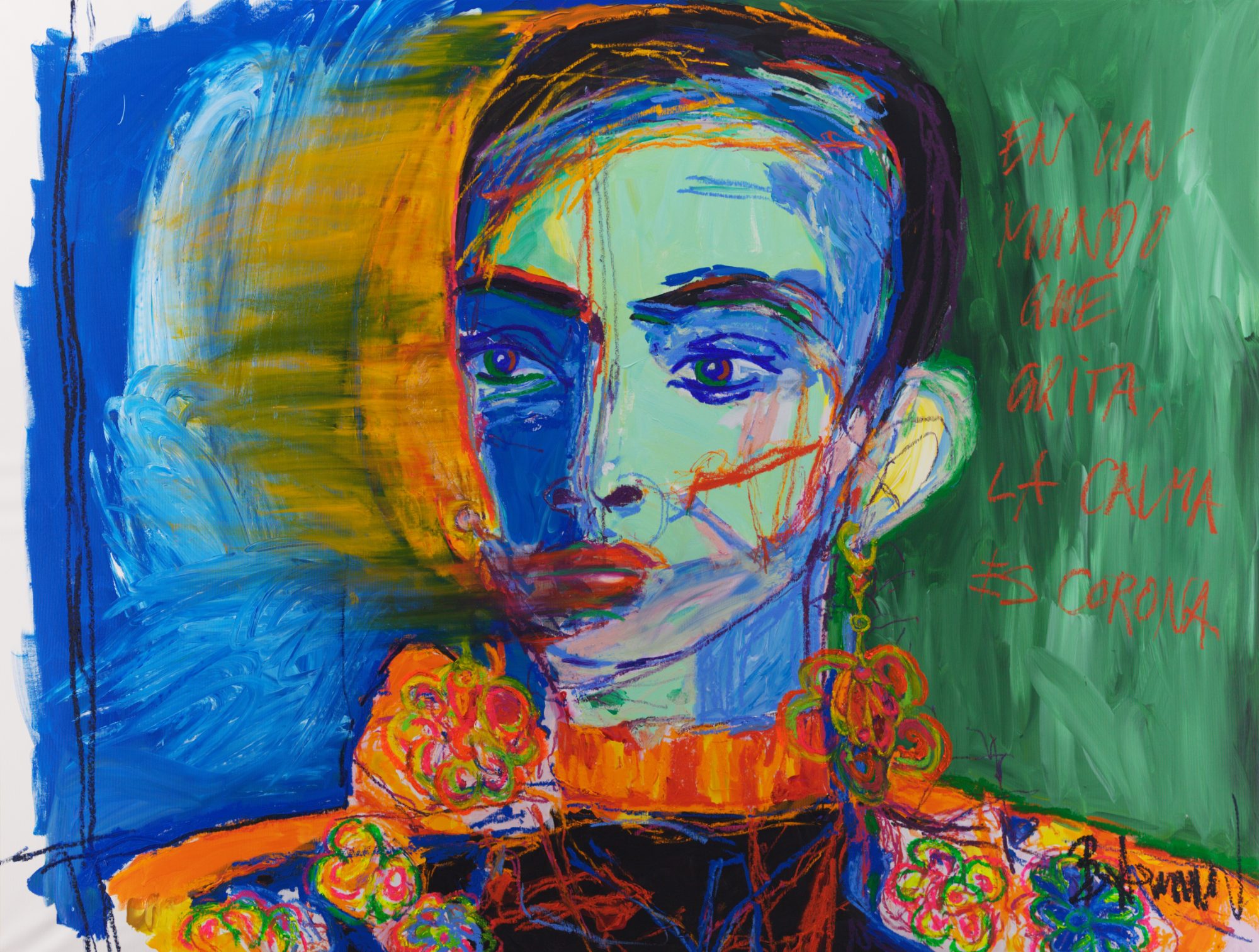
She does not raise her voice. A woman with short dark hair looks straight at us, calm and upright, wearing large flower earrings, an orange collar and a jacket embroidered with blossoms.
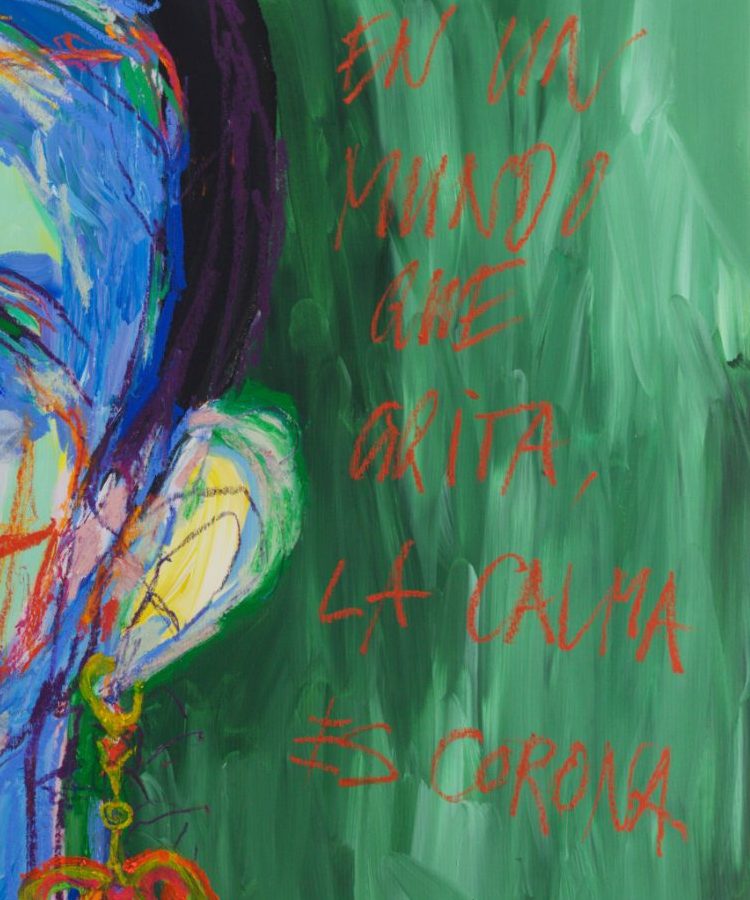
Beside her, written by hand in red oil stick on the green ground, are the words “En un mundo que grita, la calma es corona.” In a world that shouts, calm is a crown.
A condition, not a story
Pianissimo shows no event and no setting. It shows a woman who is proud, beautiful and sure of herself, without any pose. She does not need to perform her strength. She simply has it.
The world is loud, she is still
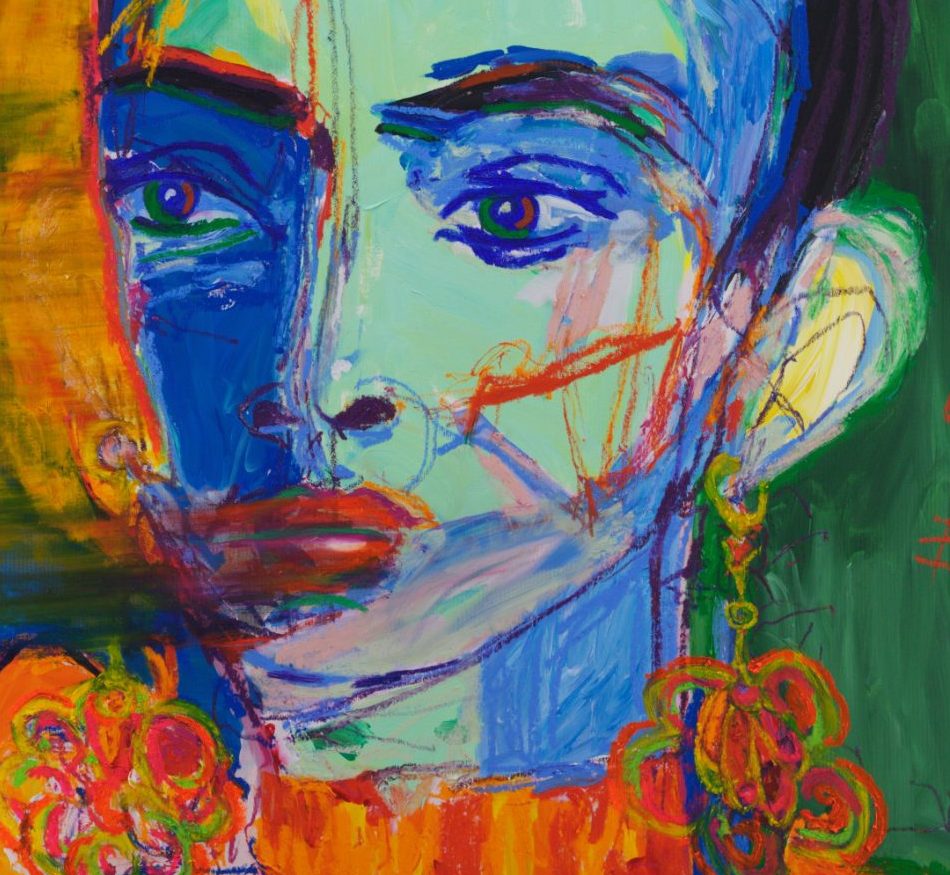
On the left the canvas is in motion. Broad strokes of ochre and light blue rush past her like a gust of wind and sweep a golden glow around her head, like a halo set in motion. They even pull her mouth sideways, as if the noise of the world were passing straight through the picture.
She stays still. Her eyes do not move, and that is the point. In music, pianissimo means “very softly”, and the softest note in a room is often the one everyone listens to.
A crown that is not painted
The painting is a tribute to the strength of women: quiet, confident and entirely her own. There is no crown on her head. The sentence on the green tells us why: calm is the crown, and she is already wearing it.
Freedom below, precision above
The picture is built in two separate moves. First the ground: the deep blue and the sweeping strokes on the left, the green on the right, the planes of blue and mint green in the face, the orange of the collar and shoulders, laid in with coarse, broad brushstrokes that settle nothing precisely. Then the drawing, on top of that ground: the eyes and brows, the hair, the red lines across the cheek, the flower earrings, the embroidered blossoms and the handwritten sentence. The line never sinks into the paint; it stays on top. Like every figurative work in this series, the image is built forward, never scraped back — the exact inversion of the abstract series, where surfaces are built over months and cut back into.
An architect's scale
At 150 × 200 cm the face is larger than life and meets the viewer at eye level. Bertermann, who holds a Master's degree in Architecture, uses that scale the way a building uses a quiet wall: the portrait does not ask for attention, it holds the room.
Made by a real person — not AI
Like every work in the studio, Pianissimo is an original, one-of-a-kind painting, made by hand by a real person, not AI. The sweeping strokes, the running colour, the sentence written letter by letter in oil stick — all of it is intentional, and all of it is the record of a human hand working in front of a canvas two metres wide.
Pianissimo, 2026. Acrylic and oil stick on canvas, 150 × 200 cm (height × width). Signed on the front and the back. Part of the figurative works.
→ View Pianissimo in the gallery
This painting belongs to Claus Bertermann’s 2026 figurative series — large-format works in acrylic and oil stick in which the drawn layer always lies on top of the paint, never in it.