Twin Palms (2026): Two Friends, One Pool and a Chair for You
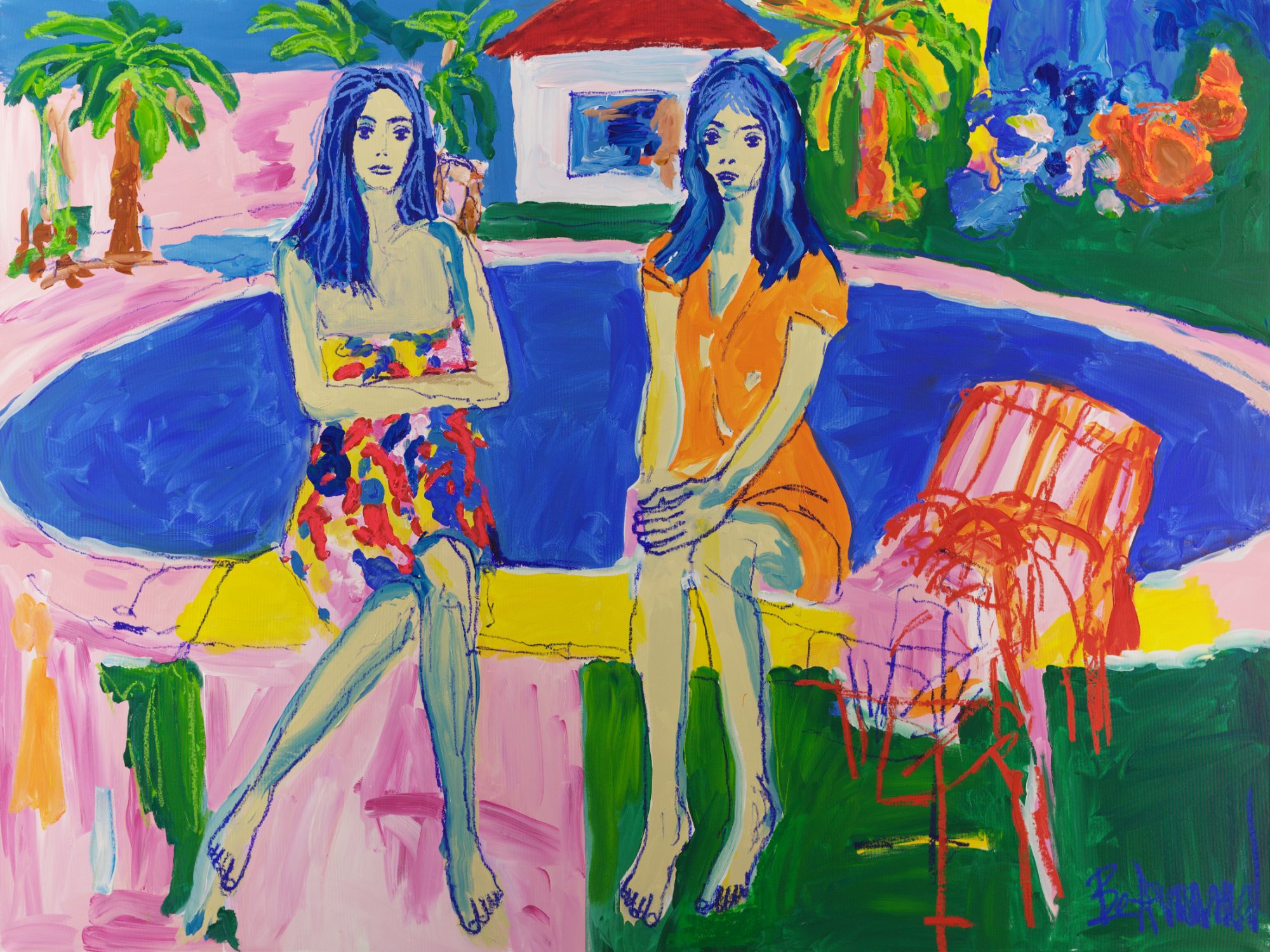
A pink terrace, a deep blue pool, palm trees and a little white house with a red roof. Two young women sit side by side on the yellow edge of the pool, barefoot, and look straight at you.
Nobody jumps in. Nobody needs to. This is their afternoon, and they are perfectly at home in it.
A condition, not a story
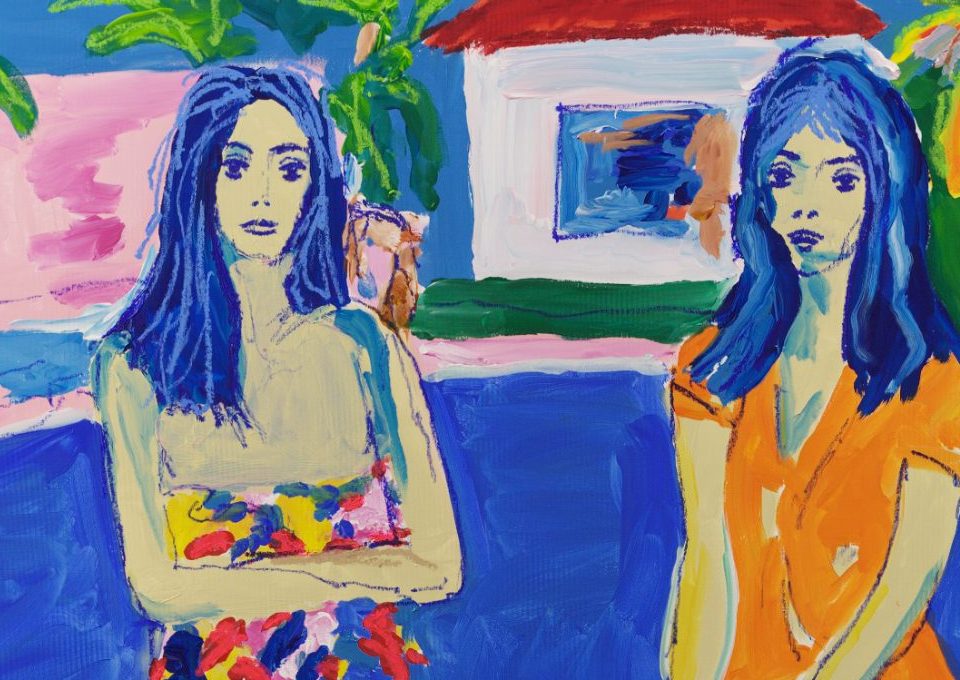
Twin Palms does not tell who they are waiting for or what happens next. It shows a state: one woman with her arms and legs crossed, cool and composed; the other leaning forward a little, her hands resting on her knee. The same blue hair, the same dark eyes, almost the same face — only their poses tell them apart.
A house called Twin Palms
The title borrows the name of one of the most famous houses of mid-century America: Twin Palms in Palm Springs, designed by E. Stewart Williams in 1947 for Frank Sinatra and known for its pool and its parties. Bertermann keeps the pool, the palms and the sunshine — and reduces the party to its essence: two friends, the water and the afternoon. The two women become the twin palms of the title, side by side, rooted and completely at ease.
One chair, still free
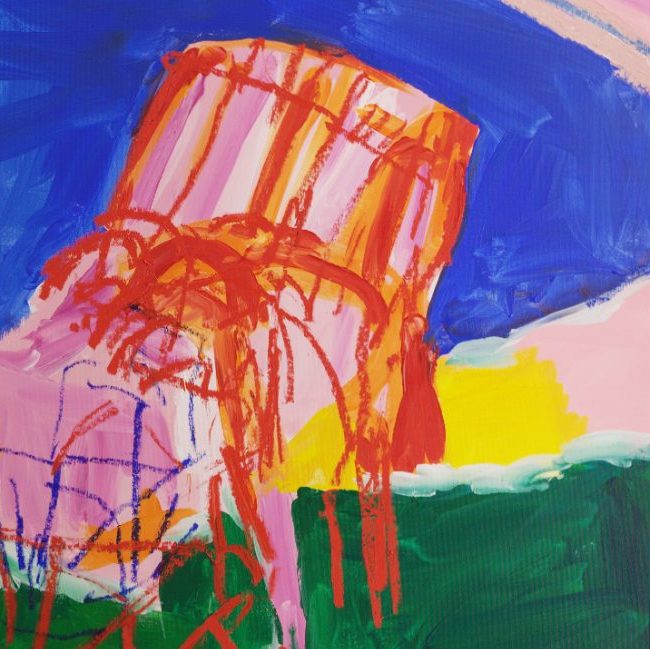
On the right, a pink-and-white striped garden chair stands at the pool's edge, drawn in quick red lines. Nobody sits in it. In a painting where both women look straight out of the canvas, the empty chair reads like an invitation — the seat is reserved for the viewer.
Freedom below, precision above
The picture is built in two separate moves. First the ground: the ultramarine pool, the pink terrace, the yellow pool edge, the green lawn, the palms, the house and the blossoms, laid in with coarse, broad brushstrokes that settle nothing precisely. Then the drawing, on top of that ground: the blue contours of the two women, their eyes and mouths, the crossed arms and folded hands, the bare feet — and the whole chair in red. The line never sinks into the paint; it stays on top. Like every figurative work in this series, the image is built forward, never scraped back — the exact inversion of the abstract series, where surfaces are built over months and cut back into.
An architect's afternoon
At 150 × 200 cm the two women are almost life-size, and the pool spreads across the full width of the canvas. Bertermann, who holds a Master's degree in Architecture, paints the setting like a mid-century postcard pushed to full saturation — a small, private piece of Palm Springs modernism, seen from the next sun lounger.
Made by a real person — not AI
Like every work in the studio, Twin Palms is an original, one-of-a-kind painting, made by hand by a real person, not AI. The open red lines of the chair, the blue shadows on the skin, the pool painted in a few broad sweeps — all of it is intentional, and all of it is the record of a human hand working fast in front of a canvas two metres wide.
Twin Palms, 2026. Acrylic and oil stick on canvas, 150 × 200 cm (height × width). Signed on the front and the back. Part of the figurative works.
→ View Twin Palms in the gallery
This painting belongs to Claus Bertermann’s 2026 figurative series — large-format works in acrylic and oil stick in which the drawn layer always lies on top of the paint, never in it.