Windspiel (2026) — A Painting Named After What You See Last
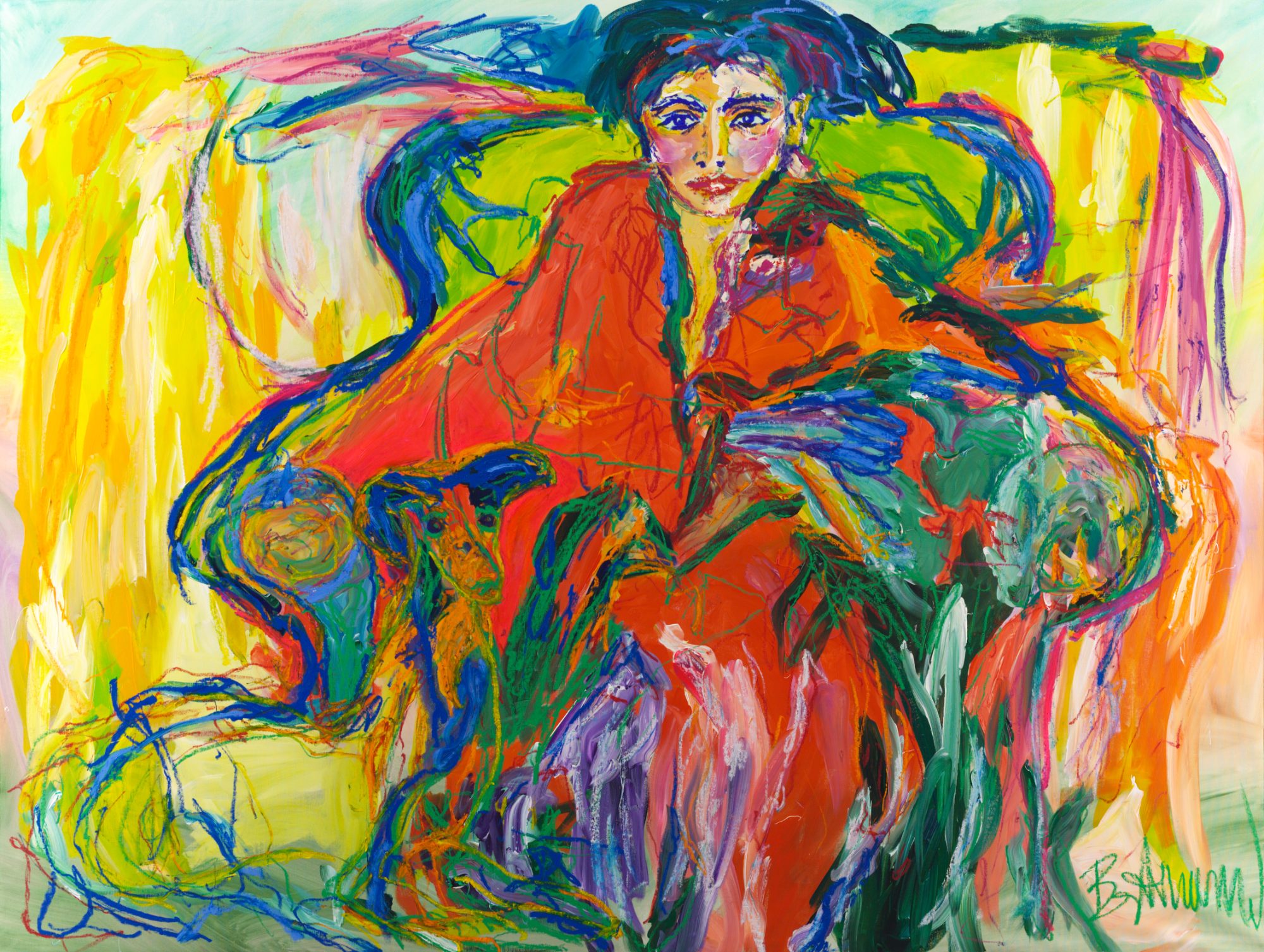
In German, a Windspiel is a small greyhound — the Italian greyhound, the slender dog of palaces and court portraits. So the title makes a simple promise: there is a dog in this picture.
Now look for it.
A condition, not a story
What you see first is a woman. She sits in a lime-green armchair, wrapped in a vermilion coat that fills the centre of the canvas, dark hair swept to one side, blue eyes fixed on you with perfect composure. Around her the picture is all movement: yellow running down in long streaks, pink and red ribbons beside the chair, blue lines looping through the lower left like a gust of wind. Anyone who does not speak German hears the wind in the title and finds it everywhere.
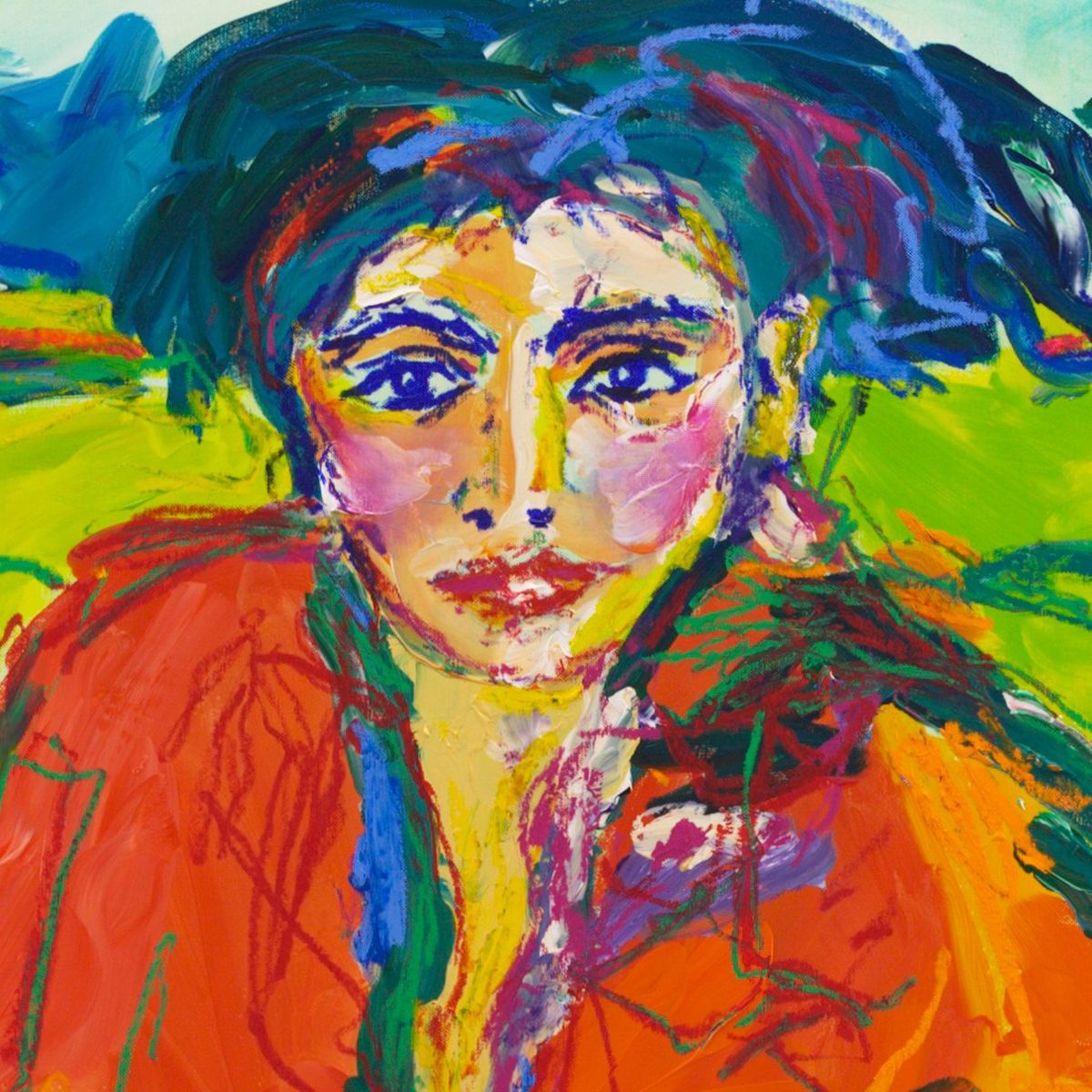
The second look
Most people need a second look, some a third. Then, low in front of the red coat, a head appears: orange, with a long narrow muzzle, two dark eyes and blue ears folded back. The Windspiel has been sitting there the whole time, upright and patient, looking straight out of the picture — at you, while you were looking at everyone else.
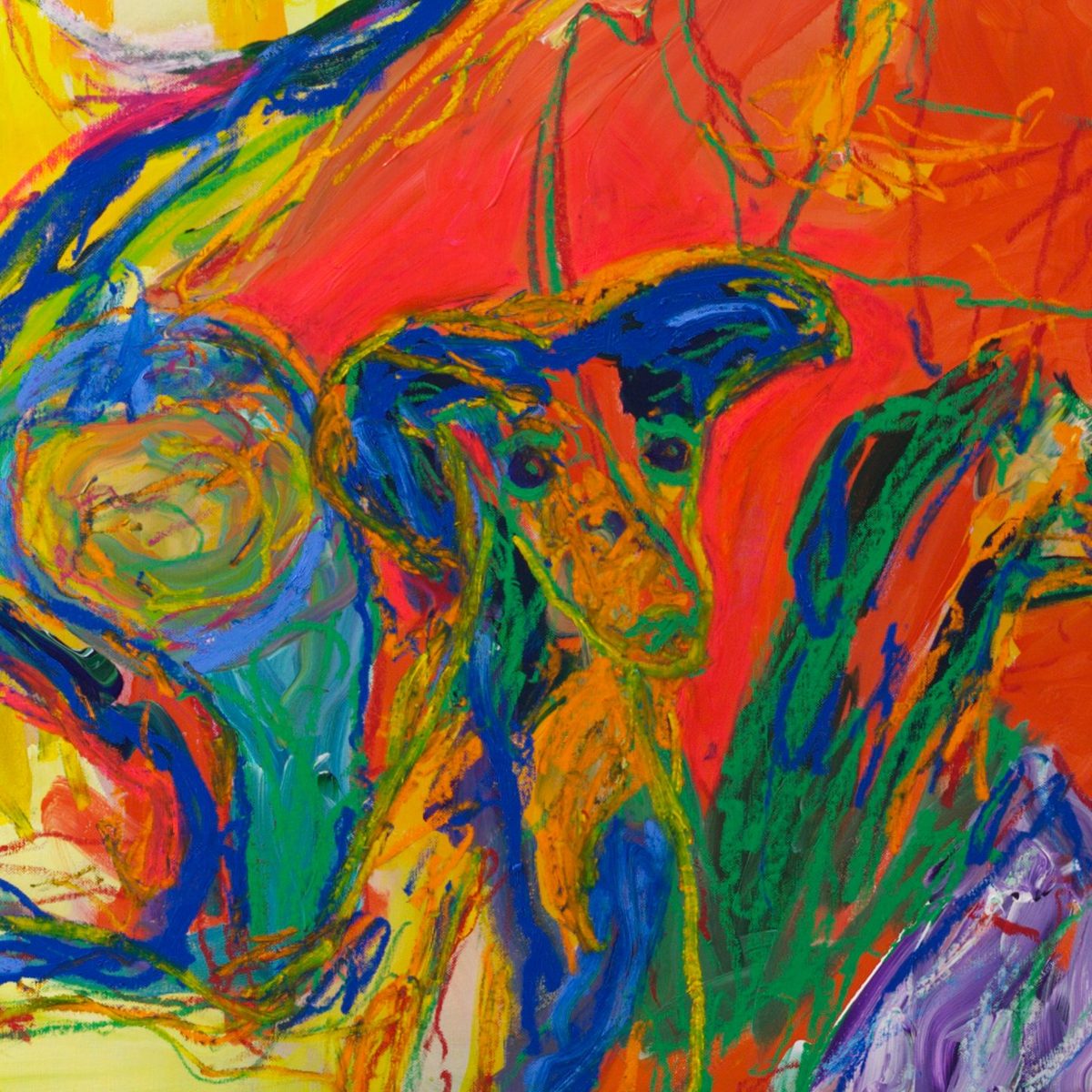
The sighthound, seen last
The greyhound is a sighthound. For thousands of years it has been bred to do one thing better than any other dog: to see first. In this painting it is the one that is seen last.
A painting named after its least visible figure is a small act of loyalty. The woman takes the room; the title goes to the dog. Frederick the Great, who loved his Windspiele enough to ask to be buried beside them at Sanssouci — a wish finally granted in 1991 — would have understood the arrangement.
Freedom below, precision above
The yellow field, the vermilion coat, the lime-green chair and the violet and green masses at the bottom are laid in first, in coarse, broad brushstrokes that settle nothing precisely. The drawing arrives afterwards and sits on top of that ground — the woman’s face and hair, the looping arms of the chair, the ribbons, the dog’s head. No scraping back: the image is built forward, like every figurative work in this series. Collectors who know the abstract series will recognise the inversion: there the surface is built over months and cut back into; here the line is laid on top and stays there.
Reversing the billing
The woman with her dog is one of the oldest pairings in portrait painting. For centuries the animal at the sitter’s side was a supporting character at the edge of the picture. Windspiel keeps the arrangement and reverses the billing: the sitter gets the space, the colour and the gaze; the dog gets the title. It is a painting about how we look — and every time it is shown to someone new, the game begins again.
Made by a real person — not AI
Like every work in the studio, Windspiel is an original, one-of-a-kind painting, made by hand by a real person, not AI. The running yellow, the loops of blue, the dog drawn in a few fast lines — all of it is intentional, and all of it is the record of a human body working in front of a canvas two metres wide.
Windspiel, 2026. Acrylic and oil stick on canvas, 150 × 200 cm (height × width). Signed on the front and the back. Part of the figurative works.
→ View Windspiel in the gallery
This painting belongs to Claus Bertermann’s 2026 figurative series — large-format works in acrylic and oil stick in which the drawn layer always lies on top of the paint, never in it.