Cross the Line (2026): The Finish That Is a Doorway
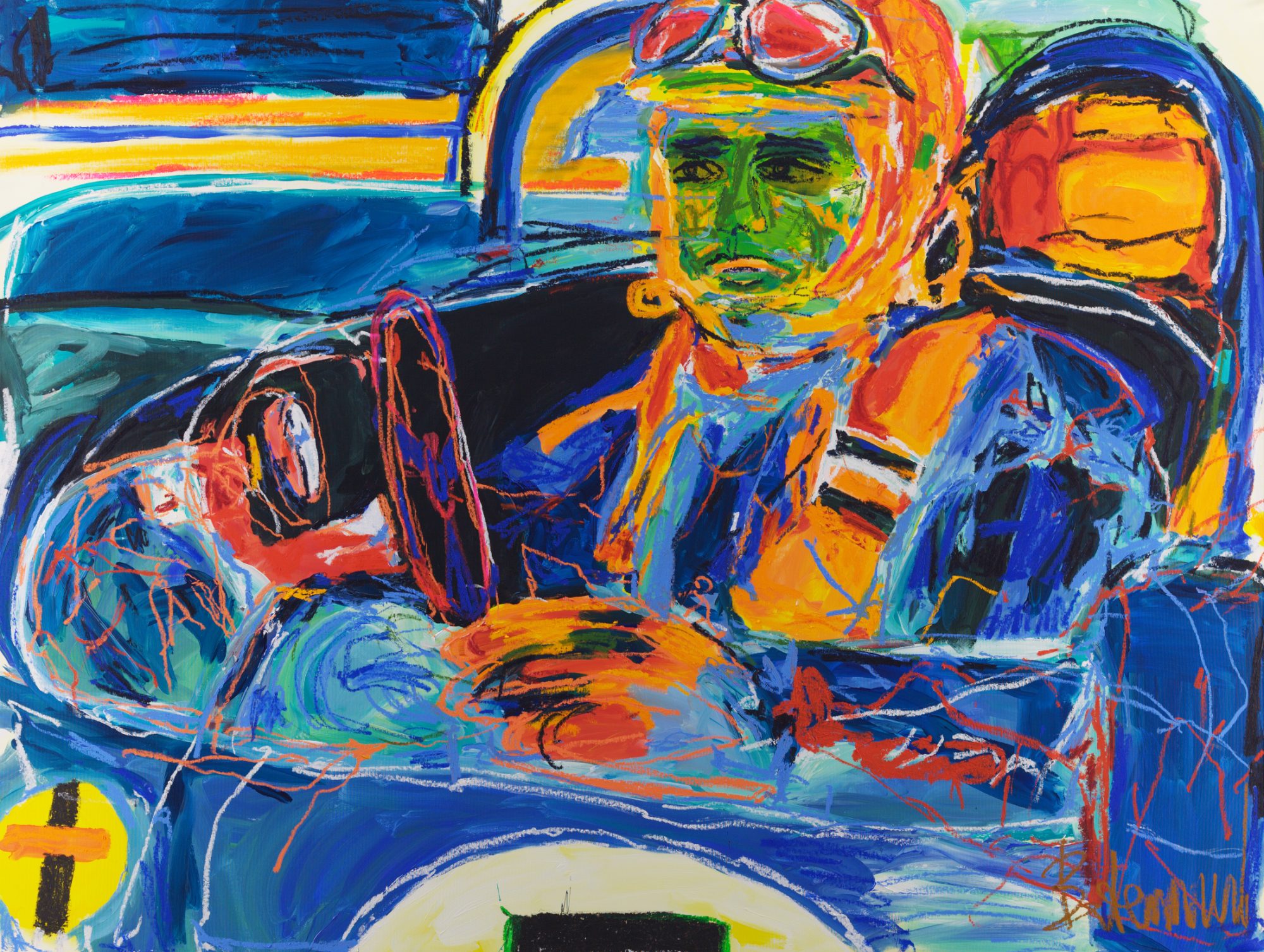
A racing driver in the 1960s, a few seconds after the finish. The engine is quiet now.
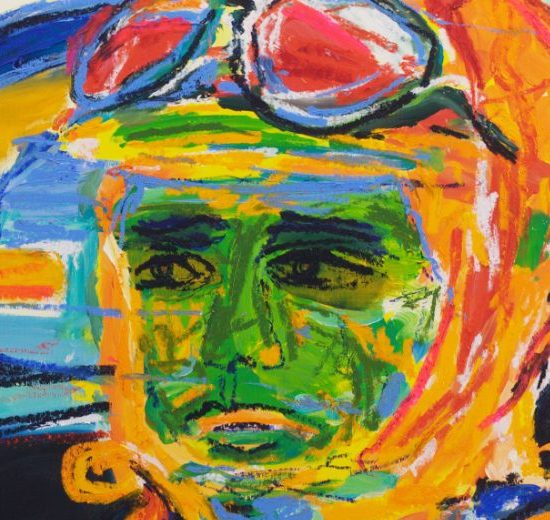
He has pushed his goggles up onto his helmet, rests his arm on the side of the car and looks straight at you, calm and clear. Behind him rises the arch he has just driven through.
A condition, not a story
Cross the Line does not show the race, the overtaking or the celebration. It shows the quiet moment just beyond the finish, when the speed has gone and only the result remains: a man who has done what he set out to do.
An arch that is really a doorway
Look again at the arch behind him. It looks less like the end of a race than like a doorway. "Crossing the line" means more than finishing: it means going further than anyone expected, taking the step after which everything is new. He has not simply arrived; he has passed through.
The painter's own line
Bertermann knows that feeling well. For years he was known for abstract paintings — more than 1,000 of them, with results at the major auction houses. In 2026 he crossed his own line and began to paint people. Cross the Line can be read as a quiet portrait of that decision: the calm after the step, and the open road beyond the arch.
Freedom below, precision above
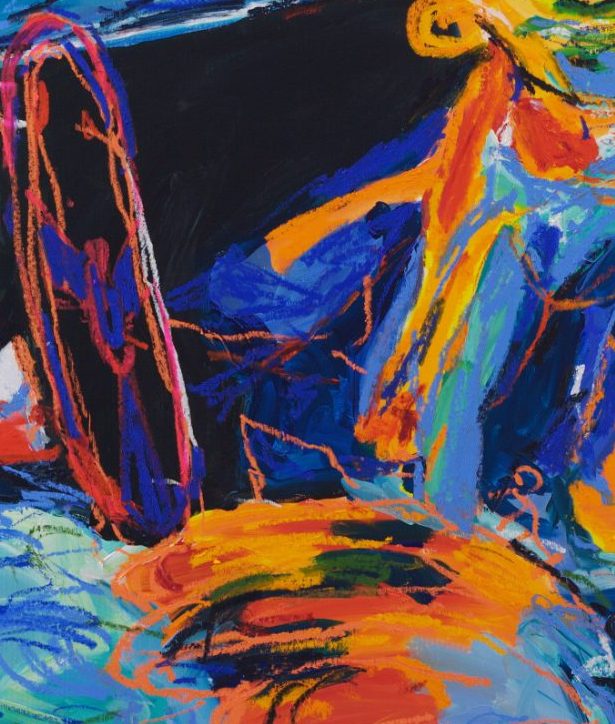
The picture is built in two separate moves. First the ground: the deep blue car, the black cockpit, the blue arch, the bands of yellow and orange in the background and the orange jacket and helmet, laid in with coarse, broad brushstrokes that settle nothing precisely. Then the drawing, on top of that ground: the eyes and mouth in the green face, the goggles, the red rim of the steering wheel, the hand on the car and the lines that sweep across the bodywork. The line never sinks into the paint; it stays on top. Like every figurative work in this series, the image is built forward, never scraped back — the exact inversion of the abstract series, where surfaces are built over months and cut back into.
Part of a motor-racing cycle
Cross the Line belongs to a group of 2026 paintings about the golden era of motor racing, together with No Halo, Eau Rouge, Parc Fermé, Pit Stop and Stranded on Track. Each canvas shows a different moment of the same world: courage, concentration and confidence.
An architect's scale
At 150 × 200 cm the driver is close to life size. Bertermann, who holds a Master's degree in Architecture, uses that scale to put the viewer right beside the car at the finish, close enough to meet his eyes.
Made by a real person — not AI
Like every work in the studio, Cross the Line is an original, one-of-a-kind painting, made by hand by a real person, not AI. The sweeping lines across the car, the running colour, the face drawn in a few sure strokes — all of it is intentional, and all of it is the record of a human hand working fast in front of a canvas two metres wide.
Cross the Line, 2026. Acrylic and oil stick on canvas, 150 × 200 cm (height × width). Signed on the front and the back. Part of the figurative works.
→ View Cross the Line in the gallery
This painting belongs to Claus Bertermann’s 2026 figurative series — large-format works in acrylic and oil stick in which the drawn layer always lies on top of the paint, never in it.