Parc Fermé (2026) — The Stewards Will Check Every Bolt. The Secret Walks Out in His Hand
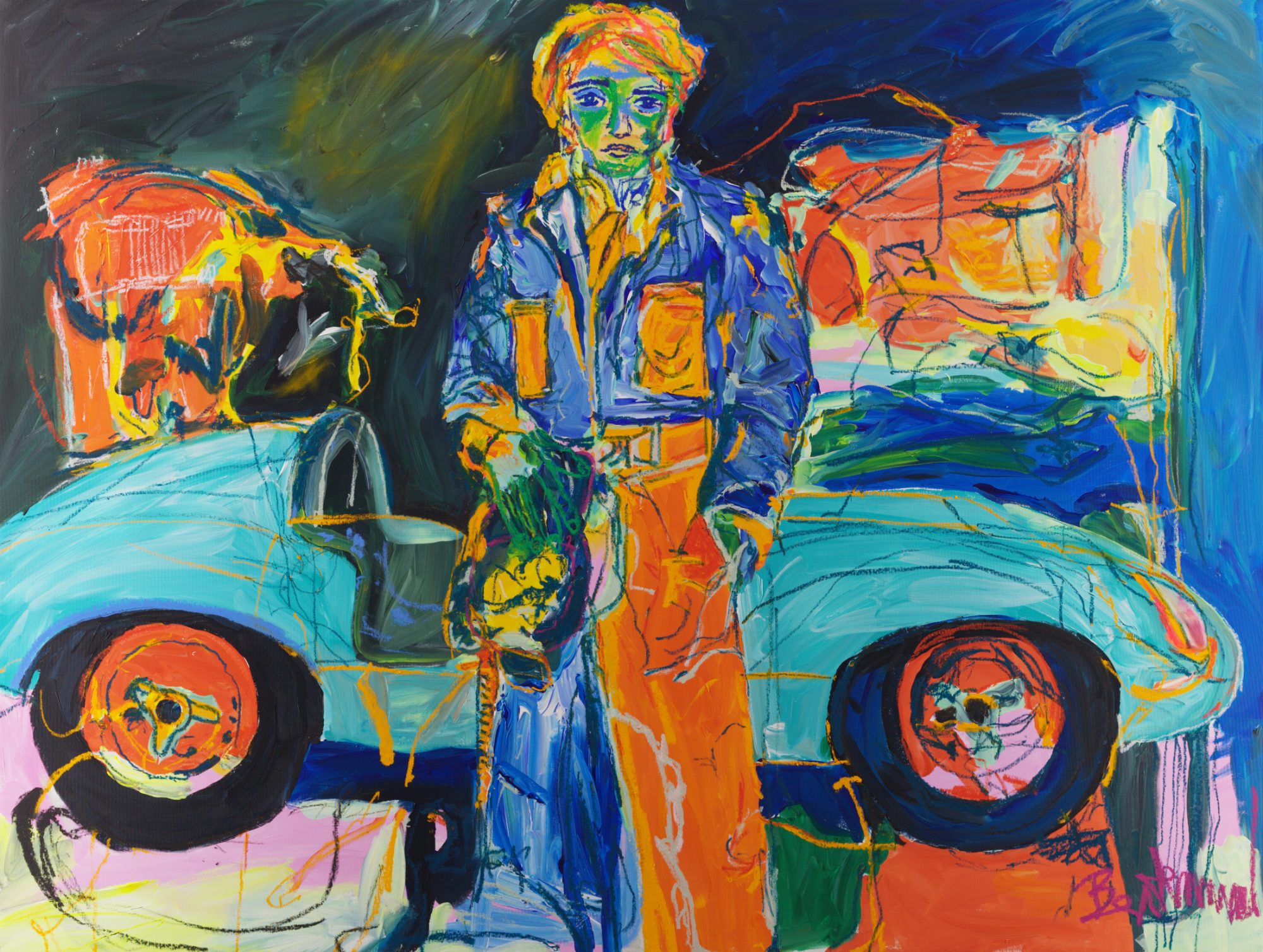
The race is over. The car has been pushed into parc fermé, and from now on no one may touch it until the stewards have checked every part.
The driver does not seem to mind. Helmet in one hand, the other hand in his pocket, he looks straight at us with the calm of a man who has nothing to hide.
A condition, not a story
Parc Fermé shows no podium, no champagne, no crowd. It shows a man standing in front of his car in the quiet minutes after the race, upright and at ease. Everything about him says that the work is done, and done well.
The part the stewards cannot inspect
In parc fermé the stewards check every bolt, every litre and every kilo. They will find nothing. The one part that made the difference is not in the car at all.
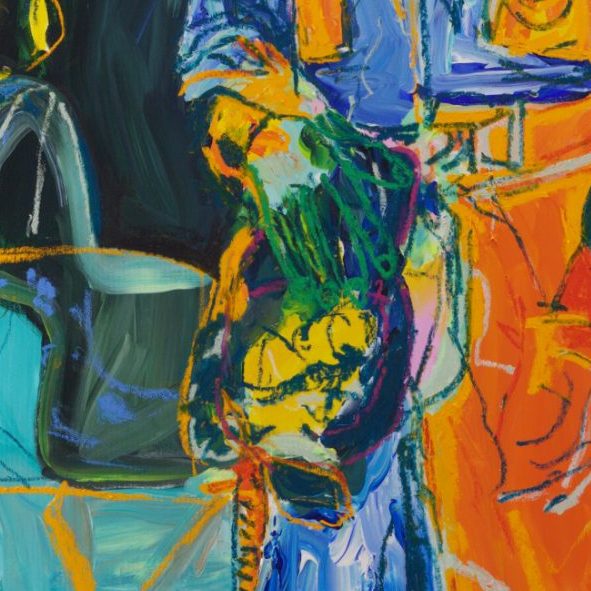
He is carrying it in his hand: the helmet, and the head that goes inside it. The car is locked away; the real secret of the race walks out freely, hand in pocket.
Face and helmet
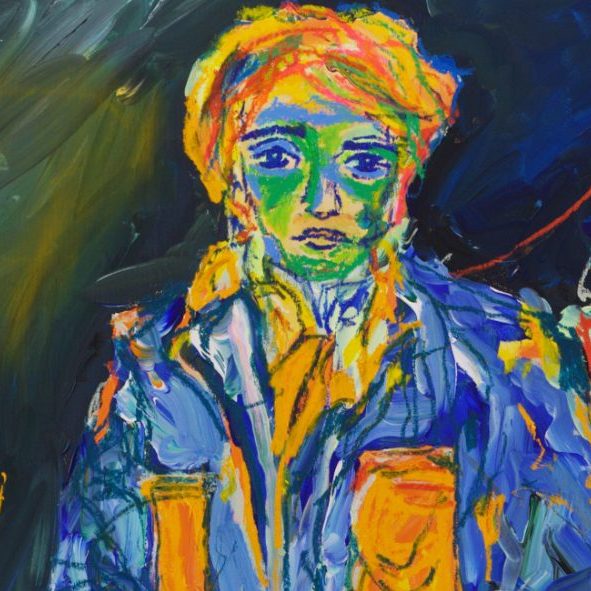
The green of his face returns in the helmet he carries, painted in yellow and green oil stick at his side. Man and helmet are painted as one: the head and the place where it belongs.
Freedom below, precision above
The picture is built in two separate moves. First the ground: the dark sky, the deep blue, the blocks of orange and red, the turquoise car and the orange trousers, laid in with coarse, broad brushstrokes that settle nothing precisely. Then the drawing, on top of that ground: the hair, the face, the seams and pockets of the jacket, the helmet, the wheels and the orange lines across the car. The line never sinks into the paint; it stays on top. Like every figurative work in this series, the image is built forward, never scraped back — the exact inversion of the abstract series, where surfaces are built over months and cut back into.
Part of a motor-racing cycle
Parc Fermé belongs to a group of 2026 paintings about the golden era of motor racing, together with No Halo, Eau Rouge, Parc Fermé, Pit Stop and Stranded on Track. Each canvas shows a different moment of the same world: courage, concentration and confidence.
An architect's scale
At 150 × 200 cm the driver stands close to life size and meets the viewer at eye level. Bertermann, who holds a Master's degree in Architecture, uses that scale the way a building uses an entrance: the painting does not show the driver from the grandstand, it stands him in front of you.
Made by a real person — not AI
Like every work in the studio, Parc Fermé is an original, one-of-a-kind painting, made by hand by a real person, not AI. The loose lines over the jacket, the running colour, the helmet drawn in a few fast strokes — all of it is intentional, and all of it is the record of a human hand working fast in front of a canvas two metres wide.
Parc Fermé, 2026. Acrylic and oil stick on canvas, 150 × 200 cm (height × width). Signed on the front and the back. Part of the figurative works.
→ View Parc Fermé in the gallery
This painting belongs to Claus Bertermann’s 2026 figurative series — large-format works in acrylic and oil stick in which the drawn layer always lies on top of the paint, never in it.